Ezra 5:17–6:5
4Q117: the oldest copy of Ezra
4Q117 (4QEzra), from Qumran Cave 4, is reported to preserve parts of 5:17–6:5, the end of Tattenai's letter and the beginning of the memorandum. It is the oldest surviving copy of any part of Ezra, about a thousand years older than the Leningrad Codex.
Stable text: no manuscript differences in meaning
The family tree
Each row is a language or text tradition. Witnesses in the same row may share ancestry, revise one another, or have an uncertain relationship; the line under each box says which. A solid arrow appears only where direct copying or a documented revised edition is established. Order by date never implies copying. Scroll sideways on a phone.
✓ contains this verse · ▢ pages lost · – no copy survives
- Same line, through lost copies
- Translation
Every witness, in order
Composed c. 5th–4th century BC (debated)
Original Ezra–Nehemiah
No original survives.
Translated c. 2nd–1st century BC
Septuagint, Esdras B (library text: Giguet's French)
How the site knows this: Known here only through a translation.
One Greek text via Giguet's French; not checked against Hanhart's Göttingen edition.
1st century BC (reported)
4Q117 (4QEzra), Qumran Cave 4
How the site knows this: Reported in scholarship; not checked by the site.
Fragments reported for 5:17 and 6:1–5. The Qumran Digital Reader gives a transcription; the site has not checked it against Ulrich's edition and plates in DJD XVI. Differences from the Masoretic Text are reported to be few and minor.
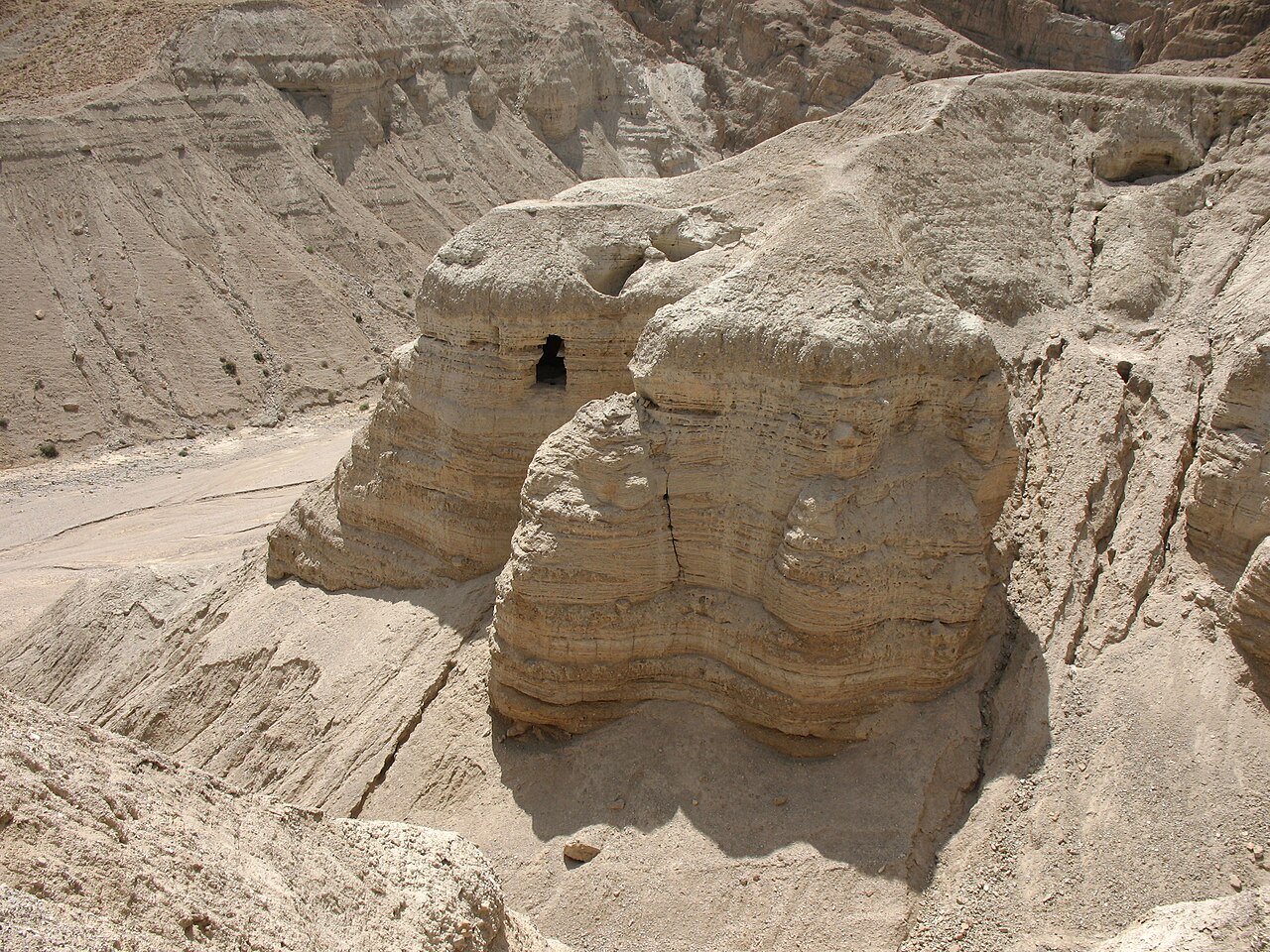
Site or place photographImage credit The photo shows the Qumran caves, not the fragment.
Source: Qumran Digital Reader, 4Q117 (4QEzra), transcription ↗; E. Ulrich, "4QEzra," in Qumran Cave 4.XI: Psalms to Chronicles, DJD XVI (2000) (edition not yet consulted by the site)
AD 1008
Masoretic Text (Leningrad Codex)
How the site knows this: Read in the site's library text: Westminster Leningrad Codex, a digital transcription of the Leningrad Codex.
וְהִשְׁתְּכַח בְּאַחְמְתָא בְּבִירְתָא דִּי בְּמָדַי מְדִינְתָּה מְגִלָּה חֲדָה
and there was found at Ecbatana, in the fortress in the province of Media, a scroll
6:2.
1611
King James Bible
How the site knows this: Read in the site's library text: King James Version (1769 text).
And there was found at Achmetha, in the palace that is in the province of the Medes, a roll
What changed, and why
What 4Q117 establishes: the Aramaic chapters of Ezra existed and were being copied in the 1st century BC, in a text close to the later Masoretic one. What it cannot establish: that the whole book existed in that form at Qumran (only fragments of chapters 4–6 survive), the date of composition, or the authenticity of the letters. Do not confuse it with 4Q118, a disputed fragment connected with Chronicles.
What the evidence shows
- 4Q117 preserves parts of Ezra 4–6.
Source: Qumran Digital Reader, 4Q117 (4QEzra), transcription ↗
- The site has collated 4Q117's letters. Not yet done.
Sources
- Qumran Digital Reader, 4Q117 (4QEzra), transcription ↗
- E. Ulrich, "4QEzra," in Qumran Cave 4.XI: Psalms to Chronicles, DJD XVI (2000) (edition not yet consulted by the site)
Related lessons
- Haggai, Zechariah and an Imperial Inquiry →The prophets Haggai and Zechariah stir Zerubbabel and Jeshua to build again. Tattenai, governor of Across-the-River, comes asking who authorized the work and takes the builders' names, but does not stop them. His letter to Darius reports their answer: they are rebuilding the house built by a great king of Israel, destroyed by Nebuchadnezzar, and authorized by Cyrus, who gave the vessels to Sheshbazzar. He asks the king to search the archives.
- The Memorandum, the Finished Temple and the Passover →Darius has the archives searched, and a scroll is found at Ecbatana: Cyrus' memorandum ordering the house rebuilt, sixty cubits high and wide, paid for by the crown, with the vessels returned. Darius orders his officials not to interfere, to fund the work and the sacrifices from the region's tribute, and to pray for the king. The temple is finished in his sixth year (515 BC). It is dedicated with joy, and the returned exiles, with all who had separated themselves from the uncleanness of the nations, keep the Passover.
- How Ezra Came to Us →Ezra and Nehemiah were one book in Hebrew tradition, written partly in Hebrew and partly in Aramaic, combining memoirs, lists and official letters. One Qumran manuscript, 4Q117, preserves pieces of the Aramaic chapters. In Greek there are two different books: Esdras B, a translation of Ezra–Nehemiah, and Esdras A (1 Esdras), a separate retelling with a story not found in Ezra. Their names in Latin and English are famously confusing.