Opposition, Letters and a Leap in Time
"Ye have nothing to do with us to build an house unto our God"
"Now when the adversaries of Judah and Benjamin heard that the children of the captivity builded the temple unto the LORD God of Israel; then they came to Zerubbabel, and to the chief of the fathers, and said unto them, Let us build with you: for we seek your God, as ye do; and we do sacrifice unto him since the days of Esarhaddon king of Assur, which brought us up hither."
"But Zerubbabel, and Jeshua, and the rest of the chief of the fathers of Israel, said unto them, Ye have nothing to do with us to build an house unto our God; but we ourselves together will build unto the LORD God of Israel, as king Cyrus the king of Persia hath commanded us."
"Then the people of the land weakened the hands of the people of Judah, and troubled them in building, and hired counsellors against them, to frustrate their purpose, all the days of Cyrus king of Persia, even until the reign of Darius king of Persia." In the reign of Ahasuerus they write an accusation. In the days of Artaxerxes, Bishlam, Mithredath and Tabeel write, "in the Syrian tongue" (Aramaic).
Rehum the chancellor and Shimshai the scribe write: "Be it known unto the king, that the Jews which came up from thee to us are come unto Jerusalem, building the rebellious and the bad city, and have set up the walls thereof… If this city be builded, and the walls set up again, then will they not pay toll, tribute, and custom." Search the records, they urge, and "thou shalt find… that this city is a rebellious city."
The king replies that a search has found that Jerusalem rebelled against kings of old. "Give ye now commandment to cause these men to cease, and that this city be not builded, until another commandment shall be given from me." Rehum and Shimshai go "in haste" and stop them "by force and power." "Then ceased the work of the house of God which is at Jerusalem. So it ceased unto the second year of the reign of Darius king of Persia."
The leap forward and back
| Verses | King | Date (BC) | Subject |
|---|---|---|---|
| 4:1–5 | Cyrus to Darius I | 538–520 | The temple; offer refused; discouragement |
| 4:6 | Ahasuerus (Xerxes I) | 486–465 | An accusation (no details) |
| 4:7 | Artaxerxes (I) | 465–424 | Letter of Bishlam, Mithredath, Tabeel |
| 4:8–23 | Artaxerxes (I) | 465–424 | The city and its walls; work stopped by force |
| 4:24 | Back to Darius I | 520 | The temple work resumes in his second year |
Who were the "adversaries"?
They describe themselves as descendants of people brought by Esarhaddon (681–669 BC); 4:10 adds peoples brought by "Osnappar" (probably Ashurbanipal). 2 Kings 17:24–41 describes such resettlement in Samaria and a mixed worship of the LORD and other gods. Ezra calls them "adversaries" and "the people of the land"; they call themselves worshipers of Israel's God. They should not simply be equated with the later Samaritan community, which took shape over centuries; but the conflict between Jerusalem and Samaria is one of the roots of that later division.
City, not temple
The letter of 4:12–16 accuses the Jews of rebuilding "the rebellious and the bad city" and its walls, and of being about to stop paying tribute. Nothing is said about the temple. The king's order stops the city's rebuilding "until another commandment shall be given from me": a door left open that Nehemiah 2 will walk through under the same Artaxerxes.
Ezra switches language at 4:8
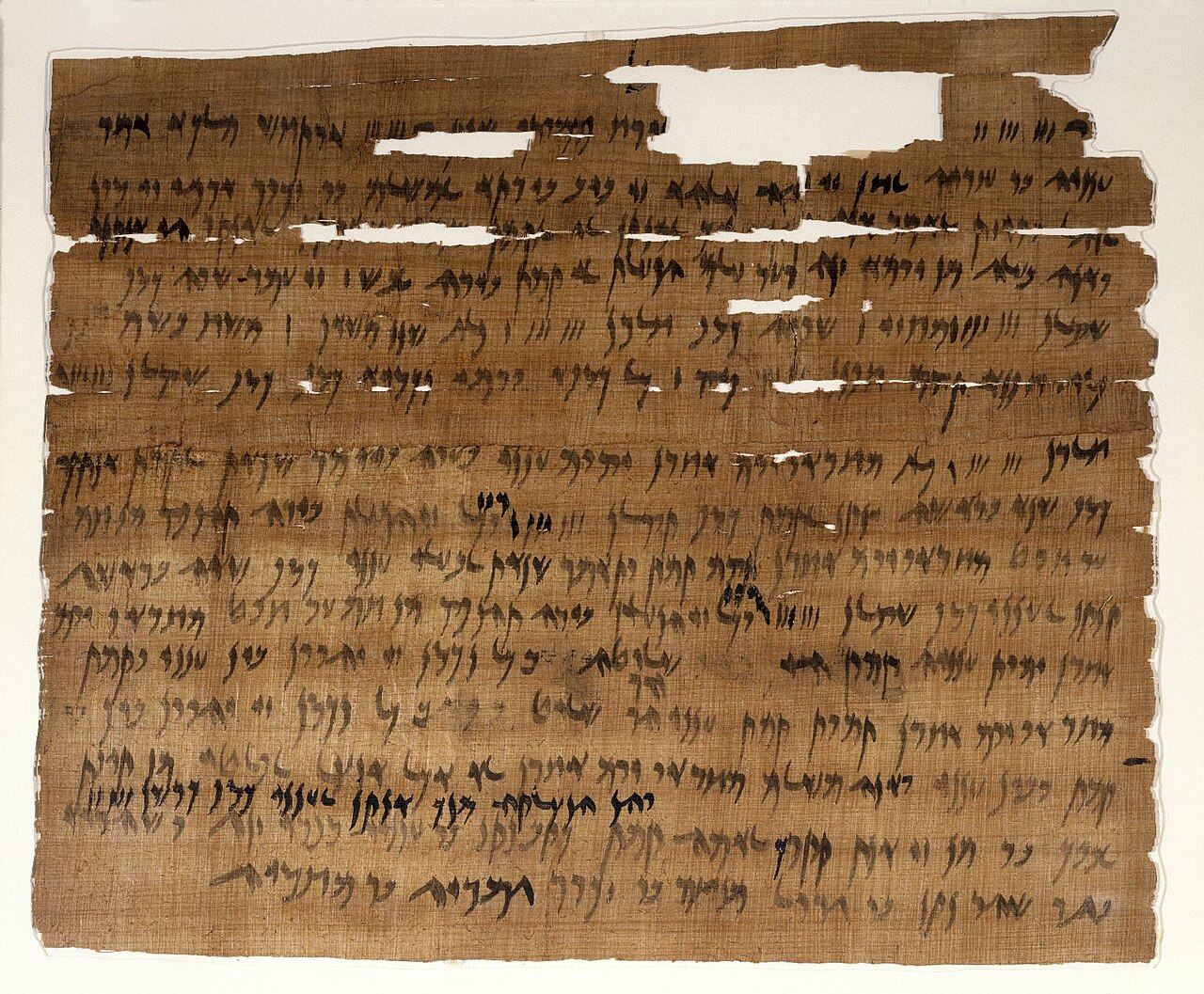
Verse 7 ends: "the writing of the letter was written in Aramaic, and interpreted [or: set out] in Aramaic." From verse 8 the book itself is in Aramaic until 6:18. The Aramaic begins with Rehum's letter and continues through narrative that is not part of any letter (4:23–24; 5:1–5; 6:13–18). So the switch is not only a matter of quoting documents in their original language; the whole section was composed or transmitted in Aramaic, the official language of the Persian empire. Most translations hide the switch; see the passage page.
Are the letters authentic?
The correspondence uses features known from Achaemenid Aramaic letters: the address formula, "and now" (ke'enet) to begin the body, official titles such as be'el te'em ("chancellor," literally "master of decree," compare Akkadian bel temi), the appeal to royal archives, and concern for tribute (mindah), custom (belo) and toll (halak). These features fit genuine Persian administrative style. But no original of any letter in Ezra survives, and a skilled writer could imitate the style. Scholars range from treating the letters as authentic archival copies (with editorial framing) to regarding them as later compositions. The site rates their authenticity as disputed.
"Bishlam": a name or "in peace"?
The Hebrew bishlam in 4:7 is read by the KJV as a personal name ("Bishlam, Mithredath, Tabeel"). The library's Greek (Giguet's French) reads "a peaceable letter" (bi-shlam, "in peace"); some modern scholars read "with the approval of" Mithredath. The letters are the same; the reading differs.
4Q117 (4QEzra)
The only identified Qumran manuscript of Ezra preserves parts of this Aramaic section. The Qumran Digital Reader transcribes fragments of 4:2–6, 4:9–11 and 5:17–6:5 (coverage reported; not yet checked against Ulrich's edition in DJD XVI). It shows the Aramaic section was being copied in the 1st century BC. It cannot show who wrote the letters or whether they are authentic.
The Case for the Biblical Account
Scripture's account
Local opponents obstruct the temple under Cyrus and Darius, and later the city walls under Xerxes and Artaxerxes, with official letters exchanged with the king (Ezra 4).
What evidence would we expect?
Persian administrative letters in Aramaic with similar formulas; provincial officials in Samaria and Across-the-River; tension between Jerusalem and Samaria.
The discoveries
Aramaic letters from Elephantine (late 5th c. BC), the Arshama letters (5th c. BC, on leather), and the Bactrian documents (4th c. BC) show the epistolary forms used in Ezra. The Elephantine petition (407 BC) names Sanballat's sons in Samaria and Bagohi in Judah. The Wadi Daliyeh papyri (4th c. BC) document Samaria's administration.
Testing the discoveries
These texts establish the style and the political setting. They do not contain the letters of Ezra 4 or name Rehum, Shimshai or Tattenai (Tattenai is attested in a Babylonian document of 502 BC as governor of Across-the-River).
The strongest reconstruction
Ezra 4 assembles real conflicts over several reigns, using documents in authentic Persian-period form; the exact relation of the quoted letters to originals is unknown.
What remains possible
Whether the letters were copied from archives, translated, adapted or composed; who the "adversaries" were.
What the evidence shows
- Ezra 4:6–23 concerns events after the temple was finished.Source: USCCB, notes on Ezra 4 (the Xerxes–Artaxerxes interlude; 4:24 resumes Darius I) ↗
- Ezra 4:8–6:18 is written in Aramaic.
- The letters in Ezra 4 use authentic Achaemenid Aramaic epistolary formulas.
- The letters are verbatim copies of Persian originals.
- 4Q117 preserves parts of Ezra 4–6. Exact coverage to be checked against DJD XVI.Source: Qumran Digital Reader, 4Q117 (4QEzra), transcription ↗
- The "adversaries" were the Samaritans of later history.
Continue the journey
Journey of a PassageEzra 4:4–24: The time leap: from Cyrus to Artaxerxes and back to DariusEzra 4:6–23 describes opposition under Xerxes and Artaxerxes, decades after the temple was finished, and about the city walls.More from this lesson
On the map
Location securely identified Probable identification Proposed or debated location Biblical route (roads schematic) Scholarly proposal
- Letters between Yehud and the court (schematic). Schematic geography of the correspondence, not a courier route. Officials of Samaria and Across-the-River wrote to the king; an archive search began in Babylon and found Cyrus' memorandum at Ecbatana. The court moved between Susa, Babylon, Ecbatana and Persepolis (Persepolis lies beyond the map).
Investigations
Optional deep dives: the ancient sources, the physical evidence, and every interpretation side by side, including unconventional ones, each labeled for what it is.
Are Ezra's Persian Letters Authentic?Style: authentic Persian-period · Originals: none survive · Authenticity: disputed
Do the Aramaic letters and decrees in Ezra 4–7 reproduce real Persian documents?
Ezra quotes seven official documents in Aramaic. Their formulas, titles and vocabulary match genuine Achaemenid Aramaic letters from Egypt, the satrap Arshama's archive and Bactria. No original of any of them survives, and their theological language has led some scholars to think they were composed or reworked by Jewish writers. Opinion ranges from authentic archival copies to literary creations.
Open the full investigation →Who Were the "People of the Land"?Samaria as a province: documented · Gerizim sanctuary from Persian period: disputed · Equation with later Samaritans: simplification
Who were Ezra's "adversaries of Judah and Benjamin," and were they the Samaritans?
Ezra describes neighbors who claimed to have worshiped Israel's God since Esarhaddon resettled them, and "the people of the land" who obstructed the work. Outside sources show Samaria as a Persian province with Yahwistic names among its leaders, Sanballat as its governor, and a sanctuary on Mount Gerizim from perhaps the 5th century BC. The later Samaritan community grew out of this world, but over a long time.
Open the full investigation →4Q117: Ezra among the Dead Sea ScrollsManuscript: authentic · Coverage: fragments of chs. 4–6 (reported) · Letters: not yet collated by the site
What does the one Qumran manuscript of Ezra preserve?
4Q117 (4QEzra) is the only identified copy of Ezra from Qumran: three small fragments of the Aramaic section, reportedly 4:2–6, 4:9–11 and 5:17–6:5, copied in the 1st century BC and published by Eugene Ulrich in DJD XVI (2000). It is the oldest surviving copy of Ezra. It does not preserve the whole book, and it says nothing about who wrote it.
Open the full investigation →Echoes Across Civilizations
Optional: how other ancient peoples told similar stories. Open one to compare, then come back to the lesson.
Letters of the Persian empireJewish (Egypt) · Persian
How do the Aramaic letters in Ezra compare with real letters of the Persian empire?
- Jewish (Egypt): Elephantine petition and memorandum Possible historical contact
- Persian: Letters of the satrap Arshama Possible historical contact
- Persian: Aramaic copy of the Behistun inscription Possible historical contact
Why this matters to the rest of Scripture
- Foreigners settled in Samaria.
- Artaxerxes later permits the walls.
- Nehemiah 4; 6Opposition to the walls under Sanballat and Tobiah.
- Ahasuerus (Xerxes).
- Daniel also switches to Aramaic.
- "The Jews have no dealings with the Samaritans."