The Altar, the Foundation and Mixed Tears
"The people could not discern the noise of the shout of joy from the noise of the weeping"
"And when the seventh month was come, and the children of Israel were in the cities, the people gathered themselves together as one man to Jerusalem. Then stood up Jeshua the son of Jozadak, and his brethren the priests, and Zerubbabel the son of Shealtiel, and his brethren, and builded the altar of the God of Israel."
"And they set the altar upon his bases; for fear was upon them because of the people of those countries." They keep the feast of tabernacles and the daily, new-moon and festival offerings. "From the first day of the seventh month began they to offer burnt offerings unto the LORD. But the foundation of the temple of the LORD was not yet laid."
They give money to masons and carpenters, and food, drink and oil to the Sidonians and Tyrians "to bring cedar trees from Lebanon to the sea of Joppa, according to the grant that they had of Cyrus." In the second month of the second year, Levites from twenty years old are appointed to oversee the work.
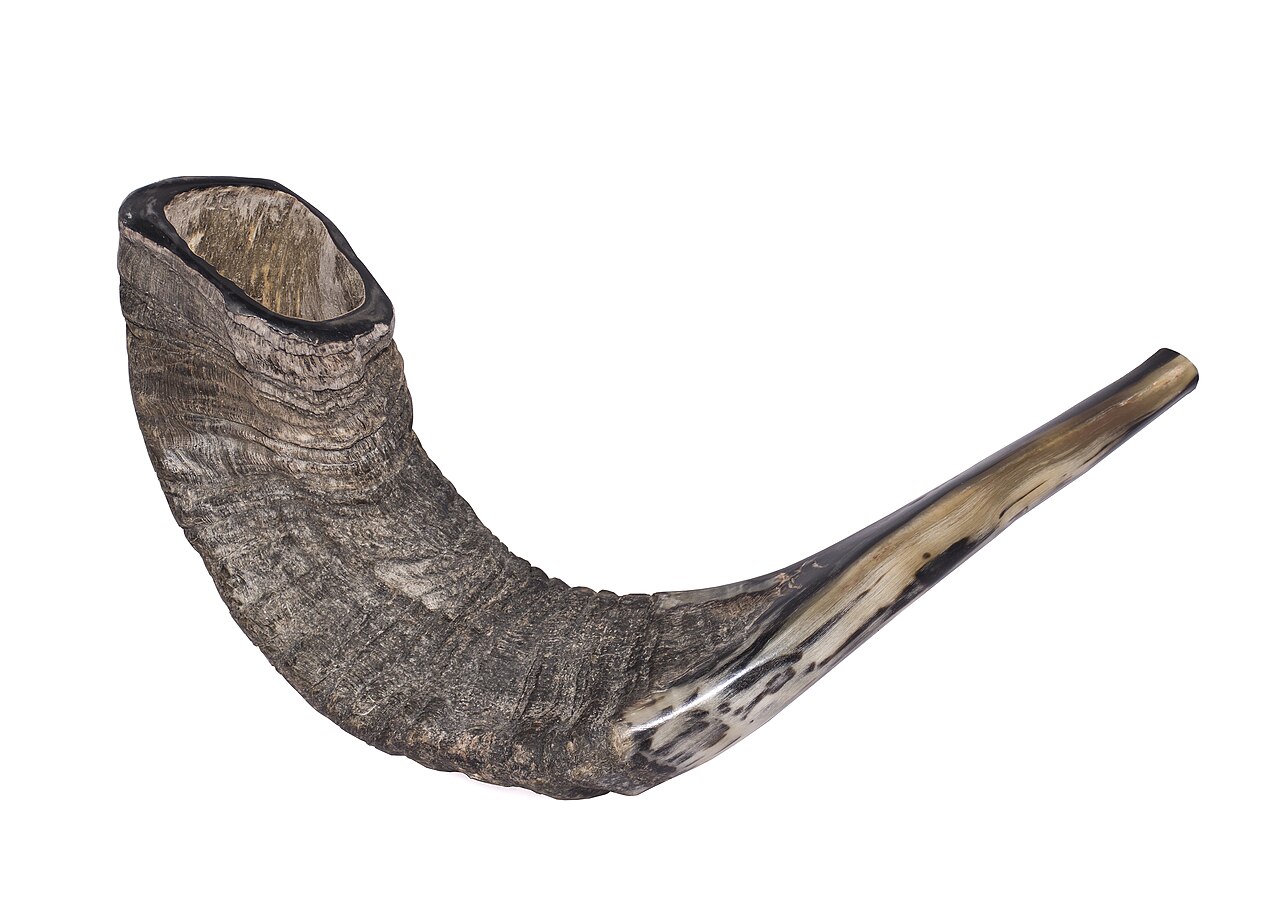
"And when the builders laid the foundation of the temple of the LORD, they set the priests in their apparel with trumpets, and the Levites the sons of Asaph with cymbals… And they sang together by course in praising and giving thanks unto the LORD; because he is good, for his mercy endureth for ever toward Israel."
"But many of the priests and Levites and chief of the fathers, who were ancient men, that had seen the first house, when the foundation of this house was laid before their eyes, wept with a loud voice; and many shouted aloud for joy: so that the people could not discern the noise of the shout of joy from the noise of the weeping of the people."
The seventh month
The seventh month held the Day of Trumpets, the Day of Atonement and Booths (Leviticus 23:23–44; Numbers 29). Ezra 3 restores the daily burnt offering first, then Booths with its daily offerings "by number, according to the custom" (Numbers 29:12–38). Solomon's temple had been dedicated in the same month (1 Kings 8:2).
Cedar again
As for Solomon (1 Kings 5; 2 Chronicles 2:16), cedar comes from Lebanon by sea to Joppa, paid in food and oil. The parallel is deliberate. Persian-era Phoenicia supplied timber across the empire (Darius' Susa foundation charter lists Lebanese cedar brought by way of Babylon). No record of this particular shipment survives.
Levites from twenty years old
Numbers 4 sets Levitical service at thirty to fifty, Numbers 8:24 at twenty-five; 1 Chronicles 23:24–27 lowers it to twenty in David's time. Ezra follows the twenty-year rule, perhaps because there were so few Levites (only 74 returned).
Joy and weeping
Haggai, speaking in 520 BC, asks: "Who is left among you that saw this house in her first glory? and how do ye see it now? is it not in your eyes in comparison of it as nothing?" (Haggai 2:3). Zechariah warns against despising "the day of small things" (Zechariah 4:10). Someone who saw the first temple as a child before 586 BC would be in his late fifties or older in 537 BC, and in his seventies by 520. The text does not say who outnumbered whom; joy and grief are heard together.
When was the foundation laid?
Ezra 3:8–13 dates the foundation to the second year after the return, under Zerubbabel and Jeshua. Ezra 5:16 says Sheshbazzar laid the foundation. Haggai 1–2 and Zechariah 4:9 imply that the foundation of Zerubbabel's work was laid in 520 BC, in Darius' second year. Proposals: (1) an initial start under Cyrus that stalled and was resumed in 520; (2) Ezra 3 telescopes the events of 520 into the first years, presenting the whole rebuilding as the response to Cyrus' decree; (3) "laying the foundation" (yasad) can mean restoring or repairing, so several "foundings" are possible. The site presents the tension rather than resolving it.
What survives of the Second Temple
No authenticated remains of the temple built under Zerubbabel have been excavated. The Temple Mount cannot be excavated, and Herod the Great rebuilt and enlarged the whole complex from about 20 BC. Some propose that a straight joint in the eastern wall of the Temple Mount, north of the southeast corner, marks earlier (Persian or Hellenistic) masonry; its date is debated. Any drawing of "Zerubbabel's Temple" is a reconstruction.
The Case for the Biblical Account
Scripture's account
The altar is rebuilt in the seventh month; offerings and Booths resume; the temple foundation is laid with music, joy and weeping (Ezra 3).
What evidence would we expect?
Renewed cult activity in Jerusalem in the Persian period; Phoenician timber trade; architectural remains of a Persian-period temple.
The discoveries
Persian-era Phoenician timber trade is documented (Darius' Susa charter). Persian-period Jerusalem was small but occupied (City of David, Ophel). No temple remains of this phase have been identified.
Testing the discoveries
Absence of temple remains is expected: the site is inaccessible and was rebuilt by Herod.
The strongest reconstruction
Worship at the altar resumed early; work on the temple began, stalled, and was completed under Darius I.
What remains possible
Whether Ezra 3:8–13 describes the 530s or 520 BC; whether Sheshbazzar's and Zerubbabel's foundations are one event or two.
What the evidence shows
- The altar was rebuilt before the temple.
- Ezra 3 and Haggai–Zechariah date the foundation differently. Ezra 3:8 (second year of the return); Haggai 2:18 and Zechariah 4:9 (520 BC).
- Remains of the temple built under Zerubbabel have been identified.
- "For he is good, for his mercy endureth for ever."
Then and Later
The Feast of Booths, then and later
- SinaiLeviticus 23 Seven days in booths.Trumpets, Atonement and Booths →
- c. 537 BCEzra 3:4 Booths kept at the rebuilt altar.
- 5th c. BCNehemiah 8 The people build booths after Ezra reads the law.
- 1st c. ADJohn 7 Jesus at the feast: "If any man thirst."
- Medieval to todayEcclesiastes at Sukkot Many communities (especially Ashkenazi) read Ecclesiastes publicly during the feast.The Finale, the Canon and Reading Ecclesiastes →
- TodaySukkot Kept by Jews worldwide.
Continue the journey
Journey of a PassageEzra 3:8–13; 5:1–2, 16; Haggai 1–2; Zechariah 4:9: When was the foundation laid?Ezra 3 places the foundation in the second year after the return under Zerubbabel and Jeshua; Ezra 5:16 credits Sheshbazzar; Haggai and Zechariah tie Zerubbabel's foundation to 520 BC.More from this lesson
Investigations
Optional deep dives: the ancient sources, the physical evidence, and every interpretation side by side, including unconventional ones, each labeled for what it is.
Can Zerubbabel's Temple Be Found?Structure: not identified · Eastern-wall seam: date debated · Site: not excavated
Do any remains of the temple completed in 515 BC survive?
No authenticated remains of the Persian-period temple have been excavated. The Temple Mount is not open to excavation, and Herod rebuilt the whole sanctuary and enlarged its platform from about 20 BC. A seam in the eastern wall is sometimes proposed as pre-Herodian; its date is debated. Every image of "Zerubbabel's temple" is a reconstruction.
Open the full investigation →Echoes Across Civilizations
Optional: how other ancient peoples told similar stories. Open one to compare, then come back to the lesson.
Sacred calendarsEmar · Israelite or Canaanite · Babylonian
Did Israel's neighbors have calendars of yearly festivals like Leviticus 23?
- Emar: The ritual archive of Emar (Emar 446 and related texts) Shared literary world
- Israelite or Canaanite: The Gezer Calendar Shared literary world
- Babylonian: The Akitu (New Year) festival Possible historical contact
Weeping at a temple's foundationBabylonian · Sumerian
Did other peoples weep and sing when a temple was rebuilt?
- Babylonian: Temple-renovation rituals with laments (kalû priests) Resemblance only
- Sumerian: Lament over the Destruction of Ur Resemblance only
Why this matters to the rest of Scripture
- The Feast of Booths.
- The offerings of Booths.
- Solomon's temple dedicated in the seventh month.
- Cedar by sea to Joppa.
- "Is it not in your eyes… as nothing?"
- "The day of small things."
- "For his mercy endureth for ever."