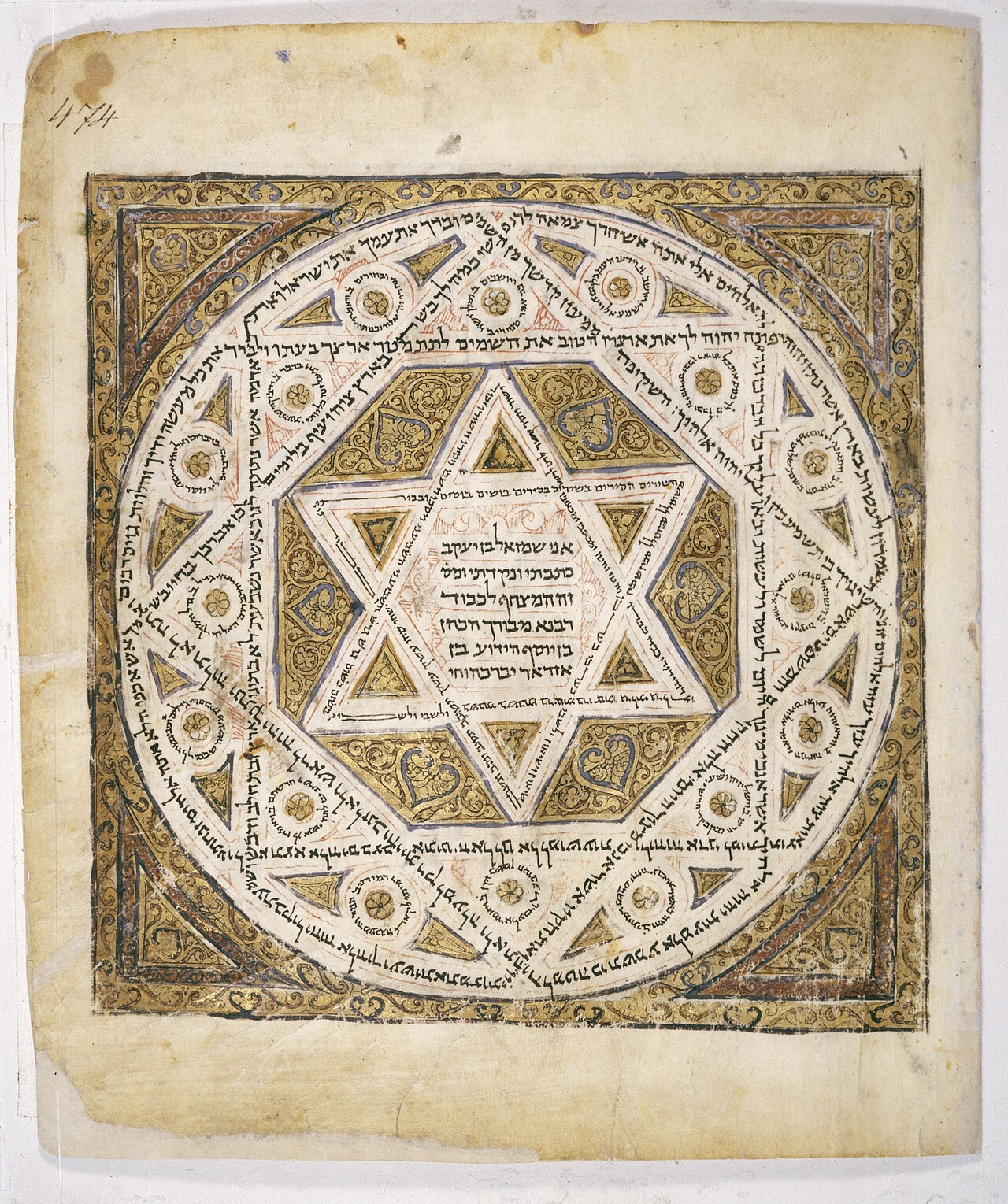
Ezra the Priest and Scribe
"Ezra had prepared his heart to seek the law of the LORD, and to do it, and to teach"
"Now after these things, in the reign of Artaxerxes king of Persia, Ezra the son of Seraiah, the son of Azariah, the son of Hilkiah…" sixteen generations back to "Aaron the chief priest." "This Ezra went up from Babylon; and he was a ready scribe in the law of Moses, which the LORD God of Israel had given: and the king granted him all his request, according to the hand of the LORD his God upon him."
He leaves on the first day of the first month and arrives in Jerusalem on the first day of the fifth month of the seventh year, "according to the good hand of his God upon him. For Ezra had prepared his heart to seek the law of the LORD, and to do it, and to teach in Israel statutes and judgments."
"Artaxerxes, king of kings, unto Ezra the priest, a scribe of the law of the God of heaven, perfect peace." Any of Israel, priests and Levites may go. Ezra is "sent of the king, and of his seven counsellors, to enquire concerning Judah and Jerusalem, according to the law of thy God which is in thine hand," carrying silver and gold from the king, his counsellors and the province of Babylon.
The treasurers beyond the river are to give Ezra up to a hundred talents of silver, a hundred measures of wheat, a hundred baths of wine and of oil, and salt without limit. No tribute may be laid on priests, Levites, singers, gatekeepers, Nethinim or temple servants. "And thou, Ezra, after the wisdom of thy God, that is in thine hand, set magistrates and judges… all such as know the laws of thy God; and teach ye them that know them not. And whosoever will not do the law of thy God, and the law of the king, let judgment be executed speedily upon him, whether it be unto death, or to banishment, or to confiscation of goods, or to imprisonment."
"Blessed be the LORD God of our fathers, which hath put such a thing as this in the king's heart, to beautify the house of the LORD which is in Jerusalem… And I was strengthened as the hand of the LORD my God was upon me, and I gathered together out of Israel chief men to go up with me."
Hebrew, Aramaic, Hebrew
7:1–11 is Hebrew narrative about Ezra; 7:12–26 is the king's letter in Aramaic; 7:27–28 returns to Hebrew and to the first person ("Blessed be the LORD… I was strengthened"). The first-person voice continues through chapter 9, the section often called the Ezra Memoir.
Ezra's ancestors
Ezra's line runs from Aaron through Eleazar, Phinehas and Zadok to Seraiah. Seraiah was the high priest killed by Nebuchadnezzar at Riblah in 586 BC (2 Kings 25:18–21), about 130 years before a mission in 458. "Son of" here means descendant. Compared with 1 Chronicles 6:3–15, Ezra's list omits six names between Meraioth and Azariah (Amariah, Ahitub, Zadok, Ahimaaz, Azariah, Johanan), perhaps because the eye skipped from one Azariah to another, or because the list was deliberately shortened. Biblical genealogies often select.
Torah and scribe
Ezra is a sofer, a scribe: in Persian administration a trained official, and in later Judaism an expert in the written law. The "law of thy God which is in thine hand" is a book. What it contained is debated: most think it was the Torah (the Pentateuch) in a form close to ours, some think a law code such as Deuteronomy or the priestly laws. Ezra 7 does not say.
Law with penalties
The decree backs the law of Ezra's God with the law of the king: death, banishment, confiscation or imprisonment. This is imperial enforcement, not a modern guarantee of religious freedom. It applies to "all the people that are beyond the river" who know the laws of Ezra's God, that is, the Jewish communities of the satrapy, not the whole population. The site presents it as a historical claim about Persian administration, with its ethical weight.
When did Ezra come?
| Proposal | Date | Main arguments |
|---|---|---|
| Artaxerxes I, year 7 (traditional) | 458 BC | The plain reading of Ezra 7:7; Ezra before Nehemiah, as in the book's order; Nehemiah 8 and 12:26, 36 place them together |
| Artaxerxes II, year 7 | 398 BC | Ezra 10:6 mentions Jehohanan son of Eliashib, apparently a high priest after Nehemiah's Eliashib (Johanan is high priest at Elephantine in 407); Ezra 9:9 thanks God for "a wall" in Jerusalem; Nehemiah's reforms seem not to know Ezra's (A. van Hoonacker, 1890) |
| Artaxerxes I, year 37 (emended) | 428 BC | Reads "thirty-seventh" in 7:7–8, keeping Ezra under Artaxerxes I but after Nehemiah's first mission |
None is certain. The 9:9 "wall" (gader) may be a metaphor for protection; Jehohanan son of Eliashib may be a different person from the high priest. The site keeps 458 BC as the conventional date and labels it disputed.
Persian imperial authorization?
Peter Frei proposed that Persia gave local laws imperial sanction, so that a community's own law became royal law in that community ("imperial authorization"). The Demotic Chronicle (verso) reports that Darius I ordered Egypt's laws collected and written in Aramaic and Demotic. Supporters see Ezra 7 as a case of the same policy, and some think it helped fix the Torah. Critics point out that the Persian evidence is thin, that Ezra 7 is known only from the Bible, and that the Torah's formation cannot be dated by this one decree. The hypothesis is disputed.
Is the decree authentic?
The decree uses Persian vocabulary (dat, "law"; adrazda, "diligently"; ganzaya, "treasury"; nishtewan, "letter") and Persian court forms ("king of kings," "the seven counsellors," compare Esther 1:14 and Herodotus 3.84). Its Jewish theological language (the "God of heaven," the stress on the Jerusalem temple) could come from a Jewish drafter at court, as Persian practice often relied on local officials, or from a later author. No original survives.
The Case for the Biblical Account
Scripture's account
Artaxerxes commissions Ezra to bring gifts to the temple, appoint judges and teach the law of God among the Jews of Across-the-River (Ezra 7).
What evidence would we expect?
Persian kings sponsoring local religious and legal arrangements; Jewish officials at court; Persian terms in the text.
The discoveries
Darius' collection of Egyptian law (Demotic Chronicle); Udjahorresnet's commission; the Elephantine Passover letter (419 BC) relaying instructions about a festival through Persian channels; Persian loanwords in the Aramaic of Ezra 7.
Testing the discoveries
They make the commission plausible, but no Persian source names Ezra or his mission.
The strongest reconstruction
A Jewish priest-scribe was sent from Babylonia with royal approval to regulate temple and community life by the Torah; the letter preserves Persian forms.
What remains possible
The date (458, 428 or 398 BC); the extent of Ezra's authority; the content of his law book.
What the evidence shows
- Ezra 7:12–26 is in Aramaic.
- The decree uses Persian administrative vocabulary.
- Ezra came in 458 BC.
- Persia formally authorized the Torah as local law.Source: P. Frei, "Persian Imperial Authorization: A Summary," in J. W. Watts (ed.), Persia and Torah (2001)
- Ezra's genealogy lists every generation from Aaron. Six names from 1 Chronicles 6 are absent.
- "The hand of the LORD his God was upon him."
Then and Later
Ezra the scribe, then and later
- 5th c. BCEzra 7; Nehemiah 8 Priest and scribe; reads the law to the people.The Return and Ezra →
- 2nd c. BC1 Esdras Retells Ezra; calls him "chief priest and reader."
- c. AD 1004 Ezra 14 An apocalypse in which Ezra restores the 24 public and 70 hidden books: a later legend, not history.
- RabbinicTalmud "Ezra would have been worthy to receive the Torah, had Moses not preceded him"; Ezra credited with the square script and with ten enactments (Sanhedrin 21b–22a; Bava Kamma 82a). Later tradition.
- TodayScribal tradition Torah scrolls are still copied by hand by scribes (soferim).
Continue the journey
Journey of a PassageEzra 7:1–5; 1 Chronicles 6:3–15: Ezra's priestly line: sixteen generations from AaronEzra's genealogy names sixteen generations from Aaron to Ezra.More from this lesson
On the map
Location securely identified Probable identification Proposed or debated location Biblical route (roads schematic) Scholarly proposal
- Ezra's caravan (schematic). Conceptual only. The caravan gathered at the river Ahava (unlocated) near Babylon, left on the 12th day of the first month and reached Jerusalem on the first day of the fifth month. Casiphia is also unlocated. The line is schematic; no stops are recorded.
Investigations
Optional deep dives: the ancient sources, the physical evidence, and every interpretation side by side, including unconventional ones, each labeled for what it is.
Are Ezra's Persian Letters Authentic?Style: authentic Persian-period · Originals: none survive · Authenticity: disputed
Do the Aramaic letters and decrees in Ezra 4–7 reproduce real Persian documents?
Ezra quotes seven official documents in Aramaic. Their formulas, titles and vocabulary match genuine Achaemenid Aramaic letters from Egypt, the satrap Arshama's archive and Bactria. No original of any of them survives, and their theological language has led some scholars to think they were composed or reworked by Jewish writers. Opinion ranges from authentic archival copies to literary creations.
Open the full investigation →Echoes Across Civilizations
Optional: how other ancient peoples told similar stories. Open one to compare, then come back to the lesson.
Kings who restored templesBabylonian (Persian king) · Egyptian · Egyptian (Persian rule) · Lycian / Persian
Did other rulers of the Persian empire restore local temples and peoples, as Cyrus and Darius do in Ezra?
- Babylonian (Persian king): The Cyrus Cylinder Possible historical contact
- Egyptian: Statue of Udjahorresnet Possible historical contact
- Egyptian (Persian rule): Darius' collection of Egyptian law (Demotic Chronicle, verso) Possible historical contact
- Lycian / Persian: Letoon trilingual inscription (Xanthos) Resemblance only
Letters of the Persian empireJewish (Egypt) · Persian
How do the Aramaic letters in Ezra compare with real letters of the Persian empire?
- Jewish (Egypt): Elephantine petition and memorandum Possible historical contact
- Persian: Letters of the satrap Arshama Possible historical contact
- Persian: Aramaic copy of the Behistun inscription Possible historical contact
Why this matters to the rest of Scripture
- Seraiah the high priest killed at Riblah.
- The high-priestly line.
- Ezra reads the law.
- "Judges and officers shalt thou make thee."
- The seven princes of Persia.
- "O how love I thy law!"
- "The scribes and the Pharisees sit in Moses' seat."