Investigation: The Persian Empire, Yehud and the Second Temple
What the empire's own records show, and what they cannot
The Persian kings in Ezra
| King | Reigned (BC) | In Ezra | Note |
|---|---|---|---|
| Cyrus II | 559–530 (Babylon 539) | 1:1–4; 3:7; 4:3–5; 5:13–17; 6:3–5 | Founder of the empire |
| Cambyses II | 530–522 | Not named | Conquered Egypt (525) |
| Darius I | 522–486 | 4:5, 24; 5–6 | Seized the throne in 522; not Cyrus' son. Temple finished in his 6th year |
| Xerxes I (Ahasuerus) | 486–465 | 4:6 | The Ahasuerus of Esther, on the usual identification |
| Artaxerxes I | 465–424 | 4:7–23; 6:14; 7–8 | Usually Ezra's and Nehemiah's king |
| Darius II | 423–405 | Not named in Ezra (Nehemiah 12:22 has "Darius the Persian") | King of the Elephantine petition (407). Not the Darius of Ezra 4–6 |
| Artaxerxes II | 405–359 | Possibly 7:1 on the 398 BC dating | Alternative king for Ezra's mission |
Timeline
| Date (BC) | Event | Evidence |
|---|---|---|
| 597 | First deportation; Jehoiachin to Babylon | Babylonian Chronicle |
| 587/586 | Jerusalem and the temple destroyed | Destruction layers; 2 Kings 25; the exact year depends on reckoning |
| 539 | Cyrus takes Babylon | Nabonidus Chronicle; Cyrus Cylinder |
| 538/537 | Decree and first return (Ezra 1–2) | Ezra; date by Ezra's "first year of Cyrus" |
| 520 | Haggai and Zechariah; building resumed | Haggai 1:1; Ezra 4:24–5:2 |
| 515 | Temple finished (Ezra 6:15) | Ezra; often written 516/515 |
| 458 (or 428, 398) | Ezra's mission | Ezra 7:7, dating disputed |
| 445/444 | Nehemiah's first mission | Nehemiah 2:1 |
| 407 | Elephantine Jews petition Bagohi, governor of Judah | Aramaic papyri (TAD A4.7–8) |
The Cyrus Cylinder
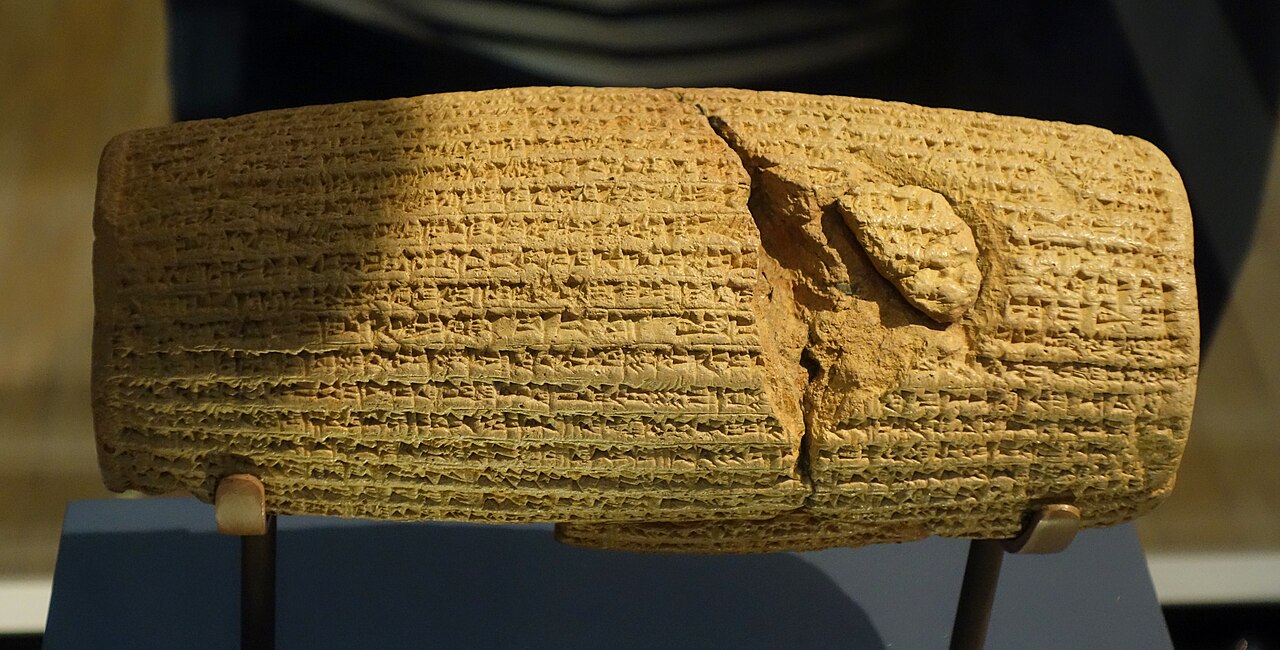
A clay barrel inscribed in Babylonian cuneiform, found at Babylon in 1879 (British Museum 1880,0617.1941). Cyrus says Marduk chose him; he returned the gods of cities east of the Tigris to their shrines and gathered their peoples to their homes. It shows a policy like the one in Ezra 1. It names no Jews, no Judah and no Jerusalem, and its god is Marduk, not the LORD. It is royal propaganda for Babylonian readers, not a charter of rights.
Yehud: the province
Hundreds of jar handles from the Persian and early Hellenistic periods are stamped YHD or YHWD ("Yehud") in Aramaic script, some with names and the title pḥw' ("governor"). Ramat Rahel, a royal or administrative site south of Jerusalem, has produced the largest number; an updated 2020 tabulation by Lipschits and Vanderhooft counts several hundred from that site alone. Small silver coins inscribed YHD were minted in the 4th century BC, some naming "Yehezqiyah the governor." These show a Persian province called Yehud with its own administration and taxation. They do not name Ezra, Zerubbabel or Nehemiah.
Jerusalem in the Persian period
Excavations in the City of David and on the Ophel show a small Persian-period settlement; estimates of its size range from a few hundred to a few thousand people, and of the whole province from roughly 15,000 to 30,000. The extent of the city wall before Nehemiah is debated. These figures come from limited excavation and surface survey and carry wide uncertainty.
Elephantine: another Jewish temple
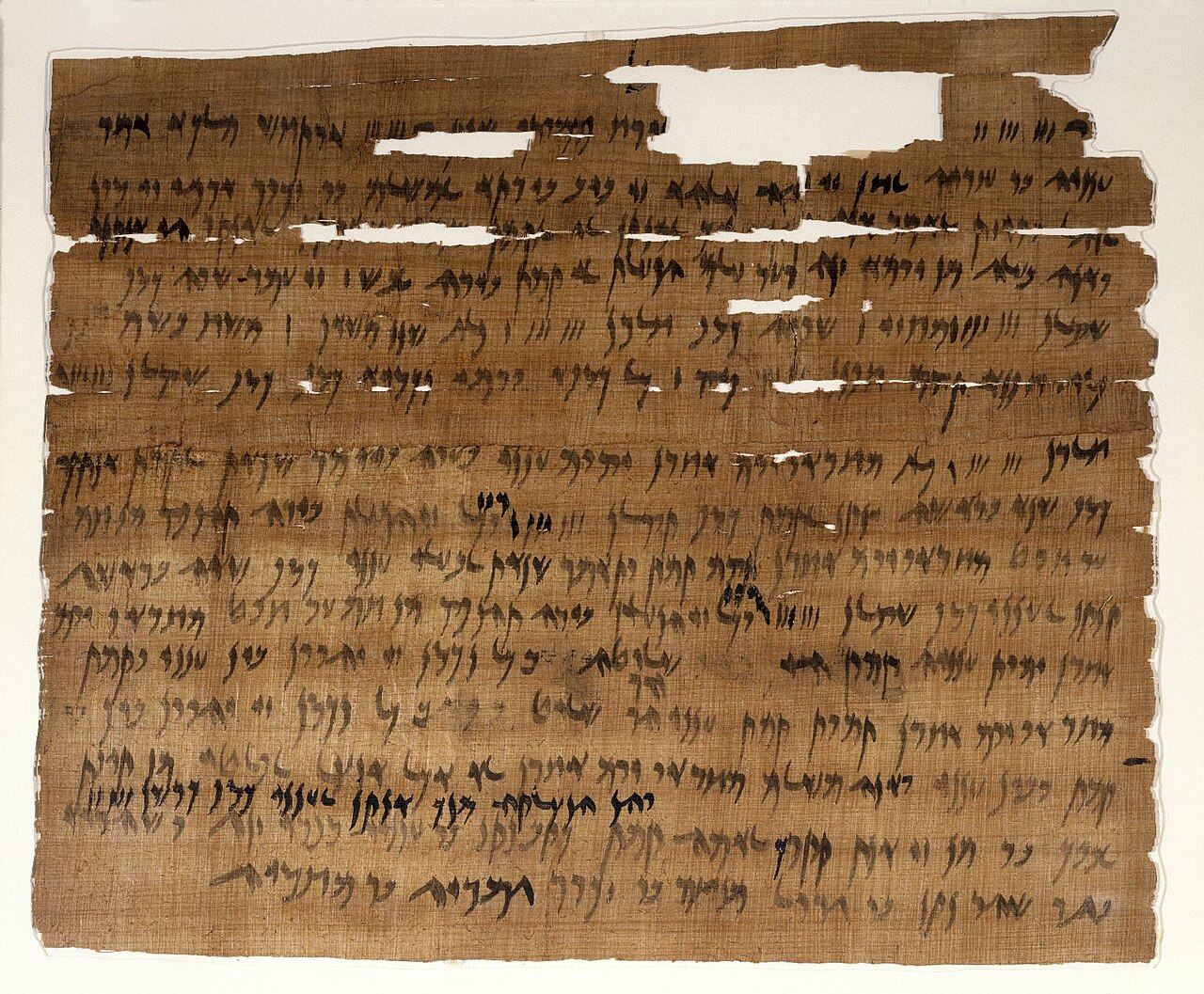
On the island of Elephantine at Aswan, a Jewish military colony in Persian service kept a temple of YHW (the divine name) from before Cambyses' conquest of Egypt in 525 BC. In 410 BC it was destroyed at the instigation of the priests of the Egyptian god Khnum. The community wrote to Bagohi (Bagavahya), governor of Judah, and to the sons of Sanballat, governor of Samaria; they had earlier written to "Johanan the high priest" in Jerusalem and received no answer. A memorandum records permission to rebuild, mentioning meal offerings and incense (not burnt offerings). The papyri show Jewish worship outside Jerusalem, contact between Jerusalem, Samaria and Egypt, and Persian channels of religious authority. They do not mention Ezra or Nehemiah.
The language of empire
Aramaic was the administrative language from Egypt to Bactria. Letters from Elephantine, the leather letters of the satrap Arshama, an Aramaic copy of Darius' Behistun inscription found at Elephantine, and 4th-century documents from Bactria all share the formulas found in Ezra 4–7. Ezra's Aramaic sections belong to this world.
Persian religion and later Judaism
Some scholars propose that contact with Persian (Zoroastrian) religion influenced later Jewish ideas of angels and demons, resurrection and the end of history. Others point out that the dating of Zoroastrian texts is very uncertain (the Avesta was written down in the Sasanian period, centuries later), that the biblical ideas have roots in earlier Israelite thought, and that similarity is not influence. The Achaemenid kings themselves invoked Ahuramazda in their own inscriptions but Marduk in Babylon (Cyrus) and local gods elsewhere; Ezra's "God of heaven" is a title the Persians could recognize. The question is open; Ezra itself shows no sign of Persian religious ideas.
Evidence matrix
| Claim | Basis | What it cannot prove |
|---|---|---|
| Persia permitted religious restoration | Cyrus Cylinder; Udjahorresnet; Ezra 1 | That the Cylinder is Ezra's decree; it does not mention Jews or Jerusalem |
| Yehud existed as a Persian province | Yehud stamps and coins; Aramaic documents | Any specific event in Ezra; the returnee lists; the temple's funding |
| Jews in Egypt had their own temple | Elephantine papyri | That Ezra knew of it; that all Jews worshiped only in Jerusalem |
| Ezra's Aramaic was copied at Qumran | 4Q117 | The whole book; that the events or documents are historical |
| The lists in Ezra and Nehemiah differ | MT Ezra 2, Nehemiah 7; 1 Esdras 5 | Which total is original |
| The temple was completed in 515 BC | Ezra 6; Haggai; Zechariah | An excavated Second Temple building |
The Case for the Biblical Account
Scripture's account
Under Persian rule, exiles return, rebuild the temple with royal support, and later receive Ezra with a royal commission.
What evidence would we expect?
Persian policies of restoration; a province of Yehud; a Jerusalem temple in the 5th century; Aramaic administration; Jewish communities in the diaspora.
The discoveries
All of these are attested: the Cylinder, the Yehud stamps and coins, the Elephantine papyri, Aramaic chancery documents, and Babylonian archives with Judean names.
Testing the discoveries
The outside evidence confirms the setting, not the specific events, names or documents of Ezra (Tattenai is the exception: a governor of that name is attested).
The strongest reconstruction
Ezra's narrative fits the Persian world well; its documents and details are plausible but known only from the Bible.
What remains possible
How far the book's documents are archival; the size of the returns; the date of Ezra.
What the evidence shows
- A Persian province called Yehud existed.Source: O. Lipschits and D. Vanderhooft, "Yehud Stamp Impressions from Ramat-Raḥel: An Updated Tabulation," BASOR 384 (2020) ↗; Posen Library, "Yehud Seal Impressions" ↗
- Jews at Elephantine had a temple of YHW in the 5th century BC.Source: B. Porten and A. Yardeni, Textbook of Aramaic Documents from Ancient Egypt, vol. 1 (1986): TAD A4.1 (Passover letter), A4.7–A4.9 (temple petition and memorandum); Center for Online Judaic Studies, the Bagohi petition (Elephantine, c. 407 BC) ↗
- Bagohi was governor of Judah around 407 BC.Source: Encyclopaedia Judaica (Jewish Virtual Library), "Bagohi" ↗
- Judaism borrowed its angels and resurrection from Persian religion.
- The outside evidence confirms the events of Ezra in detail.
Continue the journey
Journey of a PassageEzra 4:4–24: The time leap: from Cyrus to Artaxerxes and back to DariusEzra 4:6–23 describes opposition under Xerxes and Artaxerxes, decades after the temple was finished, and about the city walls.More from this lesson
Investigations
Optional deep dives: the ancient sources, the physical evidence, and every interpretation side by side, including unconventional ones, each labeled for what it is.
The Cyrus CylinderCylinder: documented · Policy of restoration: documented · Mention of Jerusalem: none
Does the Cyrus Cylinder record the decree to rebuild Jerusalem's temple?
The Cyrus Cylinder, a clay cylinder found at Babylon in 1879 (British Museum 1880,0617.1941), is a Babylonian building inscription in Cyrus' name after he took Babylon in 539 BC. It presents Cyrus as chosen by Marduk, and says he returned gods to their sanctuaries and gathered their former inhabitants. It names cities east of the Tigris, not Judah or Jerusalem. It shows a policy consistent with the biblical decree; it is not that decree.
Open the full investigation →Can Zerubbabel's Temple Be Found?Structure: not identified · Eastern-wall seam: date debated · Site: not excavated
Do any remains of the temple completed in 515 BC survive?
No authenticated remains of the Persian-period temple have been excavated. The Temple Mount is not open to excavation, and Herod rebuilt the whole sanctuary and enlarged its platform from about 20 BC. A seam in the eastern wall is sometimes proposed as pre-Herodian; its date is debated. Every image of "Zerubbabel's temple" is a reconstruction.
Open the full investigation →Are Ezra's Persian Letters Authentic?Style: authentic Persian-period · Originals: none survive · Authenticity: disputed
Do the Aramaic letters and decrees in Ezra 4–7 reproduce real Persian documents?
Ezra quotes seven official documents in Aramaic. Their formulas, titles and vocabulary match genuine Achaemenid Aramaic letters from Egypt, the satrap Arshama's archive and Bactria. No original of any of them survives, and their theological language has led some scholars to think they were composed or reworked by Jewish writers. Opinion ranges from authentic archival copies to literary creations.
Open the full investigation →The Yehud Stamp ImpressionsProvince of Yehud: documented · Link to specific events or persons in Ezra: none
What do the jar handles stamped "Yehud" tell us about the Persian province?
Jar handles stamped in Aramaic script with YHD or YHWD ("Yehud"), sometimes with a name or the title "governor," were used by the Persian and early Hellenistic administration of Judah. Most come from Ramat Rahel and Jerusalem; a 2020 tabulation counts several hundred from Ramat Rahel. Together with 4th-century YHD coins, they show a province called Yehud. They do not name Ezra, Zerubbabel or Nehemiah.
Open the full investigation →The Temple at Elephantine and the Letter to BagohiPapyri: authentic originals · Temple: documented · Connection to Ezra: context only
What do the Elephantine papyri show about Jewish worship in Ezra's century?
A Jewish garrison on Elephantine island in southern Egypt kept a temple of YHW in the 5th century BC. When it was destroyed in 410 BC, the community petitioned Bagohi, governor of Judah, and the sons of Sanballat of Samaria (407 BC), mentioning an earlier unanswered letter to Johanan the high priest in Jerusalem. A memorandum permits rebuilding with meal offerings and incense. The papyri are contemporary evidence of Jewish diversity and Persian administration; they do not mention Ezra or Nehemiah.
Open the full investigation →Echoes Across Civilizations
Optional: how other ancient peoples told similar stories. Open one to compare, then come back to the lesson.
Kings who restored templesBabylonian (Persian king) · Egyptian · Egyptian (Persian rule) · Lycian / Persian
Did other rulers of the Persian empire restore local temples and peoples, as Cyrus and Darius do in Ezra?
- Babylonian (Persian king): The Cyrus Cylinder Possible historical contact
- Egyptian: Statue of Udjahorresnet Possible historical contact
- Egyptian (Persian rule): Darius' collection of Egyptian law (Demotic Chronicle, verso) Possible historical contact
- Lycian / Persian: Letoon trilingual inscription (Xanthos) Resemblance only
Letters of the Persian empireJewish (Egypt) · Persian
How do the Aramaic letters in Ezra compare with real letters of the Persian empire?
- Jewish (Egypt): Elephantine petition and memorandum Possible historical contact
- Persian: Letters of the satrap Arshama Possible historical contact
- Persian: Aramaic copy of the Behistun inscription Possible historical contact
Why this matters to the rest of Scripture
- Cyrus and the God who forms light and creates darkness.
- "Darius the Persian."
- "In the second year of Darius the king."
- Ahasuerus over 127 provinces.
- Jews in Egypt, including Pathros (Upper Egypt).
Sources to explore
- British Museum, Cyrus Cylinder, object 1880,0617.1941 ↗
- O. Lipschits and D. Vanderhooft, "Yehud Stamp Impressions from Ramat-Raḥel: An Updated Tabulation," BASOR 384 (2020) ↗
- Posen Library, "Yehud Seal Impressions" ↗
- Center for Online Judaic Studies, the Bagohi petition (Elephantine, c. 407 BC) ↗
- Encyclopaedia Judaica (Jewish Virtual Library), "Bagohi" ↗
- J. C. Reeves, "ʿEzrā, Book of," Encyclopaedia Iranica ↗
Overviews are a starting point. Each links onward to the primary sources and specialist studies behind it.