Ezra 1:2–4 and 6:3–5
Cyrus' decree in Hebrew and in Aramaic
Ezra quotes Cyrus' decree twice: a Hebrew proclamation inviting the exiles to return (1:2–4) and an Aramaic archive memorandum specifying the building, its funding and the vessels (6:3–5). The memorandum gives the house 60 cubits of height and breadth but no length.
Read Ezra 1:2–4 and 6:3–5 in every edition
Same letters, different readings: the consonants agree, but ancient readers vocalized or interpreted them differently
The family tree
Each row is a language or text tradition. Witnesses in the same row may share ancestry, revise one another, or have an uncertain relationship; the line under each box says which. A solid arrow appears only where direct copying or a documented revised edition is established. Order by date never implies copying. Scroll sideways on a phone.
✓ contains it · ✕ does not · ❝ quotes part of it · ⓘ reports on manuscripts · ▢ pages lost · – no copy survives
- Same line, through lost copies
- Translation
The two decrees
- Ezra 1:2–4 (Hebrew)
- "The LORD God of heaven hath given me all the kingdoms… he hath charged me to build him an house at Jerusalem… Who is there among you of all his people?… let him go up." Neighbors to give silver, gold, goods, beasts.
- Ezra 6:3–5 (Aramaic)
- "Concerning the house of God at Jerusalem, Let the house be builded, the place where they offered sacrifices… height threescore cubits, breadth threescore cubits; three rows of great stones, and a row of new timber: expenses… out of the king's house." Vessels returned.
Every witness, in order
c. 539/538 BC
Cyrus Cylinder (British Museum 1880,0617.1941)
How the site knows this: Reported in scholarship; not checked by the site.
Babylonian text in Cyrus' name on restoring gods and peoples in Babylonia and beyond the Tigris. Not this decree; does not mention Jerusalem.
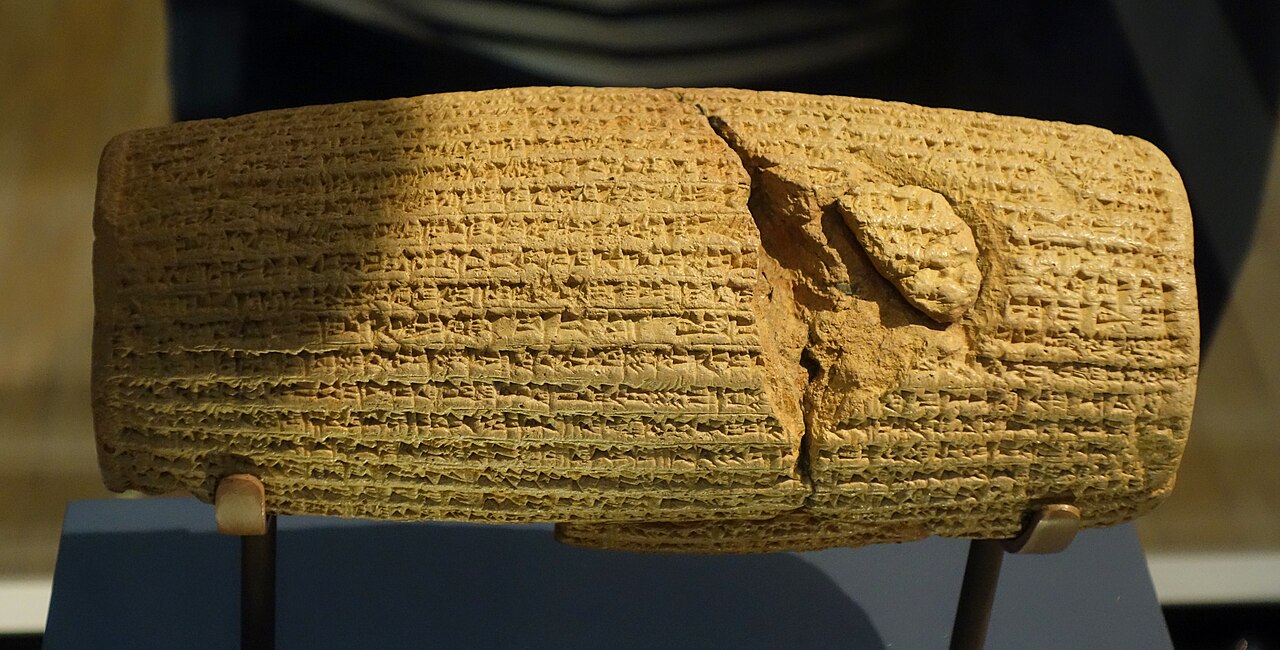
Authentic ancient artifactImage credit Source: British Museum, Cyrus Cylinder, object 1880,0617.1941 ↗
Composed c. 5th–4th century BC (debated)
Original Ezra–Nehemiah
No original survives.
Translated c. 2nd–1st century BC
Septuagint, Esdras B (library text: Giguet's French)
How the site knows this: Known here only through a translation.
Que le temple soit rebâti… Et il en a déterminé la hauteur et la largeur: soixante coudées des deux parts.
One Greek text via Giguet's French; not checked against Hanhart's Göttingen edition.
1st century BC (reported)
4Q117 (4QEzra), Qumran Cave 4
How the site knows this: Reported in scholarship; not checked by the site.
Reported to preserve parts of 6:1–5 (Qumran Digital Reader; DJD XVI). Letters not collated by the site.
Source: Qumran Digital Reader, 4Q117 (4QEzra), transcription ↗; E. Ulrich, "4QEzra," in Qumran Cave 4.XI: Psalms to Chronicles, DJD XVI (2000) (edition not yet consulted by the site)
c. AD 400
Jerome's Vulgate (1 Esdras = Ezra)
How the site knows this: Read in the site's library text: Clementine Vulgate (1592 edition).
altitudinem cubitorum sexaginta, et latitudinem cubitorum sexaginta
AD 1008
Masoretic Text (Leningrad Codex)
How the site knows this: Read in the site's library text: Westminster Leningrad Codex, a digital transcription of the Leningrad Codex.
רוּמֵהּ אַמִּין שִׁתִּין פְּתָיֵהּ אַמִּין שִׁתִּין
its height sixty cubits, its breadth sixty cubits
Aramaic. 1:2–4 is in Hebrew.
1611
King James Bible
How the site knows this: Read in the site's library text: King James Version (1769 text).
the height thereof threescore cubits, and the breadth thereof threescore cubits
1611
1 Esdras 6:25 in the King James Apocrypha
How the site knows this: Read in the site's library text: King James Version (1769 text).
Whose height shall be sixty cubits and the breadth sixty cubits, with three rows of hewn stones, and one row of new wood of that country
Same figures.
What changed, and why
The two differ as a public announcement differs from an internal memo. Some scholars think the Aramaic memorandum is closer to a real Persian document and the Hebrew proclamation a Jewish presentation of it; others think both are literary. The lack of a length in 6:3 suggests a figure was lost (Solomon's house was 60 long, 20 wide, 30 high; 1 Kings 6:2), or that the numbers set the maximum the crown would fund.
What the evidence shows
- Ezra gives the decree in two forms and two languages.
- The Aramaic memorandum preserves a Persian document.
- The new temple was 60 cubits high and wide.
Sources
- British Museum, Cyrus Cylinder, object 1880,0617.1941 ↗
- H. G. M. Williamson, Ezra, Nehemiah (Word Biblical Commentary 16, 1985)
- J. Blenkinsopp, Ezra–Nehemiah (Old Testament Library, 1988)
Related lessons
- Cyrus, the Proclamation and the Vessels →In the first year of Cyrus, "that the word of the LORD by the mouth of Jeremiah might be fulfilled," the Persian king proclaims that the house of the God of heaven be rebuilt in Jerusalem. Families rise to go; neighbors give silver, gold and animals; and Cyrus hands the temple vessels Nebuchadnezzar had taken to Sheshbazzar, "the prince of Judah." Ezra opens under a foreign emperor, not a restored king of David's line.
- The Memorandum, the Finished Temple and the Passover →Darius has the archives searched, and a scroll is found at Ecbatana: Cyrus' memorandum ordering the house rebuilt, sixty cubits high and wide, paid for by the crown, with the vessels returned. Darius orders his officials not to interfere, to fund the work and the sacrifices from the region's tribute, and to pray for the king. The temple is finished in his sixth year (515 BC). It is dedicated with joy, and the returned exiles, with all who had separated themselves from the uncleanness of the nations, keep the Passover.