2 Chronicles 36:22–23 and Ezra 1:1–3
Cyrus' proclamation, twice
The last verses of Chronicles and the first verses of Ezra are nearly identical. Chronicles stops at "let him go up"; Ezra continues "to Jerusalem… and build the house." The Cyrus Cylinder shows Cyrus restoring temples and peoples in Babylonia but does not mention Jerusalem or the Jews.
Read 2 Chronicles 36:22–23 and Ezra 1:1–3 in every edition
Manuscript variant: witnesses differ in wording
The family tree
Each row is a language or text tradition. Witnesses in the same row may share ancestry, revise one another, or have an uncertain relationship; the line under each box says which. A solid arrow appears only where direct copying or a documented revised edition is established. Order by date never implies copying. Scroll sideways on a phone.
✓ contains it · ✕ does not · ❝ quotes part of it · ⓘ reports on manuscripts · ▢ pages lost · – no copy survives
- Same line, through lost copies
- Translation
Every witness, in order
c. 539/538 BC
Cyrus Cylinder (British Museum 1880,0617.1941)
How the site knows this: Reported in scholarship; not checked by the site.
Babylonian text in Cyrus' name: he returned gods to their sanctuaries and gathered their peoples. Names cities east of the Tigris; not Judah.
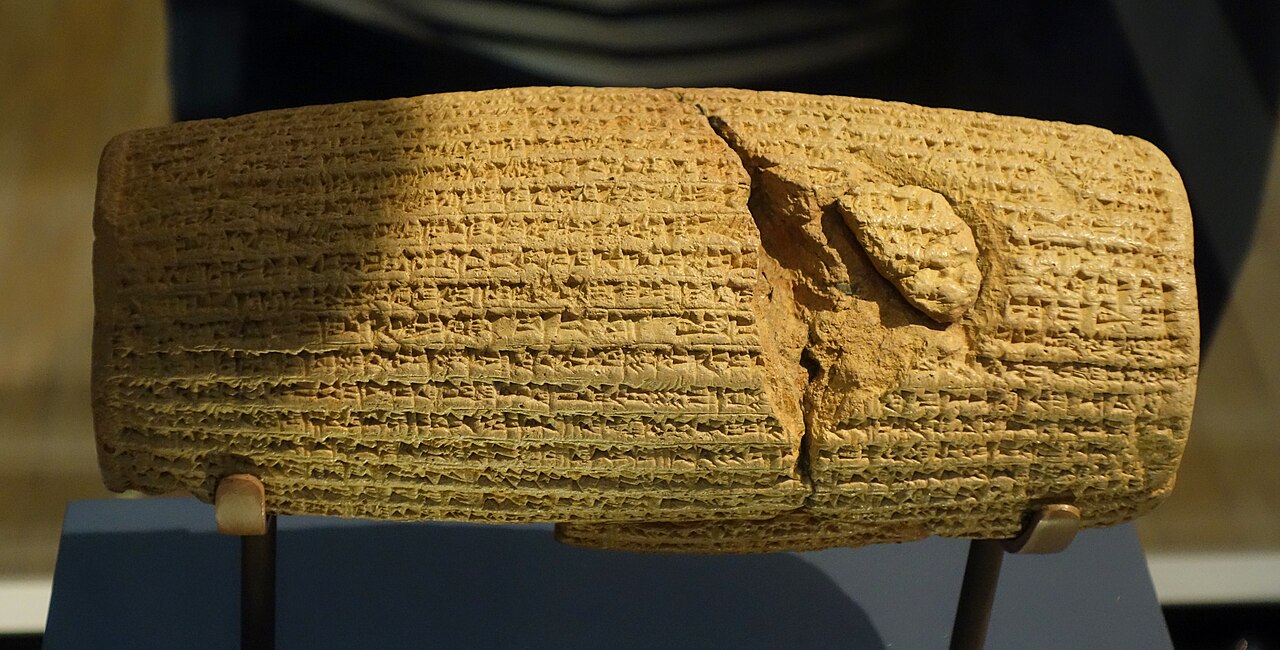
Authentic ancient artifactImage credit Source: Encyclopaedia Iranica, "Cyrus Cylinder" ↗; British Museum collection (Sennacherib reliefs, Cyrus Cylinder, Babylonian Chronicle) ↗
Ezra
Ezra 1:1–3 (parallel account, Masoretic Text)
How the site knows this: Read in the site's library text: Westminster Leningrad Codex, a digital transcription of the Leningrad Codex, quoted here in English.
Who is there among you of all his people? his God be with him, and let him go up to Jerusalem, which is in Judah, and build the house of the LORD God of Israel
Composed c. 4th century BC (debated)
Original Chronicles
No original survives.
Translated c. 2nd century BC
Septuagint, 2 Paraleipomena (library text: Giguet's French)
How the site knows this: Known here only through a translation.
Qui, parmi vous tous, est de son peuple? Son Dieu sera avec lui, et qu'il parte.
One Greek text (Vaticanus type) via Giguet's French; not checked against a critical Greek edition.
AD 1008
Masoretic Text (Leningrad Codex)
How the site knows this: Read in the site's library text: Westminster Leningrad Codex, a digital transcription of the Leningrad Codex.
מִי־בָכֶם מִכָּל־עַמּוֹ יְהוָה אֱלֹהָיו עִמּוֹ וְיָעַל
whoever among you of all his people, the LORD his God be with him, and let him go up
The last word of the book: veya'al.
1611
King James Bible
How the site knows this: Read in the site's library text: King James Version (1769 text).
The LORD his God be with him, and let him go up.
What changed, and why
Either Ezra–Nehemiah once continued Chronicles (the repetition linking them), or the overlap was added to connect two works. Ezra 6:3–5 gives a different, Aramaic memorandum of the decree. The Cylinder is evidence of Cyrus' general policy, not of this edict.
What the evidence shows
- 2 Chronicles 36:22–23 and Ezra 1:1–3 are nearly identical.
- The Cyrus Cylinder mentions Jerusalem.
Sources
Related lessons
- Judah's Last Kings, the Fall and Cyrus' Proclamation →In quick succession Jehoahaz is deposed by Necho, Jehoiakim is taken by Nebuchadnezzar, Jehoiachin is exiled, and Zedekiah rebels and will not humble himself before Jeremiah. God sends messengers "rising up betimes," but they mock them "till there was no remedy." The Chaldeans kill young and old, burn the temple and break down the walls; survivors go to Babylon "to fulfil the word of the LORD by the mouth of Jeremiah, until the land had enjoyed her sabbaths… seventy years." Then Cyrus king of Persia proclaims: build the house in Jerusalem; "let him go up."
- Evidence Case: External Evidence for Judah's Kings →Kings of Judah named in 2 Chronicles appear in Egyptian, Assyrian and Babylonian records, on seals and in archaeology. This lesson gathers the evidence already investigated elsewhere on the site, with a short statement of what each object shows and what it does not.
- How 2 Chronicles Came to Us →2 Chronicles is the second half of one Hebrew book. It closes the Hebrew Bible in most Jewish orders, with Cyrus' "let him go up." It cites many prophetic and royal records that do not survive. At Qumran only the disputed fragment 4Q118 relates to it. The Greek Paraleipomena translates it; 1 Esdras independently retells its last chapters with Ezra.
- Cyrus, the Proclamation and the Vessels →In the first year of Cyrus, "that the word of the LORD by the mouth of Jeremiah might be fulfilled," the Persian king proclaims that the house of the God of heaven be rebuilt in Jerusalem. Families rise to go; neighbors give silver, gold and animals; and Cyrus hands the temple vessels Nebuchadnezzar had taken to Sheshbazzar, "the prince of Judah." Ezra opens under a foreign emperor, not a restored king of David's line.
- How Ezra Came to Us →Ezra and Nehemiah were one book in Hebrew tradition, written partly in Hebrew and partly in Aramaic, combining memoirs, lists and official letters. One Qumran manuscript, 4Q117, preserves pieces of the Aramaic chapters. In Greek there are two different books: Esdras B, a translation of Ezra–Nehemiah, and Esdras A (1 Esdras), a separate retelling with a story not found in Ezra. Their names in Latin and English are famously confusing.