Origen, Hexapla
- Language
- Hebrew and Greek
- Composed
- c. AD 240
- Oldest surviving copy
- Fragments; Syro-Hexapla; marked Greek manuscripts
- Status
- Christian scholarship
Additions marked with asterisks.
Ancient Mysteries & Interpretations
The Old Greek of Job lacked roughly 390 of the Hebrew's poetic lines, mostly in the later chapters. Origen (c. AD 240) supplied them from Theodotion and marked them with asterisks; later copies kept the additions and lost the marks. Most scholars think the translator abridged a Hebrew text much like ours; some propose a shorter Hebrew original. The Sahidic Coptic preserves the shorter form; the library's Coptic copy lacks 168 verses, concentrated in chapters 21–42.
Shorter Old Greek: documented · Cause: debated (abridgement favoured)
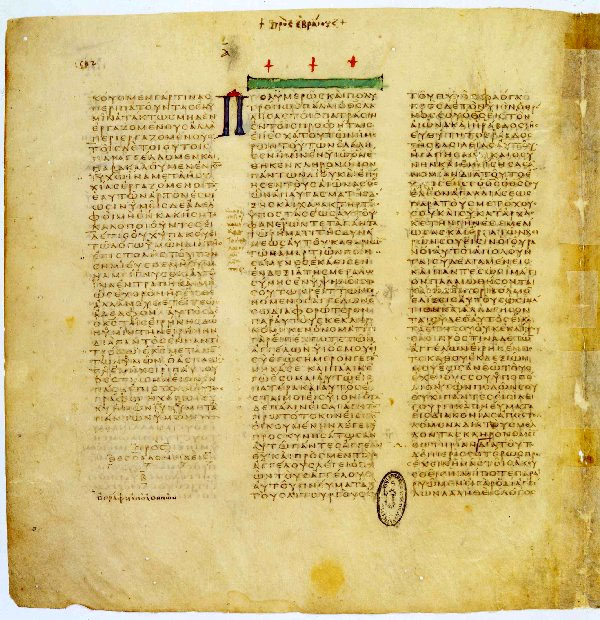
Origen, Letter to Africanus: in Job many passages, "sometimes three or four verses, sometimes fourteen or nineteen," are missing from the Greek.
Additions marked with asterisks.
Translated from the pre-Origen Greek.
Ziegler's Göttingen edition (1982) and Gentry's study (1995) reconstruct the Old Greek and the asterisked materials.
Scholarly reconstruction
The translator condensed repetitive and difficult poetry.
Source: M. Gorea, "The Book of Job," in The Oxford Handbook of the Septuagint (2021) (abstract) ↗; NETS, "Iob," translator's introduction and translation (after Ziegler's Göttingen edition, 1982) ↗
Alternative explanation
The translator had a shorter Hebrew Job.
The Old Greek abridged a full-length Hebrew text in most places; each difference must be judged separately.
What the evidence shows
Source: M. Gorea, "The Book of Job," in The Oxford Handbook of the Septuagint (2021) (abstract) ↗
Source: P. J. Gentry, The Asterisked Materials in the Greek Job (SBLSCS 38, 1995)