Since the 1980s, explorers have argued that Mount Sinai is Jebel al-Lawz in Saudi Arabia, in the land of ancient Midian. They point to a blackened summit, a stone platform with cattle petroglyphs, boundary markers, altars, and a split rock. The Midian connection is a serious biblical argument. The physical features have not been excavated or dated, and geologists and archaeologists explain them differently.
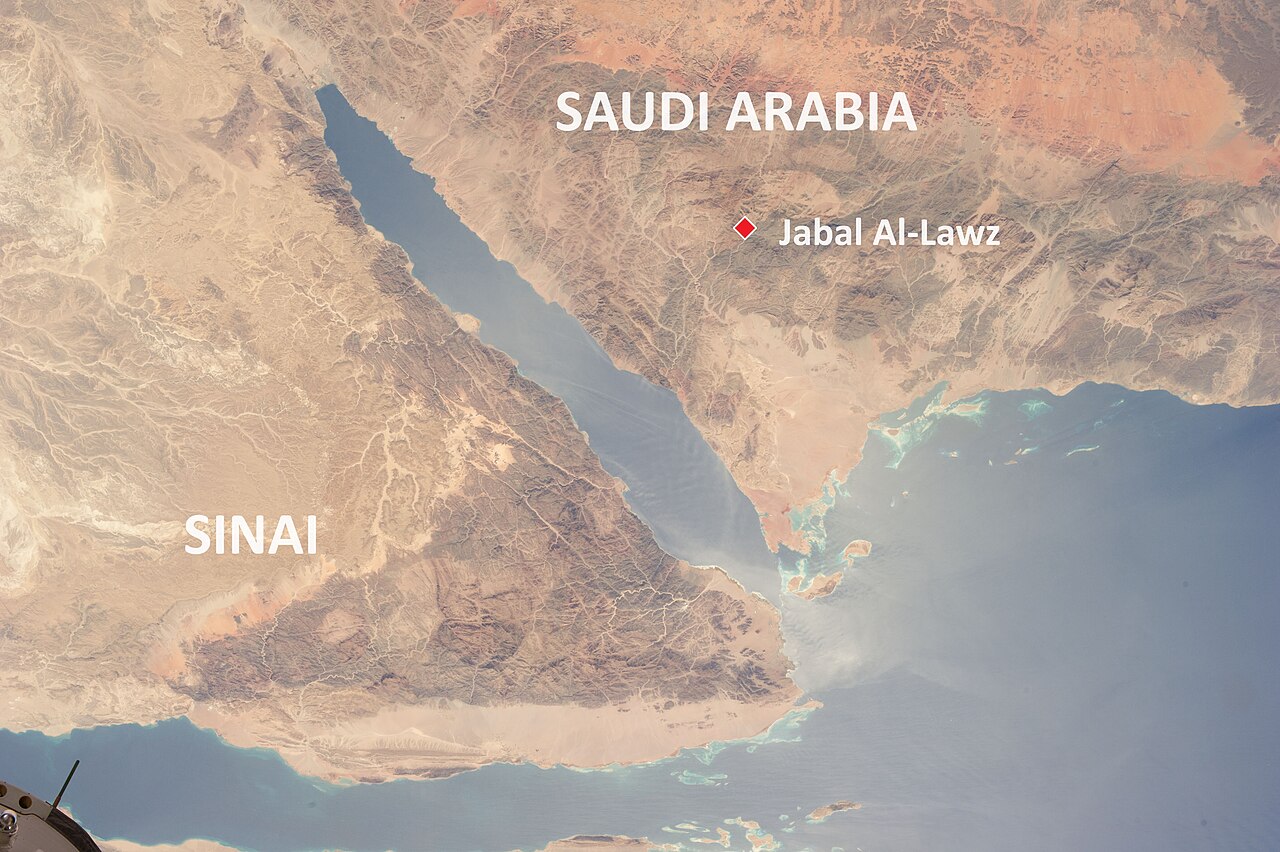
Site or place photographNorthwestern Saudi Arabia from the International Space Station, showing the location of Jebel al-Lawz, proposed as Mount Sinai.Image credit
1 What Scripture says
Moses kept Jethro's flock in Midian and "came to the mountain of God, even to Horeb" (Exodus 3:1). God promised, "ye shall serve God upon this mountain" (3:12). At Sinai "the whole mount quaked greatly" and smoked "as the smoke of a furnace" (19:18). Moses built "an altar under the hill, and twelve pillars" (24:4). Paul wrote that "Agar is mount Sinai in Arabia" (Galatians 4:25).
2 What evidence we might expect
A mountain within reach of Egypt in the time the Bible gives, with stations that can be traced.
Archaeological remains (camps, altars, pillars) securely dated to the Late Bronze Age.
Features explainable only by the biblical events, not by geology or other periods of human activity.
3 What discoveries exist
The case for Jebel al-Lawz
Midian: Moses' father-in-law was a priest of Midian, and the mountain of God was near Moses' Midianite pasturelands. Midian was in northwestern Arabia, east of the Gulf of Aqaba.
Galatians 4:25 places Sinai "in Arabia."
The summit's dark rock, said to be scorched by the fire of God's descent.
A stone platform with petroglyphs of cattle, identified as the golden calf altar.
Rows of stone piles interpreted as the boundary markers of Exodus 19:12, and stone structures interpreted as Moses' altar and twelve pillars.
A large boulder split down the middle in the same region, identified as the rock of Horeb.
Claimed crossing site at Nuweiba (see the chariots investigation) and route across the Sinai peninsula.
Site or place photographNorthwestern Saudi Arabia from the International Space Station, showing the location of Jebel al-Lawz, proposed as Mount Sinai.Image credit
Testing each feature
Feature
Claim
Assessment
Black summit
Burned by God's fire
The dark cap appears to be a different, darker rock type over lighter granite; scorched granite would not darken uniformly through the rock. No laboratory analysis has been published.
Cattle petroglyphs
Golden calf worship
Cattle and other animal petroglyphs are common across Arabia and Sinai, made over thousands of years, often in Neolithic and later styles. They have not been dated.
Stone altar and pillars
Moses' altar and twelve pillars
Not excavated; similar stone structures in Arabia include tombs, enclosures and shrines from many periods, including Nabataean.
Boundary markers
Exodus 19:12
Stone cairns are common in the region; not dated.
Split rock
Rock of Horeb
Rocks split by weathering are common; no way to connect one to the event.
What Arabia meant to Paul
In the 1st century, "Arabia" usually meant the Nabataean kingdom, whose territory included the Negev and parts of Sinai as well as northwestern Arabia. Paul's "Arabia" therefore fits more than one candidate. Paul himself went "into Arabia" after his conversion (Galatians 1:17), probably Nabataean territory near Damascus.
The Midian argument, taken seriously
Midian's heartland was in northwestern Arabia, where Qurayyah, with its distinctive painted pottery of the 13th–12th centuries BC, is the main known settlement. But Midianites were also mobile herders and traders who ranged into Sinai and the Negev (Genesis 37:28; Judges 6). Moses could have pastured Jethro's flocks a long way from Midian's towns: Exodus 3:1 says he led the flock "to the backside of the desert." And Exodus 18:27 says Jethro went "into his own land" from Sinai, implying Sinai was not in Midian itself.
4 How interpretations compare
Alternative explanation
Jebel al-Lawz is Sinai
The mountain of God was in Midian; the physical features at Jebel al-Lawz are the remains of the Exodus encampment and the golden calf.
Assessment: The Midian argument deserves weight, but it is not decisive. None of the physical features has been dated or excavated, and each has ordinary explanations. The identification remains unproven.
Source: H. Blum, The Gold of Exodus: The Discovery of the True Mount Sinai (1998); R. Cornuke and D. Halbrook, In Search of the Mountain of God (2000); R. Wyatt, reports and videos on Jebel al-Lawz (1984 onward)
Traditional reading
Southern Sinai (Jebel Musa)
The site venerated since the 4th century, with Christian tradition that may preserve older memory.
Assessment: Ancient tradition but no Bronze Age evidence.
Source: Egeria, Itinerarium (381–384 AD), tr. J. Wilkinson, Egeria's Travels (1999)
Scholarly reconstruction
Location unknown
The evidence does not yet allow any mountain to be identified; the route stations must be located first.
Source: J. K. Hoffmeier, Ancient Israel in Sinai (Oxford, 2005), ch. 6; G. Franz, "Is Mount Sinai in Saudi Arabia?" Bible and Spade 13:4 (2000)
5 The strongest supported reconstruction
The case for Arabia raises a real biblical question about Midian, and it is a legitimate candidate. The features offered as physical proof have not been documented archaeologically or dated, and they have ordinary explanations. Until excavations are published, Jebel al-Lawz remains a proposal, not a discovery.
6 What remains possible or unknown
The dates of the stone structures and rock art at Jebel al-Lawz.
Whether future Saudi archaeological surveys of the region will publish relevant findings.
7 How this material came to us
Ron Wyatt entered the area in 1984; Bob Cornuke and Larry Williams in 1988 (Howard Blum's The Gold of Exodus, 1998); later documentaries, beginning with The Exodus Revealed (2001), and many online videos spread the claim. Saudi authorities fenced parts of the site after the explorers' visits.
What would settle it
Excavation and radiocarbon or other dating of the altar, pillars and cairns.
Dating of the cattle petroglyphs by style, patina, or associated deposits.
Laboratory analysis of the dark summit rock.
Identification of the route stations between Egypt and the mountain.
What the evidence shows
Independently documentedMidian was centered in northwestern Arabia.
Source: On Qurayyah and Midianite archaeology: P. J. Parr, "Further Reflections on Late Second Millennium Settlement in North West Arabia" (1996); J. Intilia, Qurayyah Painted Ware (2016)
Independently documentedCattle petroglyphs and stone structures exist near Jebel al-Lawz.
Not independently verifiedThe dark summit was scorched by fire.
Not independently verifiedThe structures date to the time of the Exodus.
DisputedJebel al-Lawz is Mount Sinai.
Source: Bible History Daily (Biblical Archaeology Society), "Is Mt. Sinai in Saudi Arabia?" and "Searching for Biblical Mount Sinai"