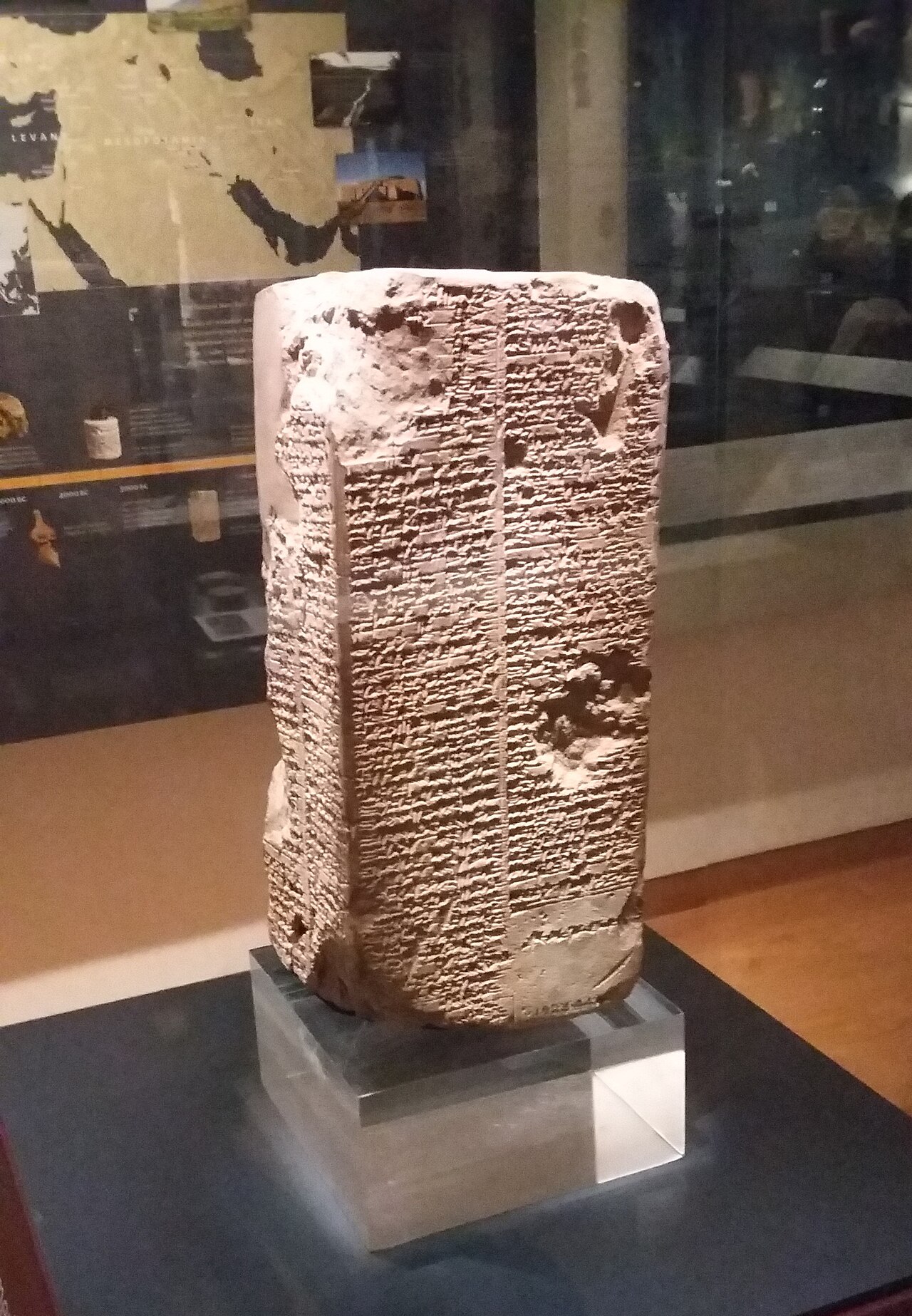
Genesis lists ten generations from Adam to Noah, with lifespans of up to 969 years. The Sumerian King List names kings who reigned before the Flood for up to 43,200 years each, and Berossus later gave ten kings before the Flood. Both traditions remember a primeval age of extraordinary duration ended by a flood.
Ancient texts: documented · Numbers: differ between manuscript traditions · Meaning of the numbers: debated
Authentic ancient artifactThe Weld-Blundell Prism (c. 1800 BC), Ashmolean Museum: kings before the Flood with reigns of thousands of years.Image credit
1 What Scripture says
Genesis 5 repeats a pattern: X lived so many years and fathered Y; X lived so many more years and had other children; all the days of X were so many years, "and he died." Only Enoch breaks it: "he was not; for God took him." Genesis 11 continues with shorter and shorter lives from Shem to Terah.
2 What evidence we might expect
Other ancient lists of pre-Flood generations or rulers.
Clues to why the numbers are so large.
Differences between copies of each list.
3 What ancient sources survive
Sumerian King List
Language
Sumerian
Composed
Probably Ur III or early Isin period (21st–19th century BC), with later versions
Oldest surviving copy
The Weld-Blundell Prism (WB 444), c. 1800 BC, Ashmolean Museum; other versions include WB 62
WB 444 gives eight kings in five cities before the Flood, totaling 241,200 years; WB 62 gives ten.
Source: Ashmolean Museum: the Weld-Blundell Prism (AN1923.444), Sumerian King List; T. Jacobsen, The Sumerian King List (Chicago, 1939)
Berossus, Babyloniaca
Language
Greek
Composed
c. 290–278 BC
Oldest surviving copy
Quotations in later authors
Ten kings before the Flood, from Aloros to Xisouthros (Ziusudra), the flood hero.
Genesis 5
Language
Hebrew
Composed
Debated
Oldest surviving copy
Dead Sea Scroll fragments; complete in the Leningrad Codex (1008)
The ages differ between the Hebrew, Greek and Samaritan traditions.
4 What discoveries exist
The Sumerian numbers are built on the sar, 3,600 years: Alulim's 28,800 years is 8 sars, Alalgar's 36,000 is 10 sars. The scale and arithmetic reflect Mesopotamian base-60 counting and royal ideology. Genesis' numbers are lifespans, not reigns, and are smaller by two orders of magnitude, yet the structure is similar: a long primeval line, a flood, and a sharp drop afterward.
Use the comparison below to switch between the Genesis lifespans in each manuscript tradition and the Sumerian reigns.
Before the Flood: two ancient chronologies
Adam930 years
Seth912 years
Enosh905 years
Kenan910 years
Mahalalel895 years
Jared962 years
Enoch365 years
Methuselah969 years
Lamech777 years
Noah950 years
Total lifespans. Enoch's 365 is the age at which God took him (Genesis 5:23–24). Highlighted bars differ from the Hebrew. The traditions also differ in each father's age at his son's birth, which changes the total time to the Flood.
5 How interpretations compare
Traditional reading
Literal lifespans
Many traditional readers take the ages as literal, with lifespans declining after the Flood as the world changed.
Scholarly reconstruction
Honorific or symbolic numbers
Others see meaningful numbers: Enoch's 365 years (the solar year), Lamech's 777, and patterns that may encode honor or theology. Some propose the numbers were adapted from a different counting system.
Scholarly reconstruction
A shared tradition, reworked
The ten-generation structure in Genesis and Berossus, with a special seventh figure (Enoch; Enmeduranki), suggests a common Near Eastern pattern which Genesis tells in its own way.
Source: R. S. Hess, Studies in the Personal Names of Genesis 1–11 (1993)
Modern speculative theory
A different kind of human
Some alternative writers argue the long reigns record nonhuman rulers or advanced beings.
Assessment: Neither list describes its figures as anything but kings or ancestors; the Sumerian numbers follow mathematical conventions.
6 The strongest supported reconstruction
Genesis and Mesopotamian tradition both preserve the idea of an extraordinary age before a great flood, with long-lived figures and a turning point after the Flood. The numbers in each are part of their own literary and mathematical conventions, and should not be converted into each other.
7 What remains possible or unknown
What the original numbers in Genesis were, given that three traditions differ.
Whether the patriarchs' ages were meant literally by the first readers.
8 How this material came to us
Genesis' ages diverge in the Masoretic, Septuagint and Samaritan traditions, which changes the time from creation to the Flood by centuries. See the Genesis 5 chronology tool in the Cain lesson and the How Genesis Came to Us lesson.
What the evidence shows
Independently documentedThe Sumerian King List assigns kings before the Flood reigns of tens of thousands of years.
Source: Ashmolean Museum: the Weld-Blundell Prism (AN1923.444), Sumerian King List; T. Jacobsen, The Sumerian King List (Chicago, 1939)
Independently documentedBerossus lists ten kings before the Flood.
Independently documentedGenesis 5's ages differ between the Hebrew, Greek and Samaritan texts.
Matter of faithHumans before the Flood lived for centuries. A claim of the text that history cannot test.