"Thou makest darkness, and it is night: wherein all the beasts of the forest do creep forth. The young lions roar after their prey… The sun ariseth… Man goeth forth unto his work… O LORD, how manifold are thy works!" (Psalm 104:20–24).
Great Hymn to the Aten
- Language
- Egyptian (Late Egyptian)
- Composed
- Reign of Akhenaten, c. 1353–1336 BC
- Oldest surviving copy
- Inscription in the tomb of Ay at Amarna (Tomb 25)
- Status
- Not scripture
Praises the sun-disc as sole creator. Night: "every lion comes from its den, all the serpents bite"; dawn: people wake and work; "ships fare north and south"; fish leap before the sun; "How many are your deeds, though hidden from sight, O sole god." (Wording follows standard English translations; to be cited claim by claim, C check.)
Psalm 104
- Language
- Hebrew
- Composed
- Unknown; many date it to the monarchy or later
- Oldest surviving copy
- Qumran Psalms manuscripts preserve parts of Psalm 104 (coverage to be checked, C); Leningrad Codex (AD 1008)
- Status
- Scripture
The LORD clothes himself with light, sets the earth on foundations, waters it, appoints the moon and sun; night is also his, the lions "seek their meat from God."
Earlier and later Egyptian sun hymns
- Language
- Egyptian
- Composed
- Before and after the Amarna period
- Oldest surviving copy
- Various papyri and inscriptions
- Status
- Not scripture
Hymns to Amun-Re and to the sun with related themes existed before Akhenaten and continued after his religion was abandoned; some scholars see these, not the Aten hymn itself, as the more likely bridge (reported).
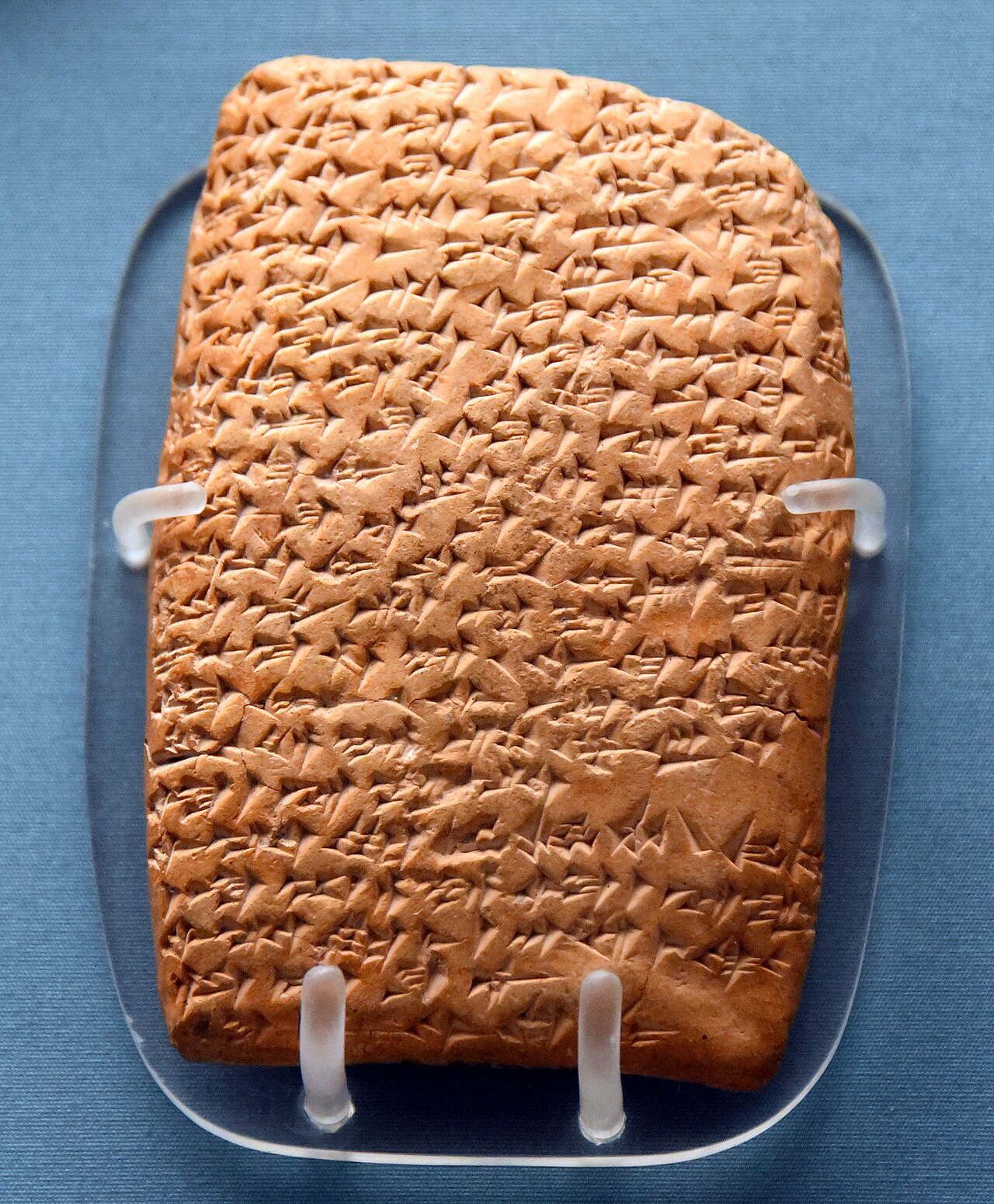
Amarna letter EA 147
- Language
- Akkadian
- Composed
- c. 1350 BC
- Oldest surviving copy
- Clay tablet from Amarna
- Status
- Not scripture
A letter from Abimilki, ruler of Tyre, praises Pharaoh in sun-hymn language, which some scholars cite as evidence that such imagery was known in Canaan (reported).
The Aten hymn was copied from the tomb of Ay at Amarna in the late 19th century. In 1909 J. H. Breasted drew attention to its resemblance to Psalm 104, and the comparison has been discussed ever since. Akhenaten's religion was suppressed after his death and his city abandoned, which is why the route by which any of its hymnody could reach Israel centuries later is the central problem.
Scholarly reconstruction
Direct literary dependence
The psalmist knew the Aten hymn, perhaps in a translation, and adapted it to the LORD.
Evidence offered: Similar sequence in Psalm 104:20–26 (night, lions, dawn, work, ships, sea creatures); the exclamation about the multitude of works.
Assessment: Possible but hard to demonstrate: no intermediate text is known and the Aten cult did not survive Akhenaten.
Scholarly reconstruction
Indirect transmission
Egyptian solar hymnody, broader and longer-lived than Akhenaten's version, influenced Canaanite and then Israelite hymns about creation.
Evidence offered: Related Egyptian hymns before and after Amarna; Egyptian influence elsewhere in Israelite wisdom (e.g. Proverbs 22–24 and the Instruction of Amenemope).
Assessment: Widely considered the most plausible form of influence; the specific route remains unknown.
Alternative explanation
Shared observation of the world
Any hymn praising a creator for day, night, animals and seasons will share themes; the similarities need no literary contact.
Evidence offered: The natural order is the same in Egypt and the Levant.
Assessment: Explains some parallels, but the specific sequence in vv. 20–26 is closer than general observation would require.
Psalm 104 shares imagery and some sequences with Egyptian sun hymnody, of which the Aten hymn is the best-known example. Its theology differs sharply: the sun is a creature that "knoweth his going down," night belongs to God as much as day, and Leviathan is God's plaything. Influence from Egyptian hymnody is plausible; direct copying from the Aten hymn is not demonstrated.
The library's Hebrew, Greek (Giguet), Latin and English agree in substance (D check). Comparisons with the Aten hymn use published translations; the site has not checked the hieroglyphic text (C check).