Psalm 104: How Manifold Are Your Works
Creation's ecology, and Leviathan at play
"Bless the LORD, O my soul. O LORD my God, thou art very great; thou art clothed with honour and majesty. Who coverest thyself with light as with a garment: who stretchest out the heavens like a curtain… who maketh the clouds his chariot: who walketh upon the wings of the wind: who maketh his angels spirits; his ministers a flaming fire: who laid the foundations of the earth, that it should not be removed for ever."
"He sendeth the springs into the valleys, which run among the hills. They give drink to every beast of the field: the wild asses quench their thirst… He causeth the grass to grow for the cattle, and herb for the service of man: that he may bring forth food out of the earth; and wine that maketh glad the heart of man, and oil to make his face to shine, and bread which strengtheneth man's heart. The trees of the LORD are full of sap; the cedars of Lebanon… where the birds make their nests: as for the stork, the fir trees are her house."
"He appointed the moon for seasons: the sun knoweth his going down. Thou makest darkness, and it is night: wherein all the beasts of the forest do creep forth. The young lions roar after their prey, and seek their meat from God. The sun ariseth… Man goeth forth unto his work and to his labour until the evening. O LORD, how manifold are thy works! in wisdom hast thou made them all: the earth is full of thy riches. So is this great and wide sea… There go the ships: there is that leviathan, whom thou hast made to play therein."
"These wait all upon thee; that thou mayest give them their meat in due season… thou takest away their breath, they die, and return to their dust. Thou sendest forth thy spirit, they are created: and thou renewest the face of the earth… I will sing unto the LORD as long as I live… Let the sinners be consumed out of the earth, and let the wicked be no more. Bless thou the LORD, O my soul. Praise ye the LORD."
The order of Genesis 1
The psalm follows roughly the order of the creation days: light (v. 2), heavens and waters (3–9), earth and plants (10–18), sun and moon (19–23), sea creatures (24–26), and the breath of life (27–30). Unlike Genesis 1 it lingers on how creation keeps working: springs, nests, night and day, food in due season.
Leviathan at play
In Psalm 74 and Job 41 Leviathan is a monster God subdues. Here, "there is that leviathan, whom thou hast made to play therein": a sea creature, perhaps a whale, frolicking in God's ocean, or, as rabbinic tradition read it, a creature God made to play with. Chaos has become one of God's creatures.
The Great Hymn to the Aten
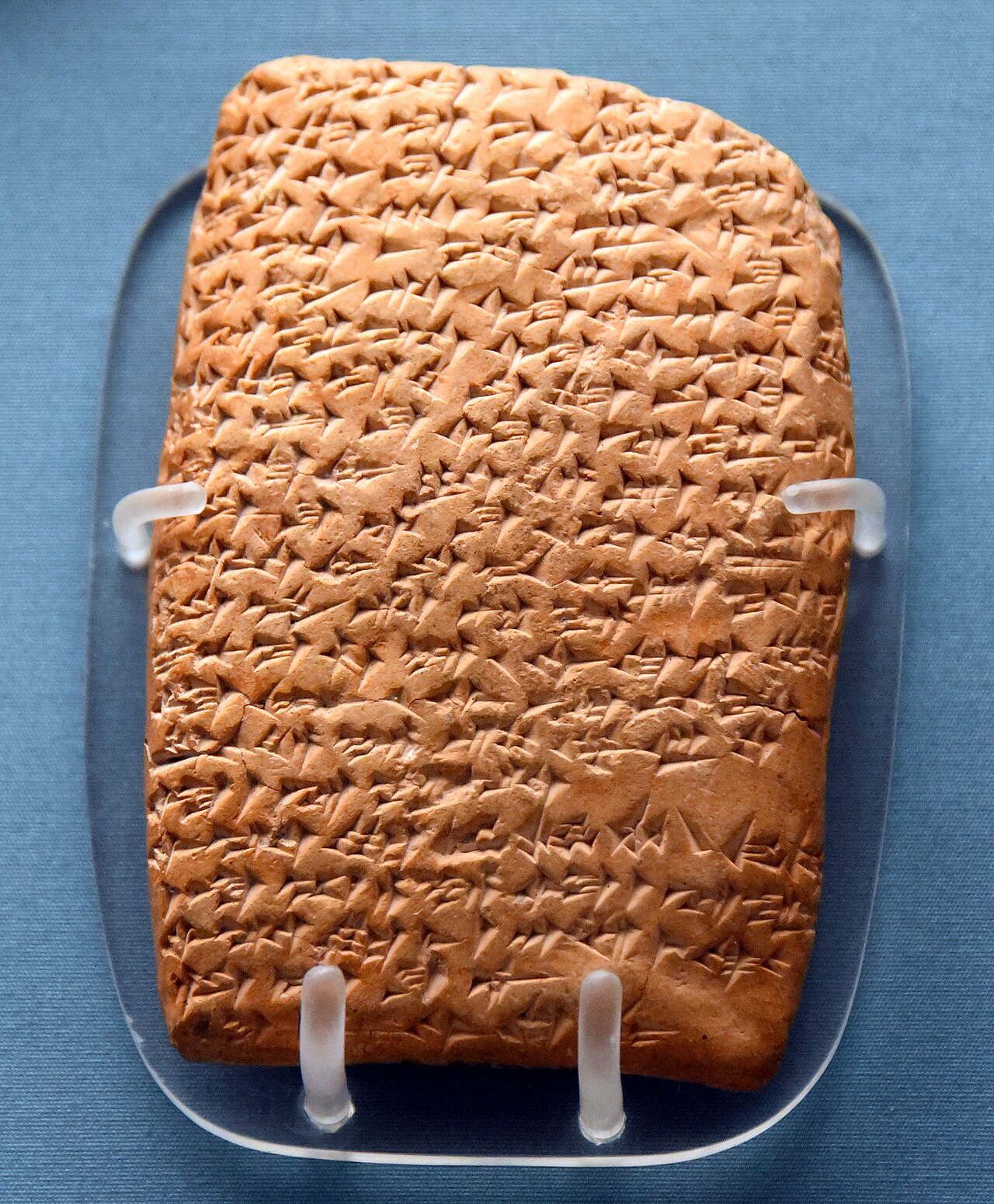
The Egyptian Great Hymn to the Aten, inscribed in the tomb of Ay at Amarna (14th century BC, the age of the Amarna letters, pictured), praises the sun-disc for creating and sustaining all life: night when "every lion comes from its den," day when people go to work, ships sailing, fish in the river. Psalm 104:20–26 shows striking similarities in content and order. Scholars debate whether the psalm drew on an Egyptian tradition transmitted over centuries or both reflect common Near Eastern themes; no direct textual dependence has been proven. The Ancient Mysteries investigation "Psalm 104 and the Great Hymn to the Aten" sets out the evidence. The psalm's God is not the sun: he "appointed the moon" and the sun "knoweth his going down."
"Maketh his angels spirits" and "Hallelujah"
104:4 can mean "who makes the winds his messengers, flames of fire his ministers" (the Hebrew mal'akh is "messenger" or "angel," ruah "wind" or "spirit"). Hebrews 1:7 quotes the Greek, "Who maketh his angels spirits," to contrast angels with the Son. The closing "Praise ye the LORD" (hallelu-yah) is the first "Hallelujah" in the Psalter (Babylonian Talmud, Berakhot 9b–10a, notes this). The Hebrew has no heading; the library's Vulgate adds "Ipsi David."
What the evidence shows
- Psalm 104 shows similarities to the Egyptian Great Hymn to the Aten.
- Psalm 104 depends directly on the Aten hymn.
- 104:35 has the first "Hallelujah" in the Psalter.
- Hebrews 1:7 quotes 104:4 from the Greek.
Continue the journey
Ancient MysteriesPsalm 104 and the Great Hymn to the AtenDid a psalm of Israel borrow from an Egyptian hymn to the sun?More from this lesson
Investigations
Optional deep dives: the ancient sources, the physical evidence, and every interpretation side by side, including unconventional ones, each labeled for what it is.
Psalm 104 and the Great Hymn to the AtenSimilar imagery and order: documented · Direct dependence: disputed · Transmission route: unknown
Did a psalm of Israel borrow from an Egyptian hymn to the sun?
Psalm 104 praises God for a world in working order: springs and grass, birds and wild goats, night when lions hunt, day when people work, ships on the sea. The Great Hymn to the Aten, carved in a tomb at Amarna under Pharaoh Akhenaten in the 14th century BC, praises the sun-disc in strikingly similar sequences. The similarities are real. Whether they show direct literary dependence, indirect transmission through later Egyptian or Canaanite hymns, or shared imagery of creation is debated, and the gap of several centuries makes direct copying hard to demonstrate.
Open the full investigation →Why this matters to the rest of Scripture
- The days of creation.
- "Canst thou draw out leviathan?"
- "Who maketh his angels spirits."