"Unto thee lift I up mine eyes, O thou that dwellest in the heavens. Behold, as the eyes of servants look unto the hand of their masters, and as the eyes of a maiden unto the hand of her mistress; so our eyes wait upon the LORD our God, until that he have mercy upon us."
"Have mercy upon us, O LORD, have mercy upon us: for we are exceedingly filled with contempt. Our soul is exceedingly filled with the scorning of those that are at ease, and with the contempt of the proud."
Watching the hand
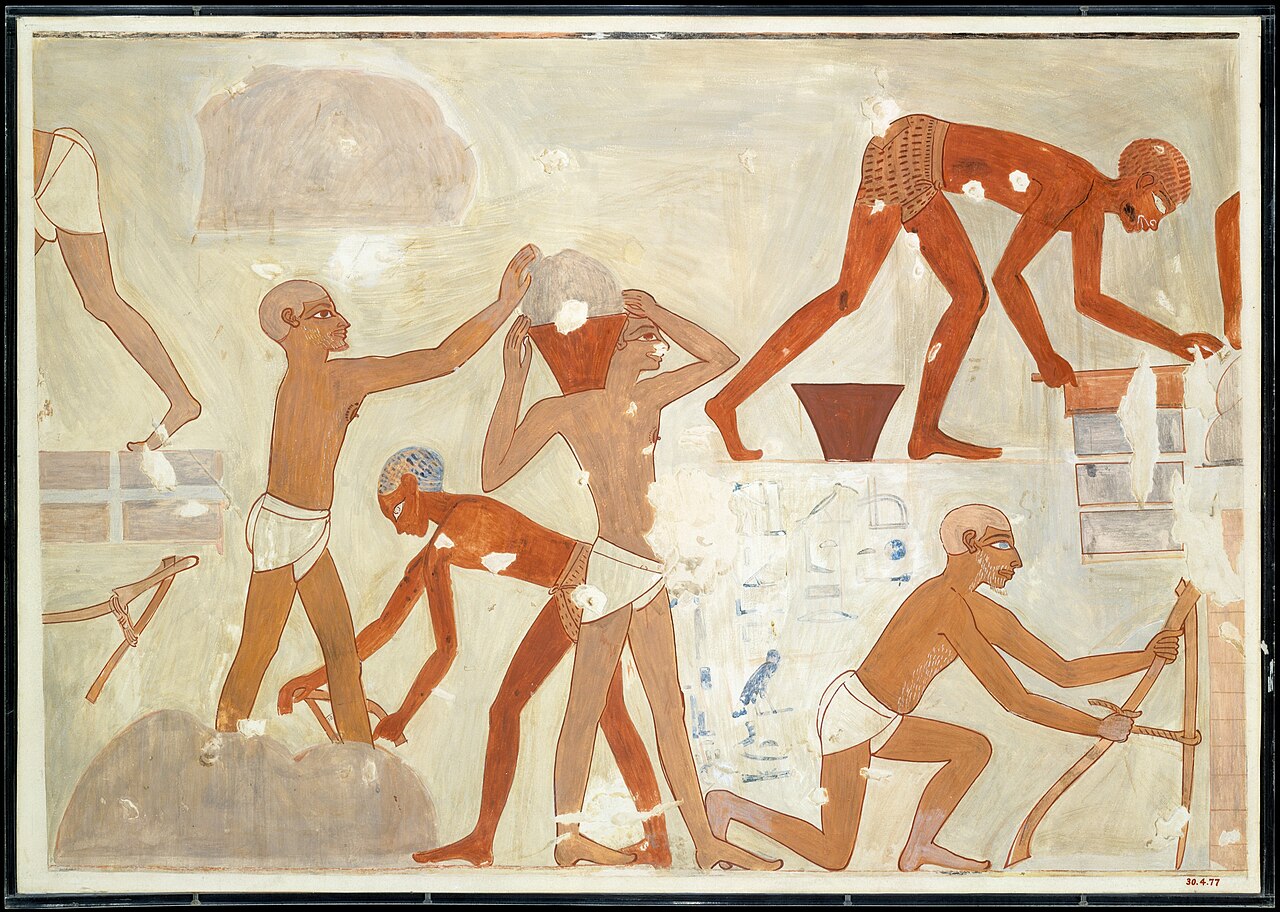
Household servants watched the hand of master or mistress for a signal: to serve, to approach, to receive. Egyptian tomb paintings show servants and labourers at work under supervision (pictured: brickmakers). The comparison expresses dependence and attentiveness, from people who are themselves despised by "those that are at ease." Modern readers may find the master–slave imagery uncomfortable; the psalm uses the social world of its time to speak of total reliance on God.
Later use
With the other Songs of Ascents it is read on winter Sabbath afternoons in many Jewish communities, and was sung at the little hours of the monastic office in Benedict's Rule.
From "I" to "we"
The psalm begins with one person ("I lift up mine eyes") and turns to the community ("our eyes," "have mercy upon us"), whose humiliation may reflect life under foreign rule after the exile (compare Nehemiah 2:19; 4:1–4). Psalms 120–134 each carry the heading "A Song of degrees" (shir ha-ma'alot, "song of the ascents"; Vulgate "Canticum graduum"). Proposals for the meaning: songs for pilgrims going up to Jerusalem; songs sung on the fifteen steps between the temple courts (the Mishnah, Middot 2:5 and Sukkah 5:4, mentions fifteen steps on which the Levites sang); songs of the return from Babylon (Ezra 7:9 calls it "the going up"); or a poetic style in which a word is picked up and repeated, step by step. The first is most widely held; none is certain.
What the evidence shows
- Psalm 123 reflects contempt suffered by the community.
Continue the journey
Connected in this bookPsalm 121: I Will Lift Up My Eyes to the HillsPsalm 121:1: "I will lift up mine eyes."More from this lesson
Why this matters to the rest of Scripture
- "I will lift up mine eyes."
- Mocked by Sanballat and Tobiah.