"Be merciful unto me, O God, be merciful unto me: for my soul trusteth in thee: yea, in the shadow of thy wings will I make my refuge, until these calamities be overpast. I will cry unto God most high; unto God that performeth all things for me. He shall send from heaven, and save me… God shall send forth his mercy and his truth."
"My soul is among lions: and I lie even among them that are set on fire, even the sons of men, whose teeth are spears and arrows, and their tongue a sharp sword. Be thou exalted, O God, above the heavens; let thy glory be above all the earth. They have prepared a net for my steps… they have digged a pit before me, into the midst whereof they are fallen themselves. Selah."
"My heart is fixed, O God, my heart is fixed: I will sing and give praise. Awake up, my glory; awake, psaltery and harp: I myself will awake early. I will praise thee, O Lord, among the people… For thy mercy is great unto the heavens, and thy truth unto the clouds. Be thou exalted, O God, above the heavens: let thy glory be above all the earth."
Waking the dawn
"I myself will awake early" is literally "I will awaken the dawn" ('a'irah shahar). Instead of waiting for morning, the singer will wake the dawn with his music. The Babylonian Talmud (Berakhot 3b–4a) tells that a lyre hung above David's bed, and at midnight the north wind played it and he rose to study, citing this verse.
Which cave?
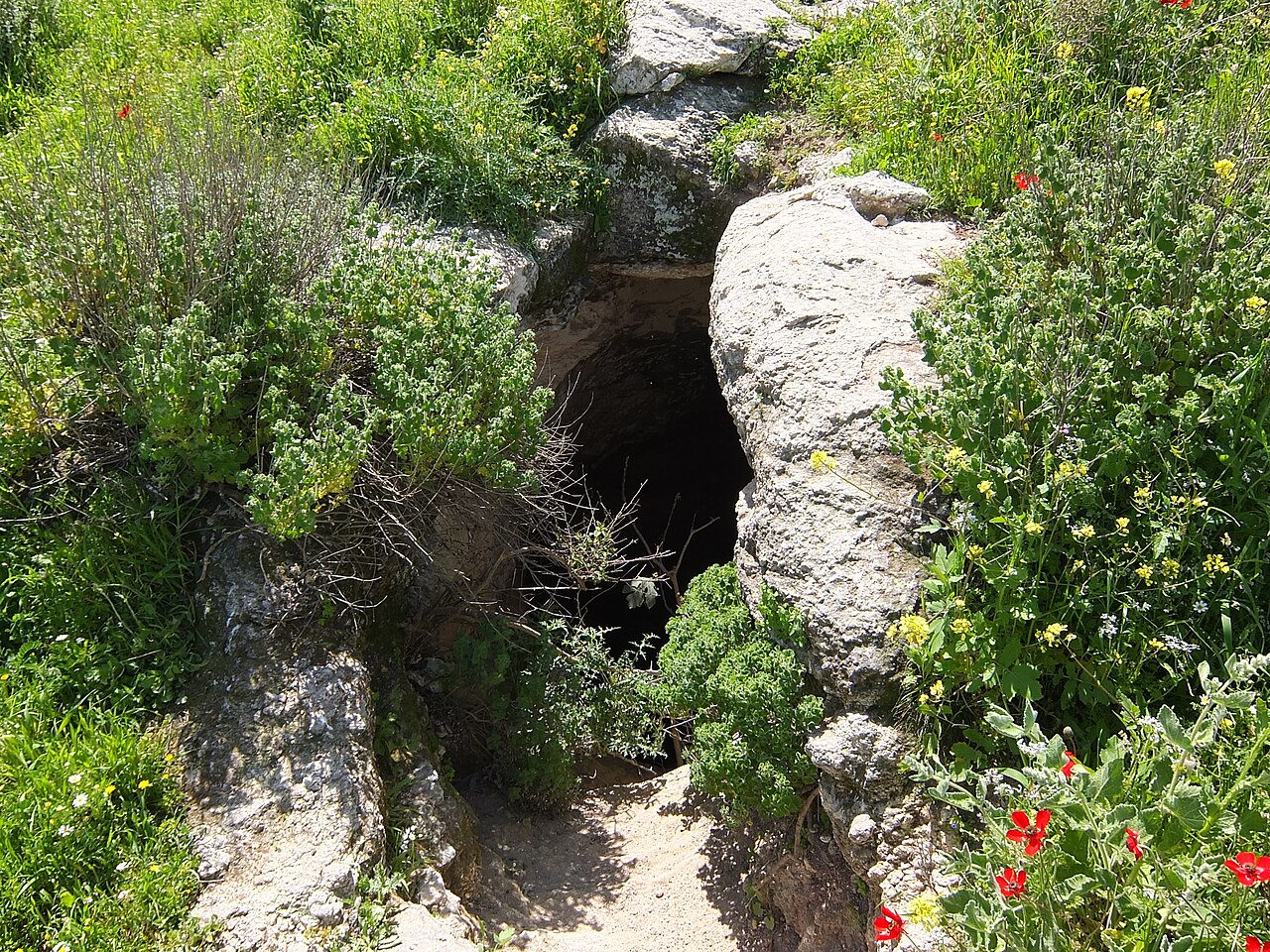
David hid in the cave of Adullam (1 Samuel 22:1, pictured) and in a cave near En-gedi, where he spared Saul (1 Samuel 24:3). The heading does not say which; the poem's lions and hunters are images, not a description of a place.
The heading
"To the chief Musician, Al-taschith, Michtam of David, when he fled from Saul in the cave." Al-tashheth, "Do not destroy," heads Psalms 57, 58, 59 and 75. It may be the opening words of a tune (Isaiah 65:8 quotes a saying, "Destroy it not, for a blessing is in it") or a prayer formula (compare Moses in Deuteronomy 9:26). The library's Vulgate translates it: "ne disperdas."
Psalm 57 and Psalm 108
Verses 7–11 reappear as Psalm 108:1–5, joined there to Psalm 60:5–12. Like Psalms 14/53 and 40/70, it is evidence that psalm units were reused to build new psalms. The site links the parallel rather than repeating it.
What the evidence shows
- 57:7–11 reappears as 108:1–5.Source: The site's library: Westminster Leningrad Codex, KJV, Clementine Vulgate (Gallican Psalter), Giguet's French of the Greek, Douay-Rheims
- The meaning of al-tashheth is known.
Continue the journey
Connected in this bookPsalm 108: A New Psalm from Two Old OnesPsalm 108:1–5: The same lines reused.More from this lesson
Why this matters to the rest of Scripture
- The same lines reused.
- David spares Saul in the cave.