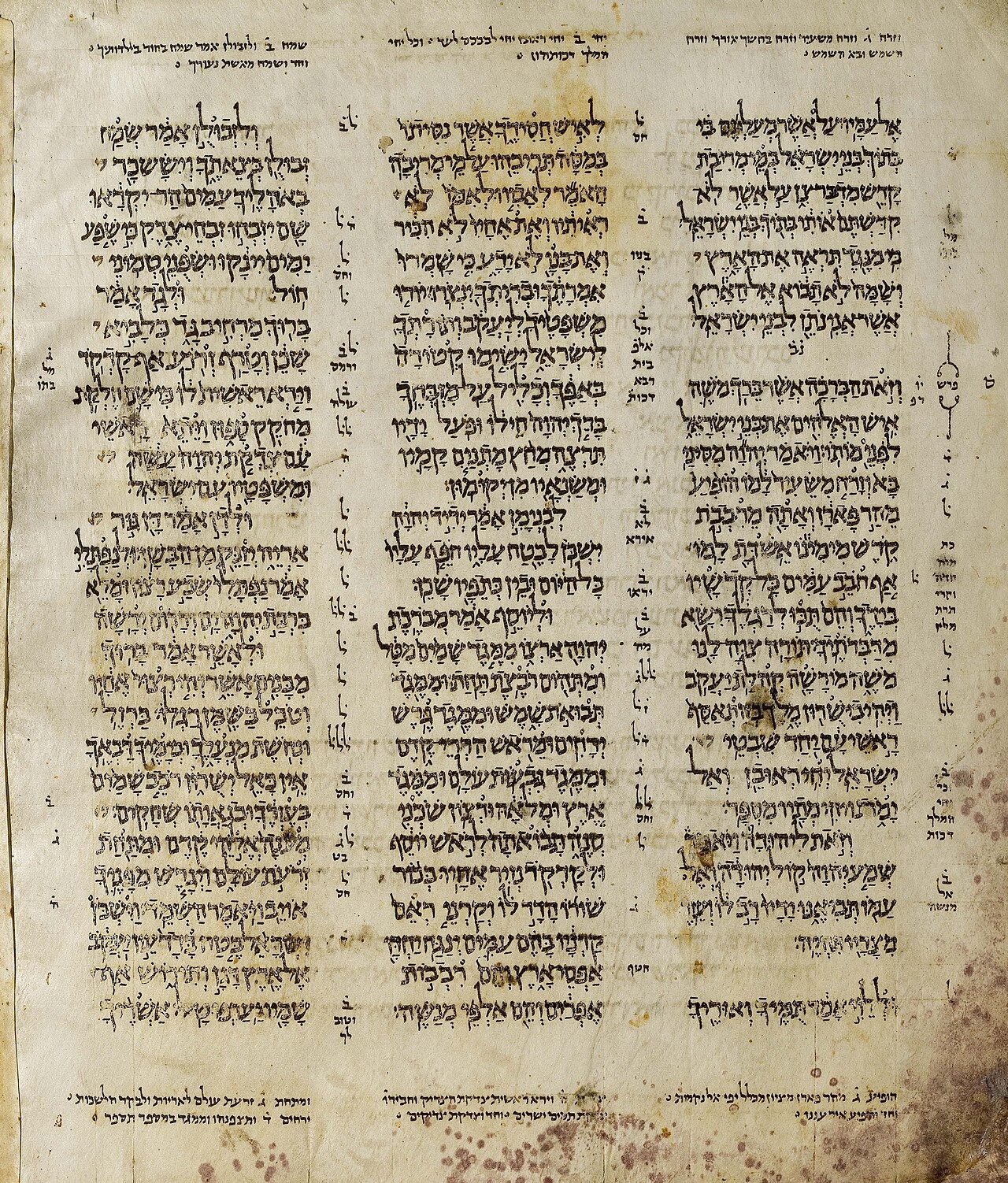
"I will praise thee, O LORD, with my whole heart; I will shew forth all thy marvellous works. I will be glad and rejoice in thee: I will sing praise to thy name, O thou most High." Each of the four lines in Hebrew begins with alef.
"When mine enemies are turned back, they shall fall and perish at thy presence. For thou hast maintained my right and my cause; thou satest in the throne judging right… The LORD also will be a refuge for the oppressed, a refuge in times of trouble. And they that know thy name will put their trust in thee."
"The heathen are sunk down in the pit that they made: in the net which they hid is their own foot taken… The wicked shall be turned into hell, and all the nations that forget God. For the needy shall not alway be forgotten: the expectation of the poor shall not perish for ever."
"Arise, O LORD; let not man prevail: let the heathen be judged in thy sight. Put them in fear, O LORD: that the nations may know themselves to be but men. Selah."
An acrostic
An acrostic poem begins each line or group of lines with successive letters of the Hebrew alphabet. In Psalm 9 the stanzas begin (in the library's Hebrew): alef (vv. 1–2), bet (3), gimel (5), he (6), vav (7–10), zayin (11), het (13), tet (15), yod (17), and kaf (18). Dalet is missing. Psalm 10 continues with lamed (10:1) and ends with qof, resh, shin and tav (10:12–17); the middle letters mem to tsade are missing or unclear. One alphabet runs across both psalms: strong evidence that 9 and 10 were once a single poem.
Muth-labben
The title "upon Muth-labben" may mean "on the death of the son" or be a tune name; some read 'al-alamot, "for young women's voices" (as in Psalm 46). The Greek has "concerning the secrets of the son" (hyper tōn kryphiōn tou huiou; Vulgate pro occultis filii). Its meaning is unknown.
One psalm or two?
The Greek and Latin number Psalms 9 and 10 as one psalm (Greek/Latin Psalm 9), and Psalm 10 has no title in Hebrew, unusual in Book I. With the shared acrostic, this suggests the two were originally one composition later divided in the Hebrew tradition. The gaps in the acrostic may come from damage in transmission or from a loose acrostic form; no Qumran fragment so far preserves the missing letters. This is why the whole Greek Psalter from 10 to 147 numbers one lower than the Hebrew.
The versions
The library's Vulgate keeps the title ("In finem, pro occultis filii. Psalmus David"); Giguet's French omits it. Because the title is Hebrew verse 1, Hebrew 9:2–21 = English 9:1–20.
In the New Testament
Paul’s speech at Athens, "he hath appointed a day, in the which he will judge the world in righteousness" (Acts 17:31), echoes the wording of 9:8 (also 96:13; 98:9). The Aramaic Targum reads the heading "Muth-labben" as "on the death of the champion," connecting the psalm with David and Goliath (reported).
What the evidence shows
- Psalms 9 and 10 share a single (incomplete) acrostic. Letters read from the WLC consonants.Source: The site's library: Westminster Leningrad Codex, KJV, Clementine Vulgate (Gallican Psalter), Giguet's French of the Greek, Douay-Rheims; Tyndale House, "The ABCs of Hebrew Acrostic Poems" (2023) ↗
- Psalms 9 and 10 were originally one poem. Shared acrostic, no title for Psalm 10, Greek and Latin numbering.
- The meaning of Muth-labben is known.
Continue the journey
Journey of a PassagePsalm 9:1–2: The first letter of a broken alphabetPsalms 9 and 10 form one alphabetic acrostic in Hebrew, and the Greek and Latin count them as one psalm (Psalm 9).More from this lesson
Why this matters to the rest of Scripture
- "Shall not the Judge of all the earth do right?": the judge of the nations.
- The second half of the acrostic.
- The pit the wicked dig.