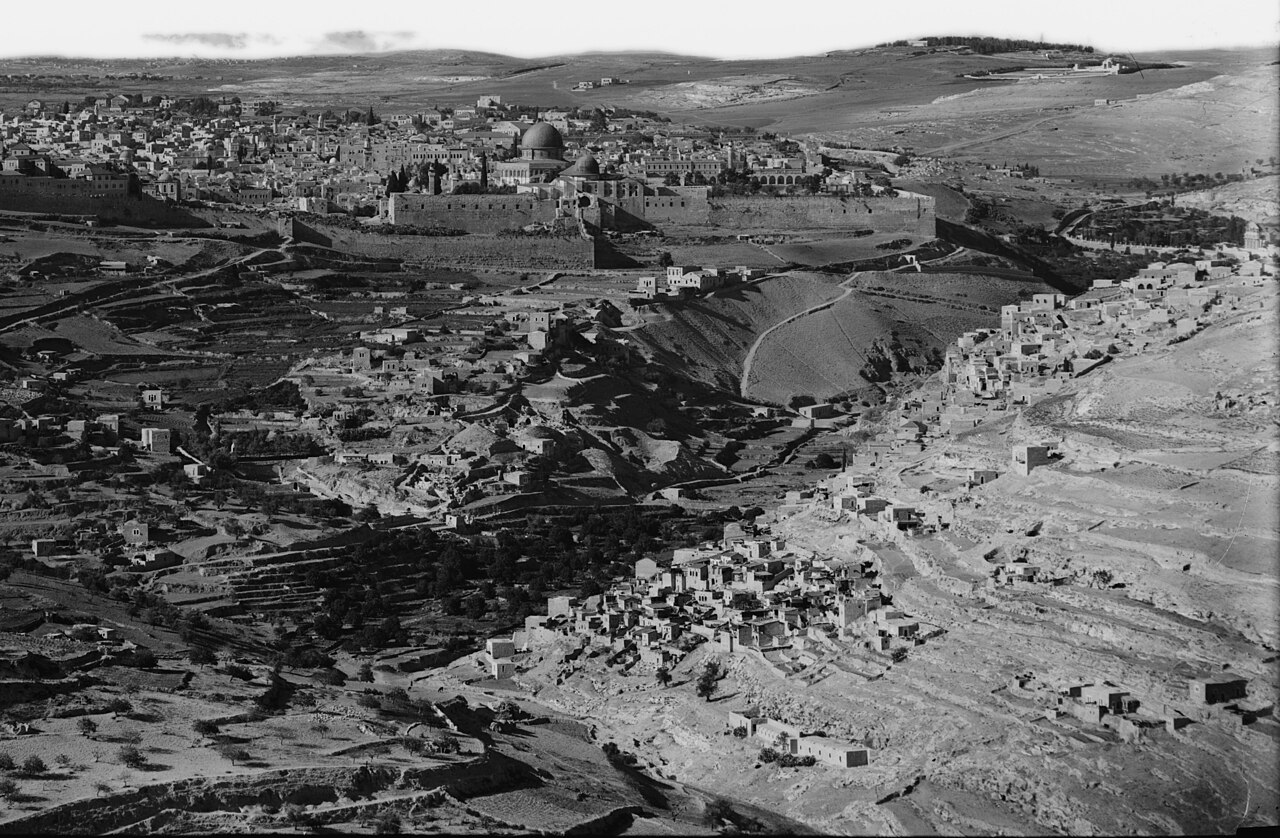
"I was glad when they said unto me, Let us go into the house of the LORD. Our feet shall stand within thy gates, O Jerusalem. Jerusalem is builded as a city that is compact together: whither the tribes go up, the tribes of the LORD, unto the testimony of Israel, to give thanks unto the name of the LORD. For there are set thrones of judgment, the thrones of the house of David."
"Pray for the peace of Jerusalem: they shall prosper that love thee. Peace be within thy walls, and prosperity within thy palaces. For my brethren and companions' sakes, I will now say, Peace be within thee. Because of the house of the LORD our God I will seek thy good."
Peace and Jerusalem
The second half plays on sounds: sha'alu shelom yerushalayim, "pray for the peace of Jerusalem"; yishlayu, "they shall prosper"; shalom, "peace"; shalvah, "prosperity." The name Jerusalem was heard as containing shalom. The city is the place of worship ("the house of the LORD") and of justice ("thrones of judgment").
Later use
Its Latin opening, Laetatus sum, is the verse of the introit for the fourth Sunday of Lent (Laetare Sunday). Hubert Parry's anthem "I was glad" (1902), set to this psalm, has been sung at British coronations since Edward VII's. Jewish pilgrims and modern visitors to Jerusalem sing "Our feet shall stand within thy gates."
Heading and music
"A Song of degrees of David." The phrase "the thrones of the house of David" may suggest a time when the dynasty ruled, or later remembrance of it. Psalms 120–134 each carry the heading "A Song of degrees" (shir ha-ma'alot, "song of the ascents"; Vulgate "Canticum graduum"). Proposals for the meaning: songs for pilgrims going up to Jerusalem; songs sung on the fifteen steps between the temple courts (the Mishnah, Middot 2:5 and Sukkah 5:4, mentions fifteen steps on which the Levites sang); songs of the return from Babylon (Ezra 7:9 calls it "the going up"); or a poetic style in which a word is picked up and repeated, step by step. The first is most widely held; none is certain. The Latin "Laetatus sum" has many settings; Hubert Parry's anthem "I was glad" (1902) is sung at British coronations.
What the evidence shows
- Psalm 122 plays on shalom and the name Jerusalem.
- David composed Psalm 122. Heading tradition.
Continue the journey
Connected elsewhere in ScriptureThe Festivals and the CourtsDeuteronomy 16:16: Three times a year all males appear before the LORD.More from this lesson
Why this matters to the rest of Scripture
- Three times a year all males appear before the LORD.
- "Walk about Zion."