Psalm 72: The Prayers of David Are Ended
Justice for the poor, and the close of Book II
"Give the king thy judgments, O God, and thy righteousness unto the king's son. He shall judge thy people with righteousness, and thy poor with judgment. The mountains shall bring peace to the people, and the little hills, by righteousness. He shall judge the poor of the people, he shall save the children of the needy, and shall break in pieces the oppressor."
"They shall fear thee as long as the sun and moon endure… He shall come down like rain upon the mown grass: as showers that water the earth. In his days shall the righteous flourish… He shall have dominion also from sea to sea, and from the river unto the ends of the earth… The kings of Tarshish and of the isles shall bring presents: the kings of Sheba and Seba shall offer gifts. Yea, all kings shall fall down before him: all nations shall serve him."
"For he shall deliver the needy when he crieth; the poor also, and him that hath no helper. He shall spare the poor and needy, and shall save the souls of the needy. He shall redeem their soul from deceit and violence: and precious shall their blood be in his sight… His name shall endure for ever… and men shall be blessed in him: all nations shall call him blessed."
"Blessed be the LORD God, the God of Israel, who only doeth wondrous things. And blessed be his glorious name for ever: and let the whole earth be filled with his glory; Amen, and Amen. The prayers of David the son of Jesse are ended."
The king as protector of the weak
Ancient Near Eastern rulers claimed to protect the vulnerable. Hammurabi's laws (c. 1750 BC) say they were set up "so that the strong might not oppress the weak, and to give justice to the orphan and the widow." Psalm 72 makes this the condition of the king's blessing: righteousness first, then rain, harvest, long life and tribute.
Tarshish, Sheba and Seba
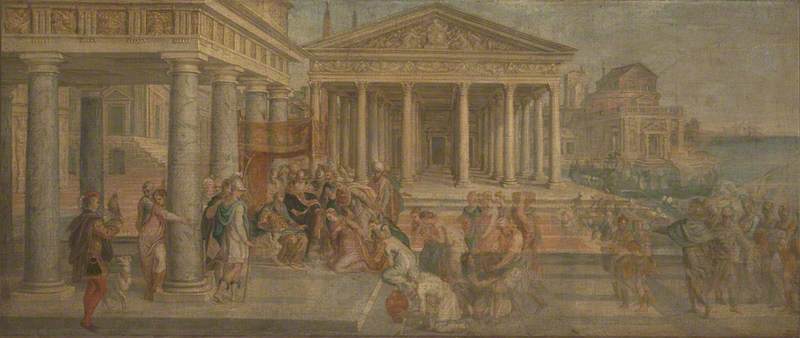
The farthest west (Tarshish, perhaps in Spain or Sardinia) and the far south (Sheba in south Arabia, Seba perhaps in Africa) bring gifts; "gold of Sheba" (v. 15) recalls the queen of Sheba's visit to Solomon (1 Kings 10, pictured in a later painting). Isaiah 60:6 and Matthew 2:11 echo the picture, and Christian liturgy uses Psalm 72 at Epiphany, the feast of the Magi.
"For Solomon"
The heading lishlomoh can mean "of/by Solomon" or "for/concerning Solomon." The Greek (eis Salōmōn) and the library's Vulgate ("Psalmus, in Salomonem") take it as "for Solomon": a prayer for the king's son (v. 1). Only Psalms 72 and 127 are headed "of Solomon."
"The prayers of David are ended"
72:20 is an editor's note, not part of the poem. It marks the end of a collection of Davidic prayers, yet Davidic psalms continue later (86, 101, 103, 108–110, 122, 124, 131, 133, 138–145). The note therefore points to an earlier, smaller Psalter that once ended here, later expanded with Books III–V. The library's Vulgate reads "Defecerunt laudes David, filii Jesse," "the praises (hymns) of David… are ended," where the Hebrew has "prayers" (tefillot); the Greek is reported to read hymnoi, "hymns." See the passage page.
The doxology
72:18–19 closes Book II, as 41:13 closed Book I. Its prayer that "the whole earth be filled with his glory" echoes Numbers 14:21 and Isaiah 6:3.
What the evidence shows
- 72:20 marks the end of an earlier Davidic collection.Source: G. H. Wilson, The Editing of the Hebrew Psalter (SBLDS 76, 1985)
- The Vulgate reads "praises" where the Hebrew of 72:20 has "prayers."Source: The site's library: Westminster Leningrad Codex, KJV, Clementine Vulgate (Gallican Psalter), Giguet's French of the Greek, Douay-Rheims
- Solomon wrote Psalm 72. The heading can mean "for Solomon."
Continue the journey
Journey of a PassagePsalm 72:20: "The prayers of David… are ended"An editor's note closes Book II: "The prayers of David the son of Jesse are ended." The Vulgate reads "the praises of David are ended" ("Defecerunt laudes David").More from this lesson
Why this matters to the rest of Scripture
- The queen of Sheba brings gold.
- "All they from Sheba shall come."
- "His dominion shall be from sea even to sea."
- The doxology closing Book I.