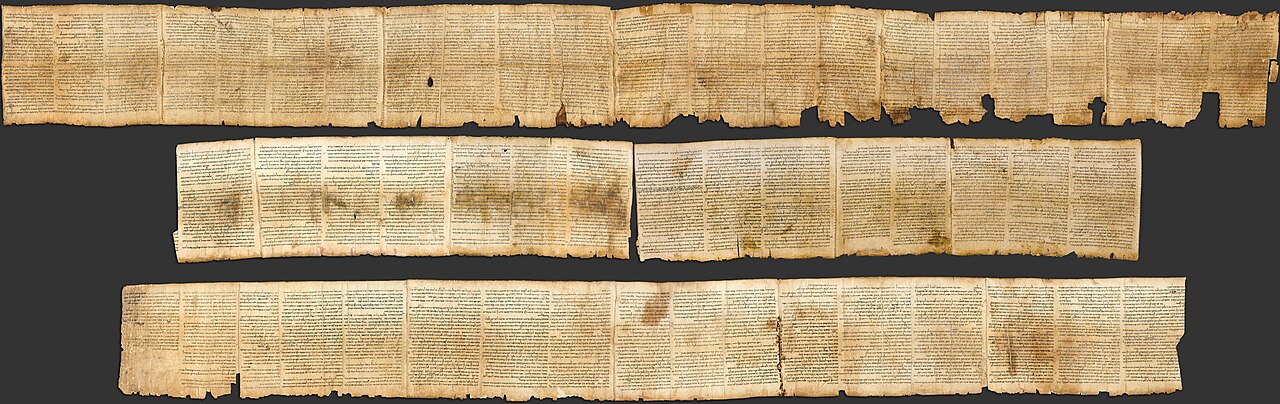
"The heavens declare the glory of God; and the firmament sheweth his handywork. Day unto day uttereth speech, and night unto night sheweth knowledge. There is no speech nor language, where their voice is not heard." The Hebrew of v. 3 can mean "there is no speech, no words; their voice is not heard": the sky speaks without sound.
"Their line is gone out through all the earth, and their words to the end of the world. In them hath he set a tabernacle for the sun, Which is as a bridegroom coming out of his chamber, and rejoiceth as a strong man to run a race… and there is nothing hid from the heat thereof."
"The law of the LORD is perfect, converting the soul: the testimony of the LORD is sure, making wise the simple. The statutes of the LORD are right, rejoicing the heart: the commandment of the LORD is pure, enlightening the eyes… More to be desired are they than gold… sweeter also than honey and the honeycomb."
"Who can understand his errors? cleanse thou me from secret faults. Keep back thy servant also from presumptuous sins… Let the words of my mouth, and the meditation of my heart, be acceptable in thy sight, O LORD, my strength, and my redeemer."
Two halves, one poem?
Part one (vv. 1–6) uses El ("God") and speaks of creation; part two (vv. 7–14) uses YHWH (seven times) and speaks of torah. Some scholars think two poems were joined; others see a deliberate design: the sun's heat searches everything (v. 6) as the torah searches the heart (v. 12). The link word is "nothing is hidden" / "hidden faults."
The sun
In Mesopotamia the sun god Shamash was the god of justice who sees everything, praised in a long Akkadian "Hymn to Shamash." In Egypt the sun was Ra or the Aten. Psalm 19 makes the sun a creature for whom God pitches a tent, a runner and bridegroom, not a god: the parallel highlights a difference.
The heading
Hebrew: "To the chief musician, a psalm of David." Lamnatseah, "to the chief musician" (or "for the director"), heads 55 psalms and appears again in Habakkuk 3:19; its meaning is uncertain. The Greek understood it as eis to telos, "to the end" (the library's Vulgate: "In finem").
"Their line" or "their voice"
19:4 Hebrew qavvam, "their line" (a measuring line). The Greek reads ho phthongos autōn, "their sound" (Vulgate sonus eorum; Giguet "leur voix"), perhaps from a Hebrew text reading qolam, "their voice," which fits the parallel "their words" better. Paul quotes the Greek in Romans 10:18 of the gospel's spread. Modern versions divide: "their line" (KJV) or "their voice" (NRSV).
A prayer that entered liturgy
19:14 is recited at the end of the Jewish Amidah (the standing prayer) and is widely used before sermons. It is one of the most-used verses of the Psalter in worship.
What the evidence shows
- The Greek reads "their sound" where the Hebrew has "their line" (19:4).Source: The site's library: Westminster Leningrad Codex, KJV, Clementine Vulgate (Gallican Psalter), Giguet's French of the Greek, Douay-Rheims
- Psalm 19 was composed as two separate poems.
Continue the journey
Journey of a PassagePsalm 19:4: "Their line" or "their voice"The Hebrew says the heavens' qav, "line" (a measuring cord), has gone out through all the earth.More from this lesson
Why this matters to the rest of Scripture
- The sun as a light God set in the heavens.
- Paul quotes 19:4 in Greek.
- The great torah psalm.