Psalm 56: Tears in God's Bottle
"What time I am afraid, I will trust in thee"
"Be merciful unto me, O God: for man would swallow me up; he fighting daily oppresseth me. Mine enemies would daily swallow me up… What time I am afraid, I will trust in thee. In God I will praise his word, in God I have put my trust; I will not fear what flesh can do unto me."
"Every day they wrest my words: all their thoughts are against me for evil. They gather themselves together, they hide themselves, they mark my steps, when they wait for my soul."
"Thou tellest my wanderings: put thou my tears into thy bottle: are they not in thy book? When I cry unto thee, then shall mine enemies turn back: this I know; for God is for me. In God will I praise his word: in the LORD will I praise his word. In God have I put my trust: I will not be afraid what man can do unto me… For thou hast delivered my soul from death: wilt not thou deliver my feet from falling, that I may walk before God in the light of the living?"
Wanderings and the wineskin
"Thou tellest my wanderings (nodi): put thou my tears into thy bottle (be-nodekha)." The two Hebrew words sound alike: God counts the fugitive's wanderings and keeps his tears in a skin bottle (nod), like precious wine or water. And they are written "in thy book": God's record (compare Exodus 32:32; Malachi 3:16).
A refrain of trust
"In God I will praise his word… I will not fear what flesh can do unto me" (v. 4) returns, expanded, in vv. 10–11. "Flesh" (basar) in the first becomes "man" ('adam) in the second.
The heading
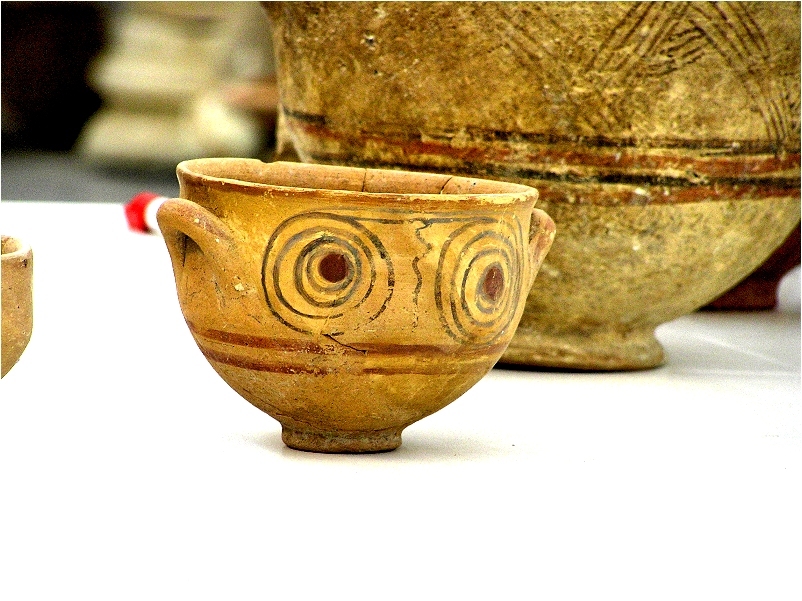
"To the chief Musician upon Jonath-elem-rechokim, Michtam of David, when the Philistines took him in Gath." Jonat 'elem rehoqim may mean "the dove of the distant terebinths" or "the silent dove of far-off places," probably a tune; its meaning is uncertain. The library's Vulgate reads "pro populo qui a sanctis longe factus est," "for the people that is far removed from the holy ones," an interpretation of the same words. 1 Samuel 21:10–15 tells of David at Gath (Philistine pottery pictured); the psalm says nothing of feigned madness.
No bottle in the Greek
In v. 8 the Greek and Latin do not have "bottle": "you have set my tears before you, as in your promise" (Vulgate "sicut et in promissione tua"; Giguet "selon votre promesse"). The translators seem to have read be-nodekha differently, perhaps as "before you," and the following words as a reference to God's promise.
"Tear bottles"
From the 18th and 19th centuries, small glass vessels found in Roman tombs were popularly called "lachrymatories" or "tear bottles" and connected with this verse, as if mourners collected their tears in them. Archaeologists identify most of them as unguentaria, flasks for perfumed oils. The reception shows how a single image of the psalm entered popular culture.
What the evidence shows
- The Greek and Latin of 56:8 lack "bottle."Source: The site's library: Westminster Leningrad Codex, KJV, Clementine Vulgate (Gallican Psalter), Giguet's French of the Greek, Douay-Rheims
- The meaning of Jonath-elem-rechokim is known.
Continue the journey
Connected elsewhere in ScriptureNob, the Holy Bread and Gath1 Samuel 21:10–15: David at Gath.More from this lesson
Why this matters to the rest of Scripture
- David at Gath.
- "A book of remembrance was written before him."
- "I will not fear what man shall do unto me" (from Psalm 118:6).