Investigation: Alphabetic Poems
Nine acrostics, their gaps, and Psalm 119's 22 stanzas
Alphabetic poetry is a discipline and a delight: a poet works through the whole alphabet, as if to say everything "from alef to tav." Lamentations 1–4 and Proverbs 31:10–31 are also acrostics; Nahum 1 may contain a partial one. Babylonian poets made acrostics too, spelling out names or sentences rather than the alphabet (the Babylonian Theodicy spells "I, Saggil-kinam-ubbib, the incantation priest, am adorant of the god and the king").
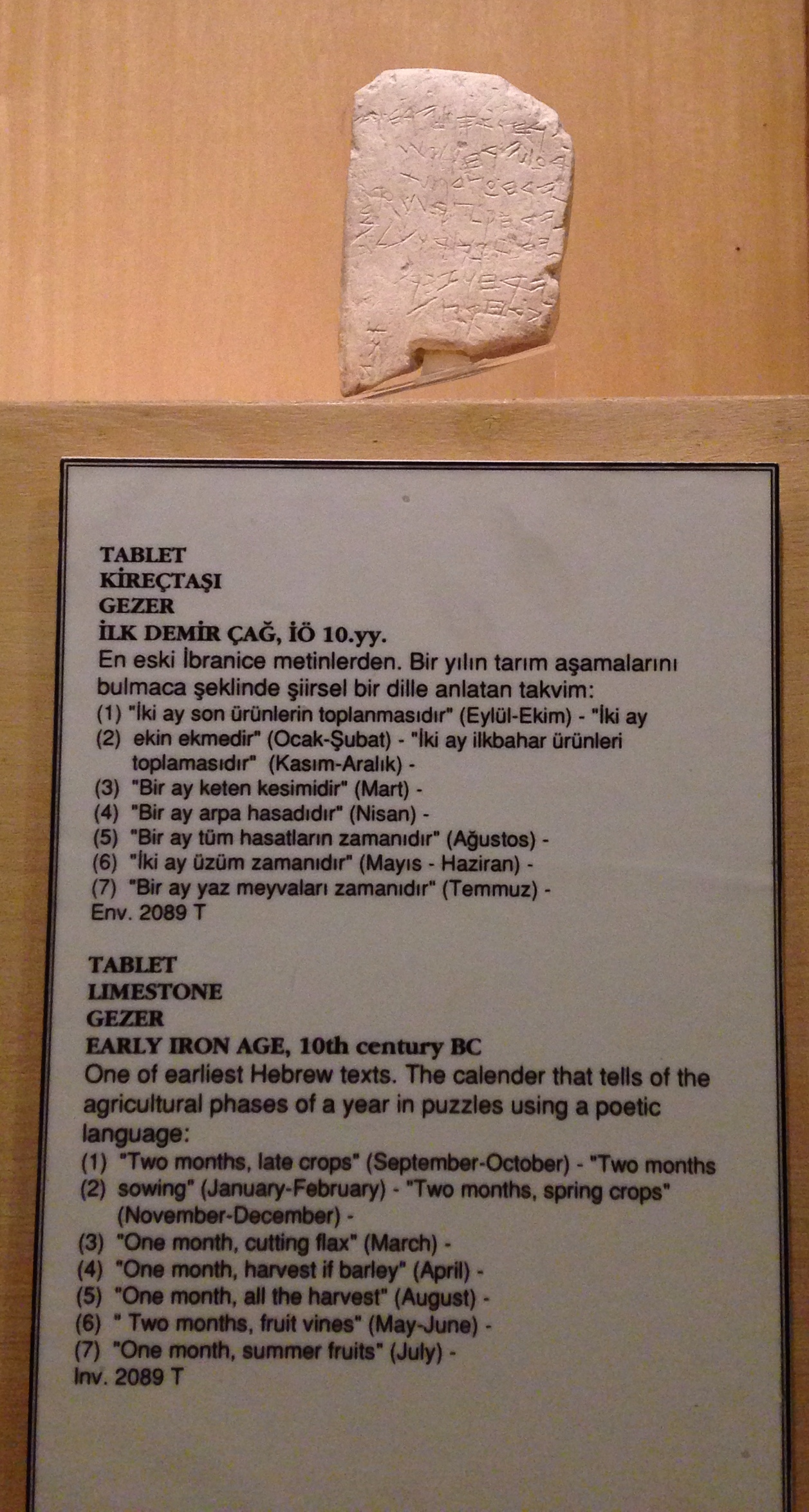
The Hebrew alphabet itself is old: the Gezer Calendar (10th century BC, the image above) is written in early Hebrew-Phoenician letters, and alphabet practice lists (abecedaries) from Israelite sites, such as the 'Izbet Sartah ostracon and inscriptions at Kuntillet 'Ajrud, show students copying the letters in order. A poem built on the alphabet is a poem built on how people learned to write.
In the site's reader, open Psalm 119 in the Hebrew (WLC) or any English edition: each of the 22 stanzas is marked with its letter, and in the Hebrew the first letter of every verse is highlighted, so the structure can be seen as well as described.
| Psalm | Unit | Initial letters in the library's Hebrew | Irregularities |
|---|---|---|---|
| 9–10 | Pairs of verses | Alef to kaf in 9; lamed in 10:1; qof–tav in 10:12–17 | Dalet missing; mem to tsade missing or unclear; split into two psalms in Hebrew |
| 25 | Verse | Alef to tav | No vav, no qof (resh twice); extra final pe line (v. 22) |
| 34 | Verse | Alef to tav | No vav; extra final pe line (v. 22) |
| 37 | Two-verse stanza | Alef (37:1, second word) to tav | The ayin stanza (v. 28) begins with kaf in the Masoretic Text; tav stanza (v. 39) begins with the conjunction vav before tav |
| 111 | Half-line | 22 half-lines, alef to tav | Complete |
| 112 | Half-line | 22 half-lines, alef to tav | Complete; shares phrases with 111 |
| 119 | 8-verse stanza | 22 × 8 = 176 verses, each verse beginning with its stanza's letter | Complete (checked for all 176 verses) |
| 145 | Verse | Alef to tav | No nun line in the Masoretic Text (present in Qumran, Greek, Syriac) |
Psalm 119, letter by letter
Alef (1–8), bet (9–16), gimel (17–24), dalet (25–32), he (33–40), vav (41–48), zayin (49–56), het (57–64), tet (65–72), yod (73–80), kaf (81–88), lamed (89–96), mem (97–104), nun (105–112: "Thy word is a lamp unto my feet"), samekh (113–120), ayin (121–128), pe (129–136), tsade (137–144), qof (145–152), resh (153–160), shin (161–168), tav (169–176). Almost every verse also names God's word with one of eight terms (torah, edut, piqqudim, chuqqim, mitsvah, mishpat, davar, imrah). The King James Bible prints the letter names (ALEPH, BETH…) above the stanzas, a reminder of the Hebrew structure.
Never faking a letter
The site reads acrostics only from Hebrew. An English translation cannot show them, and nobody should "find" a letter by translating an English line back into Hebrew. Where the Masoretic Text has a gap, the site says so and shows what other witnesses read; it does not silently fill it.
What gaps can mean
A missing or misplaced letter may be (1) damage in transmission (a line lost by a copyist's eye skipping, as many suggest for 145's nun), (2) a looser poetic form in which the alphabet guides but does not bind (often suggested for 9–10), or (3) a deliberate effect: the extra pe lines of 25 and 34, both about redemption (padah), may mark the ending, and some find a spelled word (alef + lamed + pe, the first, middle and last letters) at work. Each explanation must be argued case by case. Restoring a missing line requires actual textual evidence, as at 145:13; no Qumran fragment has yet supplied the missing letters of 9–10 (C check).
Why acrostics?
Suggested purposes: as an aid to memory; as a sign of completeness (praise or lament "from A to Z"); as a teaching form for young scribes; as artful constraint. Many acrostics are wisdom or praise psalms, often thought to be late (post-exilic) compositions, but the form itself is old.
In Jewish and Christian practice
Psalm 145 (Ashrei) is recited three times daily in Jewish prayer. Psalm 119 is recited in sections in some traditions for the sick or the dying, by the letters of a person's name. In Christian monastic offices Psalm 119 (Greek and Latin 118) was divided across the day hours. The Greek and Latin Psalters, with no Hebrew letters, lost the visible acrostic, though some Latin manuscripts and the King James Bible print the Hebrew letter names.
What the evidence shows
- Every verse of Psalm 119 begins with its stanza's letter in the library's Hebrew. Checked for all 176 verses.Source: The site's library: Westminster Leningrad Codex, KJV, Clementine Vulgate (Gallican Psalter), Giguet's French of the Greek, Douay-Rheims
- Psalm 145 has no nun line in the Masoretic Text.Source: The site's library: Westminster Leningrad Codex, KJV, Clementine Vulgate (Gallican Psalter), Giguet's French of the Greek, Douay-Rheims
- Psalms 25 and 34 both lack vav and end with an extra pe line.Source: The site's library: Westminster Leningrad Codex, KJV, Clementine Vulgate (Gallican Psalter), Giguet's French of the Greek, Douay-Rheims; Tyndale House, "The ABCs of Hebrew Acrostic Poems" (2023) ↗
- Psalms 9 and 10 share one incomplete acrostic.Source: The site's library: Westminster Leningrad Codex, KJV, Clementine Vulgate (Gallican Psalter), Giguet's French of the Greek, Douay-Rheims; Tyndale House, "The ABCs of Hebrew Acrostic Poems" (2023) ↗
- The gaps in the acrostics were caused by scribal loss. Possible for some; others may be poetic freedom or design.
Continue the journey
Journey of a PassagePsalm 145:13: The missing nun linePsalm 145 is an alphabetic acrostic: in the Hebrew each verse begins with the next letter of the alphabet.More from this lesson
Why this matters to the rest of Scripture
- Four acrostic laments.
- The capable woman, an acrostic.
- Read it in the reader with its 22 stanzas marked.