Psalm 74: The Sanctuary in Ruins
Axes in the temple, and the God who broke Leviathan
"O God, why hast thou cast us off for ever? why doth thine anger smoke against the sheep of thy pasture? Remember thy congregation, which thou hast purchased of old… this mount Zion, wherein thou hast dwelt. Lift up thy feet unto the perpetual desolations; even all that the enemy hath done wickedly in the sanctuary."
"Thine enemies roar in the midst of thy congregations; they set up their ensigns for signs. A man was famous according as he had lifted up axes upon the thick trees. But now they break down the carved work thereof at once with axes and hammers. They have cast fire into thy sanctuary… They said in their hearts, Let us destroy them together: they have burned up all the synagogues of God in the land. We see not our signs: there is no more any prophet: neither is there among us any that knoweth how long."
"For God is my King of old, working salvation in the midst of the earth. Thou didst divide the sea by thy strength: thou brakest the heads of the dragons in the waters. Thou brakest the heads of leviathan in pieces, and gavest him to be meat to the people inhabiting the wilderness… The day is thine, the night also is thine… Thou hast set all the borders of the earth: thou hast made summer and winter."
"Remember this, that the enemy hath reproached, O LORD… O deliver not the soul of thy turtledove unto the multitude of the wicked… Have respect unto the covenant… Arise, O God, plead thine own cause: remember how the foolish man reproacheth thee daily."
Which destruction?
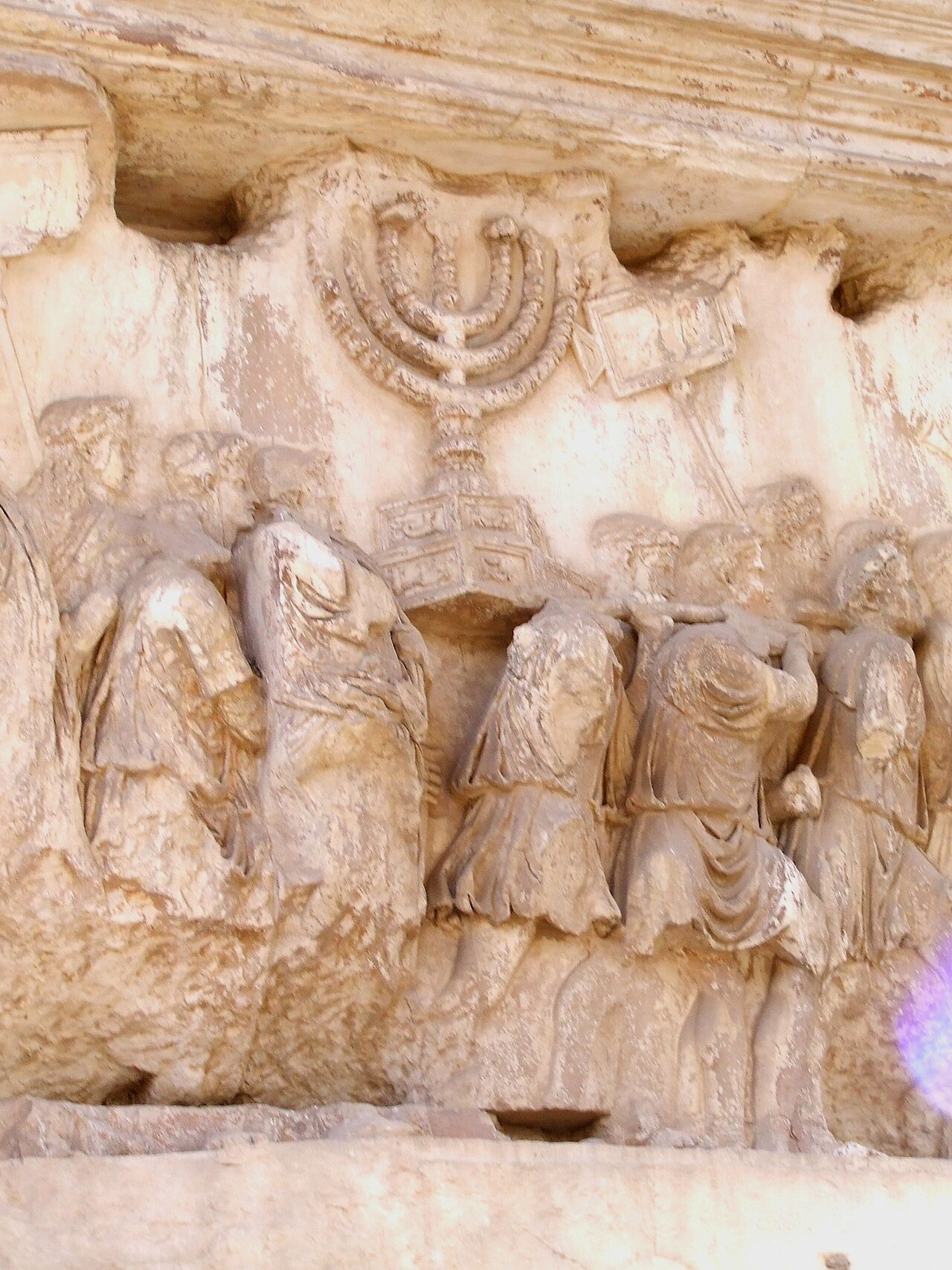
The psalm describes the temple burned and its carved panelling smashed. The Babylonian destruction of 587/586 BC (2 Kings 25:9) is the most commonly proposed setting. Others propose the desecration under Antiochus IV in 167 BC, when the temple was profaned but not burned down, or other attacks. The Arch of Titus (pictured) records a later destruction still, in AD 70, which Jewish tradition came to mourn together with the first; the psalm itself names no enemy.
Leviathan and the sea
Verses 13–17 recall God's victory over the sea and its monsters: "the dragons" (tanninim) and Leviathan with many heads. Ugaritic poems describe Baal (and Anat) defeating Litan, "the twisting serpent… the seven-headed one." The psalm uses this shared imagery for God's creation and his parting of the sea at the exodus, and asks him to act again. See also Isaiah 27:1 and Job 41.
"Synagogues" or "meeting places"
74:8 mo'ade-el means "meeting places of God" or "appointed feasts of God." The KJV's "synagogues" fits a later period, when synagogues existed, and some scholars use the verse to argue for a Maccabean date; others read "meeting places" of any period. The library's Greek and Latin read "feasts" (Vulgate "Quiescere faciamus omnes dies festos Dei a terra"; Giguet "abolissons… les fêtes du Seigneur").
"No more any prophet"
74:9 laments the absence of prophets and signs. 1 Maccabees 4:46, 9:27 and 14:41 also speak of a time when no prophet appeared, which supports the Maccabean proposal for some readers; the complaint would also fit the exile (Lamentations 2:9). The date remains open.
The heading
"Maschil of Asaph." Asaph was a Levite singer appointed under David according to 1 Chronicles 16:5–7 and 25:1–2; 2 Chronicles 29:30 calls him "the seer." Twelve psalms carry his name (50 and 73–83). "The sons of Asaph" were still a guild of temple singers after the exile (Ezra 2:41), so the heading probably names a guild and its collection rather than one poet.
What the evidence shows
- Psalm 74 laments a destruction of the temple by fire.
- Psalm 74 refers to the destruction of 587/586 BC. Most common proposal; a Maccabean setting is also argued.
- The Greek/Latin read "feasts" in 74:8.Source: The site's library: Westminster Leningrad Codex, KJV, Clementine Vulgate (Gallican Psalter), Giguet's French of the Greek, Douay-Rheims
Continue the journey
Journey of a PassagePsalm 74:8: "Synagogues of God" or "feasts of God"Hebrew mo'ade-el: "the meeting places (or appointed times) of God." The KJV has "synagogues"; the Greek and Latin read "feasts" (Vulgate "dies festos Dei").More from this lesson
Why this matters to the rest of Scripture
- The house of the LORD burned.
- "Her prophets also find no vision."
- "Leviathan the piercing serpent."