Psalm 89: Where Are Your Former Mercies?
The covenant with David, and its collapse; the close of Book III
"I will sing of the mercies of the LORD for ever: with my mouth will I make known thy faithfulness to all generations… I have made a covenant with my chosen, I have sworn unto David my servant, Thy seed will I establish for ever, and build up thy throne to all generations. Selah."
"And the heavens shall praise thy wonders, O LORD… in the congregation of the saints. For who in the heaven can be compared unto the LORD?… Thou rulest the raging of the sea… Thou hast broken Rahab in pieces… The north and the south thou hast created them: Tabor and Hermon shall rejoice in thy name."
"Then thou spakest in vision to thy holy one, and saidst, I have laid help upon one that is mighty… I have found David my servant; with my holy oil have I anointed him… He shall cry unto me, Thou art my father… Also I will make him my firstborn, higher than the kings of the earth… If his children forsake my law… Then will I visit their transgression with the rod… Nevertheless my lovingkindness will I not utterly take from him… Once have I sworn by my holiness that I will not lie unto David."
"But thou hast cast off and abhorred, thou hast been wroth with thine anointed. Thou hast made void the covenant of thy servant: thou hast profaned his crown by casting it to the ground… Thou hast made his glory to cease, and cast his throne down to the ground… How long, LORD? wilt thou hide thyself for ever?… Lord, where are thy former lovingkindnesses, which thou swarest unto David in thy truth?… Blessed be the LORD for evermore. Amen, and Amen."
The promise retold
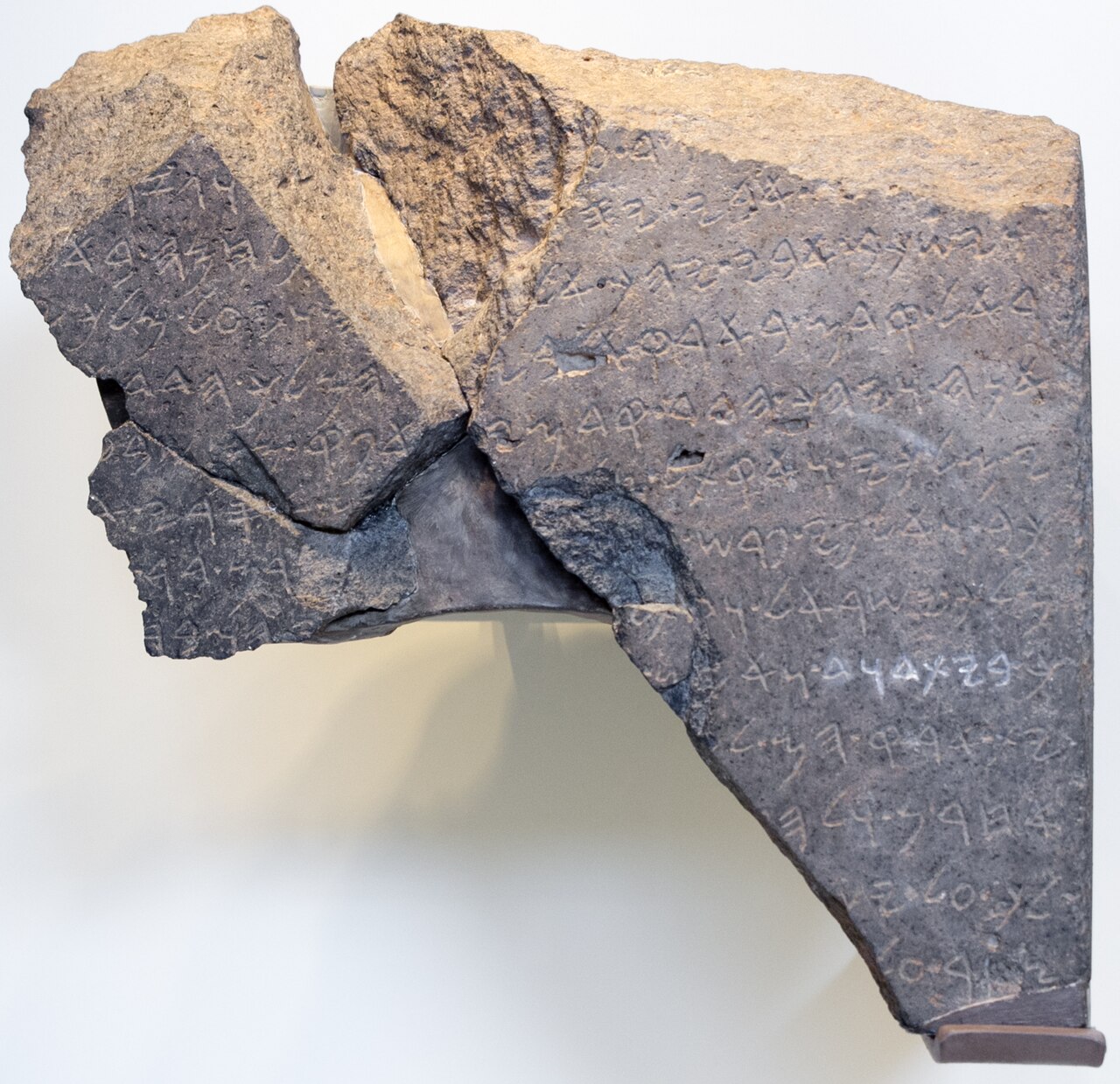
Verses 19–37 retell Nathan's oracle in 2 Samuel 7: an everlasting dynasty, a father–son relationship, discipline "with the rod" for disobedience, but steadfast love never withdrawn. The psalm intensifies it: the king will be God's "firstborn," the highest of earthly kings. The Tel Dan stele (pictured, 9th century BC) mentions the "House of David," the oldest known reference outside the Bible to David's dynasty.
The collapse
Verses 38–51 describe the king defeated, his crown in the dust, his walls broken, his youth cut short. The most common proposal is the fall of Jerusalem and Jehoiachin's or Zedekiah's end in 597–586 BC; other proposals include 701 BC or a ritual humiliation. The text names no king.
The heading
"Maschil of Ethan the Ezrahite." Ethan is named with Heman (Psalm 88) among the wise in 1 Kings 4:31; Chronicles also lists an Ethan among David's musicians (1 Chronicles 15:17, 19). Psalms 88 and 89, by the two Ezrahites, close Book III in darkness and protest.
Council and sea
"The congregation of the holy ones" (v. 5–7) is the divine council of Psalm 82; the victory over the sea and Rahab (vv. 9–10) is the combat imagery of Psalm 74. God's power over cosmic chaos is the ground of the promise to David, which makes the king's defeat all the more inexplicable.
Setting and date are different questions
The situation the poem describes (a Davidic king defeated, his crown cast down) is one question; when the poem, or each of its three parts, was composed is another. The setting most often proposed is 597–586 BC; the hymn and oracle sections could be older and the lament added after a disaster. See the investigation "Psalm 89: The Promise to David and the Fall of the Monarchy."
The end of Book III
89:52 is the doxology closing Book III, as 41:13 and 72:18–19 closed Books I and II. Gerald Wilson argued that the Psalter's editors placed Psalm 89's crisis of the Davidic covenant at the seam, and answered it in Book IV, which begins with Moses (Psalm 90) and proclaims "The LORD reigneth" (Psalms 93–99). Revelation 1:5 ("the first begotten of the dead, and the prince of the kings of the earth") echoes 89:27, 37.
In the versions
The library's witnesses agree in substance (D check). The Vulgate's opening, "Misericordias Domini in aeternum cantabo," became a frequent text in Latin liturgy and Christian art. In the Hebrew the heading takes verse 1, so the psalm runs one verse ahead of English.
What the evidence shows
- 89:19–37 retells the promise of 2 Samuel 7.
- Psalm 89 laments the fall of the Davidic monarchy in 586 BC.
- The Psalter's editors placed Psalm 89 deliberately at the end of Book III.Source: G. H. Wilson, The Editing of the Hebrew Psalter (SBLDS 76, 1985)
Continue the journey
Journey of a Passage1 Chronicles 17:13–14: The covenant without the "rod of men"2 Samuel 7:14–16 promises David's son discipline "with the rod of men" if he sins, and speaks of "thy house and thy kingdom." 1 Chronicles 17:13–14 omits the warning and reads "mine house and my kingdom."More from this lesson
Investigations
Optional deep dives: the ancient sources, the physical evidence, and every interpretation side by side, including unconventional ones, each labeled for what it is.
The "House of David" on the Tel Dan SteleInscription: documented · Reading "House of David": widely accepted · Events of David's own reign: not recorded
Does an inscription outside the Bible name David's dynasty?
Fragments of a basalt victory stele found at Tel Dan in 1993–1994 record an Aramaean king, probably Hazael (c. 840 BC), boasting of killing a king of Israel and a king of the "House of David" (bytdwd). Most scholars accept the reading. It is the earliest undisputed mention of David's dynasty outside the Bible, about 150 years after David.
Open the full investigation →Psalm 89: The Promise to David and the Fall of the MonarchyLink to 2 Samuel 7: documented · Setting in 586 BC: plausible · Composition date: unknown
What does Psalm 89 describe, and when was it written?
Psalm 89 recites God's oath that David's line will last "as the days of heaven," then laments a king whose crown is in the dust, walls broken, youth cut short: "Thou hast made void the covenant of thy servant." Two questions must be kept apart: the situation the poem describes (a defeated Davidic king), and the date the poem, or its parts, were composed. The fall of Jerusalem in 597–586 BC is the most common setting proposed; other proposals exist, and the psalm may combine older material with a later lament.
Open the full investigation →After the Fall of the King: Book IV and "The LORD Reigneth"The pattern: documented · Deliberate editorial design: supported but debated
Was Book IV of the Psalms arranged as an answer to the collapse of David's dynasty?
Book III ends with Psalm 89 asking where God's promises to David have gone. Book IV (Psalms 90–106) begins with the only psalm headed "of Moses," proclaims again and again that "the LORD reigneth" (93, 96, 97, 99), recalls Moses and the wilderness (90, 95, 99, 103, 105, 106), and ends with a prayer to be gathered from among the nations. Many scholars, following Gerald Wilson, read this as a deliberate editorial answer to the exile: the Davidic king has fallen, but the LORD is still King, as he was in Moses' time before there were kings. The individual psalms are older and varied; the argument concerns their arrangement.
Open the full investigation →Why this matters to the rest of Scripture
- Nathan's oracle to David.
- Book IV begins with Moses.
- "The prince of the kings of the earth."