Psalm 46: God Is Our Refuge and Strength
A river in the city, and "be still"
"God is our refuge and strength, a very present help in trouble. Therefore will not we fear, though the earth be removed, and though the mountains be carried into the midst of the sea; though the waters thereof roar and be troubled, though the mountains shake with the swelling thereof. Selah."
"There is a river, the streams whereof shall make glad the city of God, the holy place of the tabernacles of the most High. God is in the midst of her; she shall not be moved: God shall help her, and that right early. The heathen raged, the kingdoms were moved: he uttered his voice, the earth melted. The LORD of hosts is with us; the God of Jacob is our refuge. Selah."
"Come, behold the works of the LORD, what desolations he hath made in the earth. He maketh wars to cease unto the end of the earth; he breaketh the bow, and cutteth the spear in sunder; he burneth the chariot in the fire. Be still, and know that I am God: I will be exalted among the heathen, I will be exalted in the earth. The LORD of hosts is with us; the God of Jacob is our refuge. Selah."
A river where there is none
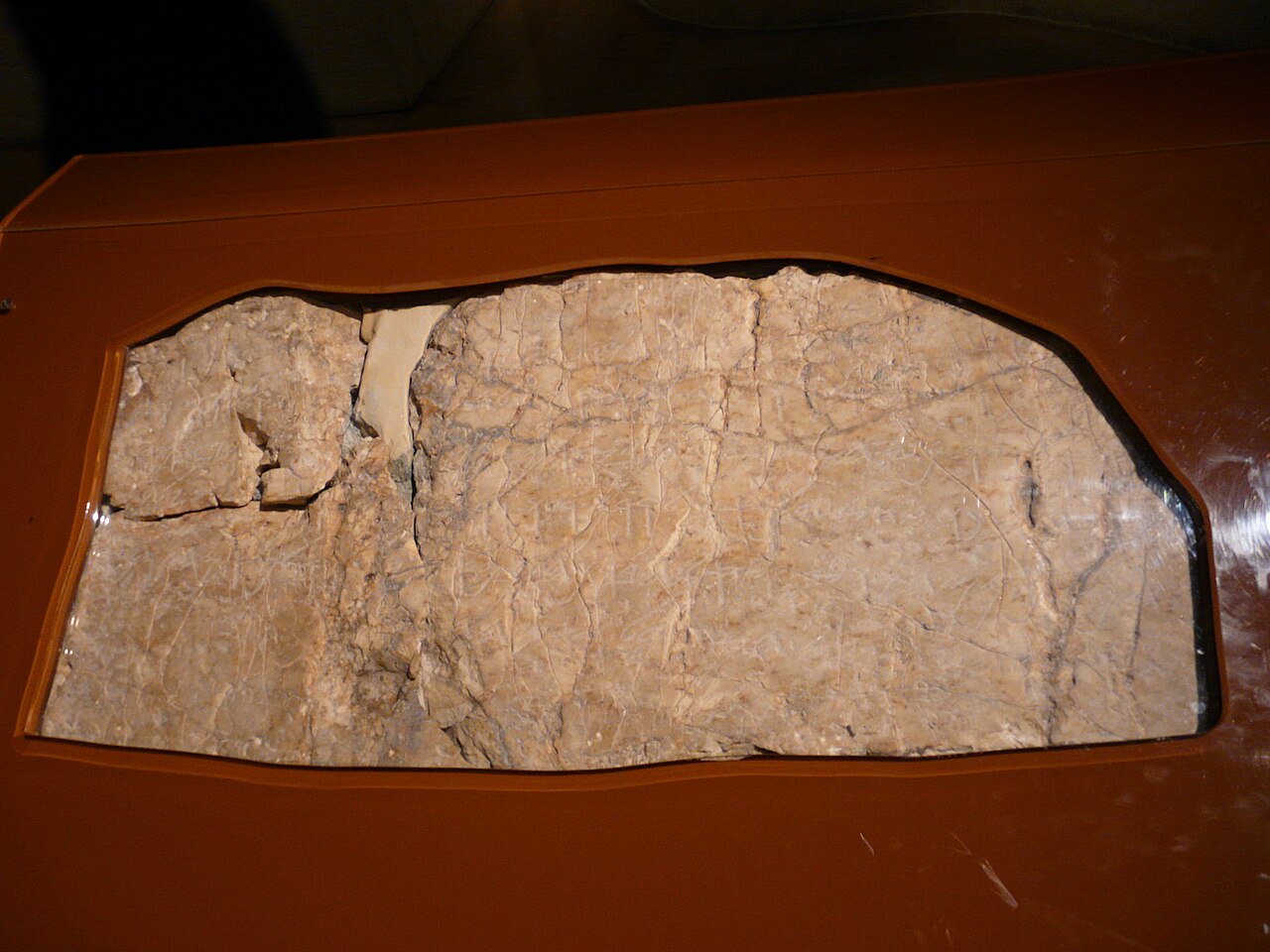
Jerusalem has no river. Its water came from the Gihon spring, brought into the city through tunnels such as Hezekiah's (the Siloam inscription, pictured, records its cutting). The psalm's river belongs to the picture of Zion as God's mountain, the source of life, developed in Ezekiel 47 and Revelation 22:1–2. The roaring sea of v. 3 and the gentle river of v. 4 are deliberate opposites.
Three stanzas and a refrain
The poem has three stanzas (vv. 1–3, 4–7, 8–11), the last two ending with the refrain. Many scholars think the refrain once followed v. 3 as well, where a selah stands without it.
The heading
"To the chief Musician for the sons of Korah, A Song upon Alamoth." 'Alamot means "young women"; 1 Chronicles 15:20 has musicians playing "with psalteries on Alamoth," perhaps a high register or soprano voices. The library's Vulgate reads "pro arcanis," "for the hidden things," the Greek having read 'alumot, "secrets." The meaning is uncertain.
"Be still"
Harpu (46:10) means "let go, stop, desist." In context it is addressed to the warring nations: "Stop fighting, and know that I am God." The verse has become a call to inner quiet, which is a later application. The library's Vulgate has "Vacate" ("be free, take leisure"), Giguet "Restez en paix."
"Ein feste Burg"
Martin Luther's hymn "Ein feste Burg ist unser Gott" ("A mighty fortress is our God," c. 1529) is a free paraphrase of Psalm 46. Earlier, the psalm's Zion confidence was connected by many interpreters with Jerusalem's deliverance from Sennacherib in 701 BC (2 Kings 19); the psalm itself names no event.
What the evidence shows
- Luther's "Ein feste Burg" paraphrases Psalm 46.
- Harpu (46:10) means "stop, let go."
- Psalm 46 celebrates the deliverance of 701 BC.
Continue the journey
Connected elsewhere in ScriptureIsaiah and Jerusalem's Deliverance2 Kings 19:32–35: Jerusalem spared from Sennacherib.More from this lesson
Why this matters to the rest of Scripture
- The river from the temple.
- Jerusalem spared from Sennacherib.
- "A pure river of water of life."