Psalm 18: The LORD Is My Rock
A king's thanksgiving, also preserved in 2 Samuel 22
"I will love thee, O LORD, my strength. The LORD is my rock, and my fortress, and my deliverer; my God, my strength, in whom I will trust; my buckler, and the horn of my salvation, and my high tower." Eight images of safety tumble out in one breath.
"The sorrows of death compassed me, and the floods of ungodly men made me afraid… In my distress I called upon the LORD… he heard my voice out of his temple." Then the world shakes: "Then the earth shook and trembled; the foundations also of the hills moved… There went up a smoke out of his nostrils, and fire out of his mouth devoured… He bowed the heavens also, and came down: and darkness was under his feet. And he rode upon a cherub, and did fly: yea, he did fly upon the wings of the wind… The LORD also thundered in the heavens… Yea, he sent out his arrows, and scattered them; and he shot out lightnings… He sent from above, he took me, he drew me out of many waters."
"The LORD rewarded me according to my righteousness… With the merciful thou wilt shew thyself merciful… For by thee I have run through a troop; and by my God have I leaped over a wall… He teacheth my hands to war, so that a bow of steel is broken by mine arms."
"It is God that avengeth me, and subdueth the people under me… Therefore will I give thanks unto thee, O LORD, among the heathen, and sing praises unto thy name. Great deliverance giveth he to his king; and sheweth mercy to his anointed, to David, and to his seed for evermore."
The storm theophany
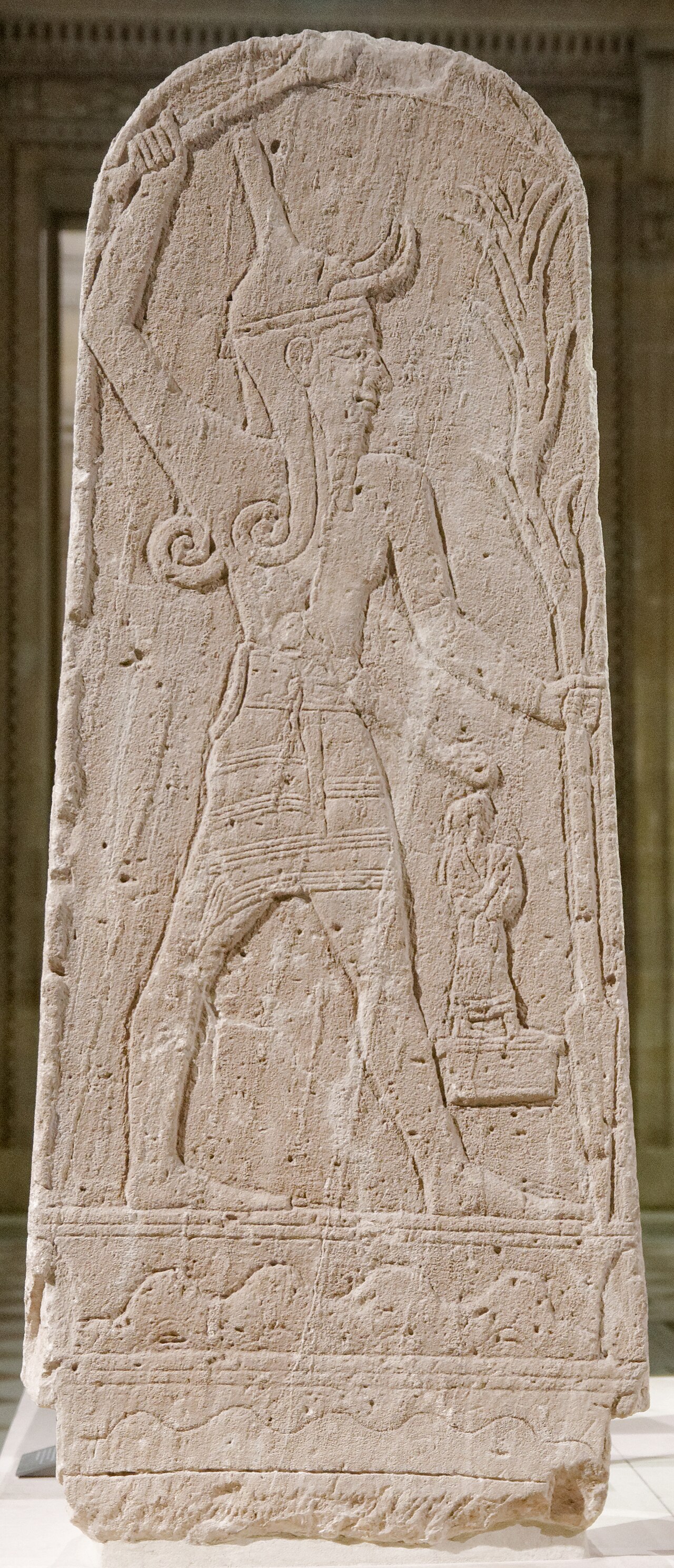
God's descent with smoke, fire, darkness, thunder, hail, lightning and the laying bare of the sea floor uses the imagery of a storm god; Baal of Ugarit is pictured striding with a raised club (stele above) and is called "rider of the clouds." Israel's poets applied the language to the LORD, "who rode upon a cherub" (18:10; compare Psalm 68:4, 33). The imagery is shared; the identity of the God is the poem's point.
"Servant of the LORD"
The title calls David "the servant of the LORD" (also Psalm 36), a royal honorific used of Moses, Joshua and David.
The versions
Greek and Latin number this Psalm 17. The library's Vulgate heading reads "Puero Domini David" ("to the servant of the Lord, David"), and Giguet's Greek, which usually omits headings, keeps this long one as verse 1 ("Pour David, serviteur de Dieu…"), so its verses run one ahead of the English.
Psalm 18 and 2 Samuel 22
The poem appears twice in the Hebrew Bible. 2 Samuel 22 lacks the opening "I will love thee, O LORD, my strength" (18:1); there are dozens of small differences in spelling and wording (e.g. 18:10 "he did fly" (wayyede') vs 2 Samuel 22:11 "he was seen" (wayyera'), one letter apart: dalet and resh look alike in Hebrew script). The two texts show how a poem could be transmitted in two places with copying variants and minor revisions. Neither can simply be called the original. See the passage page.
A royal psalm
The speaker is a king (18:50, "his king… his anointed"). Most scholars see an early royal thanksgiving, possibly reworked over time; the archaic features of its poetry are often noted. The title's David attribution and occasion come from the same tradition as 2 Samuel 22:1. The Hebrew preposition le- in "le-David" can mean "by," "for," "belonging to" or "concerning" David; a superscription records an ancient association, not a signature.
Romans 15:9
Paul quotes 18:49 (2 Samuel 22:50) in Romans 15:9 as evidence that the nations would glorify God.
What the evidence shows
- Psalm 18 and 2 Samuel 22 are two copies of the same poem with variants.
- The theophany uses storm-god imagery shared with Ugaritic poetry.Source: M. S. Smith and W. T. Pitard, The Ugaritic Baal Cycle (VTSup, 1994–2009)
- David composed Psalm 18. Attributed in the title and in 2 Samuel 22:1; not independently verifiable.
Continue the journey
Journey of a PassagePsalm 18:10: "He did fly" or "he was seen"Psalm 18 survives twice in the Hebrew Bible.More from this lesson
Why this matters to the rest of Scripture
- The same song in Samuel.
- Sinai in fire and thunder.
- Paul quotes 18:49.