"The LORD hear thee in the day of trouble; the name of the God of Jacob defend thee; Send thee help from the sanctuary, and strengthen thee out of Zion; Remember all thy offerings, and accept thy burnt sacrifice; Selah. Grant thee according to thine own heart, and fulfil all thy counsel."
"We will rejoice in thy salvation, and in the name of our God we will set up our banners." Then a single voice: "Now know I that the LORD saveth his anointed; he will hear him from his holy heaven with the saving strength of his right hand."
"Some trust in chariots, and some in horses: but we will remember the name of the LORD our God. They are brought down and fallen: but we are risen, and stand upright. Save, LORD: let the king hear us when we call."
Sacrifice before battle
Kings offered sacrifices before campaigns (1 Samuel 7:9; 13:9–12). Psalm 20 seems to accompany such an offering, with the congregation praying for the king. The shift to "Now know I" (v. 6) may mark an oracle or sign of acceptance.
Chariots and horses
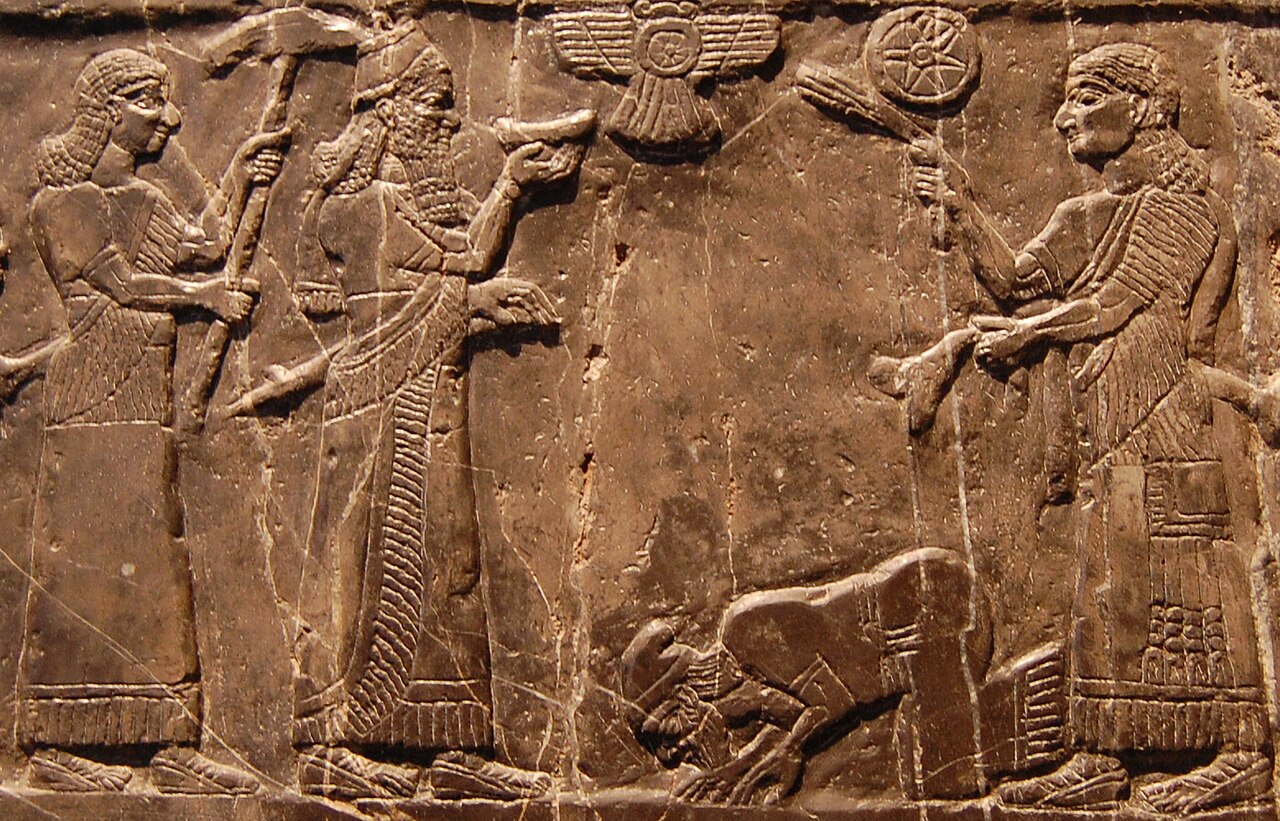
Chariotry was the elite force of the Iron Age; Ahab fielded 2,000 chariots at Qarqar (853 BC) according to the Kurkh Monolith. The Black Obelisk (pictured) shows the empire to which such forces answered. The psalm sets trust in God against this military technology (compare Isaiah 31:1).
The heading
Hebrew: "To the chief musician, a psalm of David." The psalm is about the king rather than by him: "the LORD hear thee" addresses him. This is one reason scholars read le-David as "for" or "concerning" as well as "by." Lamnatseah, "to the chief musician" (or "for the director"), heads 55 psalms and appears again in Habakkuk 3:19; its meaning is uncertain. The Greek understood it as eis to telos, "to the end" (the library's Vulgate: "In finem").
An Aramaic parallel in Egyptian script
Papyrus Amherst 63, a 4th-century BC Aramaic text written in Egyptian Demotic script, contains a prayer closely resembling Psalm 20:2–6 ("May Horus answer us in our troubles… may he send his messenger from the temple…"), addressed to Horus/El. Scholars debate whether both derive from a common older prayer or the Aramaic adapts the Israelite psalm. It is one of the most striking external parallels to any psalm.
The last line
20:9 Hebrew can be read "LORD, save the king; answer us when we call" (Greek and Vulgate: "Domine, salvum fac regem") or "Save, LORD; may the King answer us." The Greek reading gave the Latin liturgical prayer "Domine, salvum fac regem."
What the evidence shows
- Papyrus Amherst 63 contains a prayer closely parallel to Psalm 20. Relationship (common source or adaptation) debated.
- Psalm 20 is a royal prayer before battle.
Continue the journey
Connected elsewhere in ScriptureIsaiah 31: Their Horses Flesh, and Not SpiritIsaiah 31:1: Woe to those who trust in chariots.More from this lesson
Why this matters to the rest of Scripture
- Woe to those who trust in chariots.
- Thanksgiving after the battle.