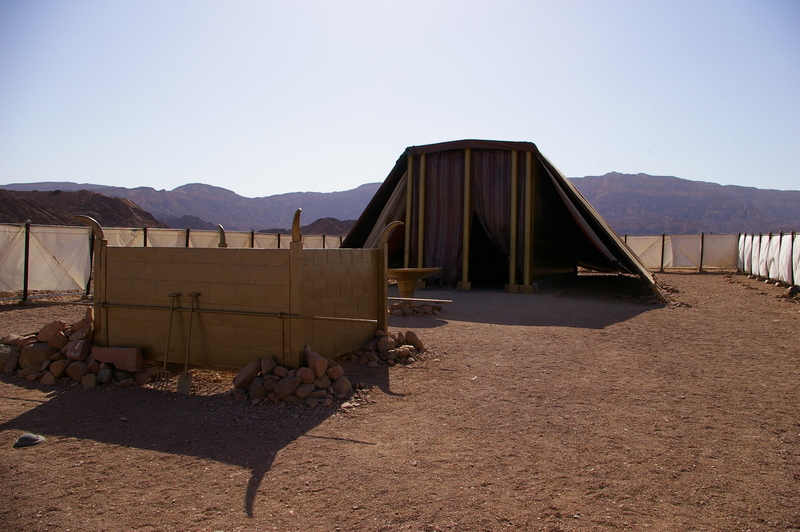
"LORD, remember David, and all his afflictions: how he sware unto the LORD, and vowed unto the mighty God of Jacob; surely I will not come into the tabernacle of my house… I will not give sleep to mine eyes… until I find out a place for the LORD, an habitation for the mighty God of Jacob. Lo, we heard of it at Ephratah: we found it in the fields of the wood. We will go into his tabernacles: we will worship at his footstool. Arise, O LORD, into thy rest; thou, and the ark of thy strength."
"The LORD hath sworn in truth unto David; he will not turn from it; Of the fruit of thy body will I set upon thy throne. If thy children will keep my covenant and my testimony that I shall teach them, their children shall also sit upon thy throne for evermore. For the LORD hath chosen Zion; he hath desired it for his habitation. This is my rest for ever: here will I dwell… There will I make the horn of David to bud."
Two oaths
The psalm balances David's oath to God (vv. 1–5: no rest until the ark has a home) with God's oath to David (vv. 11–18: a dynasty and Zion as his dwelling). Verses 8–10 are the hinge: "Arise, O LORD, into thy rest."
Ephratah and the fields of the wood
"We found it in the fields of Jaar (the wood)" points to Kiriath-jearim, "town of forests," where the ark stayed for twenty years (1 Samuel 7:1–2) before David brought it to Jerusalem (2 Samuel 6). Ephratah may be Bethlehem (Micah 5:2), David's home, or the region around Kiriath-jearim (1 Chronicles 2:50); the identification is debated.
A conditional covenant
Unlike Psalm 89, which says God's love will never be withdrawn, Psalm 132:12 makes the dynasty's continuation conditional: "If thy children will keep my covenant." Both forms of the promise appear in the Bible (2 Samuel 7:14–16; 1 Kings 9:4–7). The two psalms show two ways of understanding the Davidic covenant, which became urgent after the monarchy fell.
In Chronicles
Solomon's prayer at the dedication of the temple ends with 132:8–10 in 2 Chronicles 6:41–42, "Arise, O LORD God, into thy resting place." See that passage page. The heading "A Song of degrees" (Vulgate "Canticum graduum") marks it as one of the fifteen Songs of Ascents (Psalms 120–134; see Psalm 120 for the possible meanings).
Versions and the New Testament
The library's Vulgate reads v. 6 "invenimus eam in campis silvae," "we found it in the fields of the forest," keeping the place-name sense of Jaar. Peter's sermon in Acts 2:30 echoes 132:11 ("God had sworn with an oath to him, that of the fruit of his loins… he would raise up Christ").
What the evidence shows
- 2 Chronicles 6:41–42 quotes Psalm 132:8–10.
- "Fields of the wood" refers to Kiriath-jearim.
- Psalm 132 presents the Davidic promise as conditional.
Continue the journey
Journey of a Passage2 Chronicles 6:41–42 and Psalm 132:8–10: Solomon's prayer ends with a psalmChronicles ends Solomon's prayer with words from Psalm 132, replacing the Exodus ending of 1 Kings 8:51–53.More from this lesson
Why this matters to the rest of Scripture
- The ark brought to Jerusalem.
- The ark at Kiriath-jearim.
- The unconditional form of the promise.