Psalm 44: Awake, Why Do You Sleep?
A nation's lament: defeat without disobedience
"We have heard with our ears, O God, our fathers have told us, what work thou didst in their days, in the times of old. How thou didst drive out the heathen with thy hand… For they got not the land in possession by their own sword, neither did their own arm save them: but thy right hand, and thine arm, and the light of thy countenance."
"But thou hast cast off, and put us to shame; and goest not forth with our armies… Thou hast given us like sheep appointed for meat; and hast scattered us among the heathen. Thou sellest thy people for nought… Thou makest us a byword among the heathen, a shaking of the head among the people."
"All this is come upon us; yet have we not forgotten thee, neither have we dealt falsely in thy covenant. Our heart is not turned back… Yea, for thy sake are we killed all the day long; we are counted as sheep for the slaughter."
"Awake, why sleepest thou, O Lord? arise, cast us not off for ever. Wherefore hidest thou thy face, and forgettest our affliction and our oppression?… Arise for our help, and redeem us for thy mercies' sake."
The shape of a national lament
Memory of God's past deeds (vv. 1–8), complaint of present defeat (9–16), protest of innocence (17–22), appeal (23–26). The first section is "we"; individual "I" lines (vv. 4, 6, 15) suggest a leader or king speaking for the people. The pattern is close to Psalms 74, 79, 80 and 89.
Sold for nothing
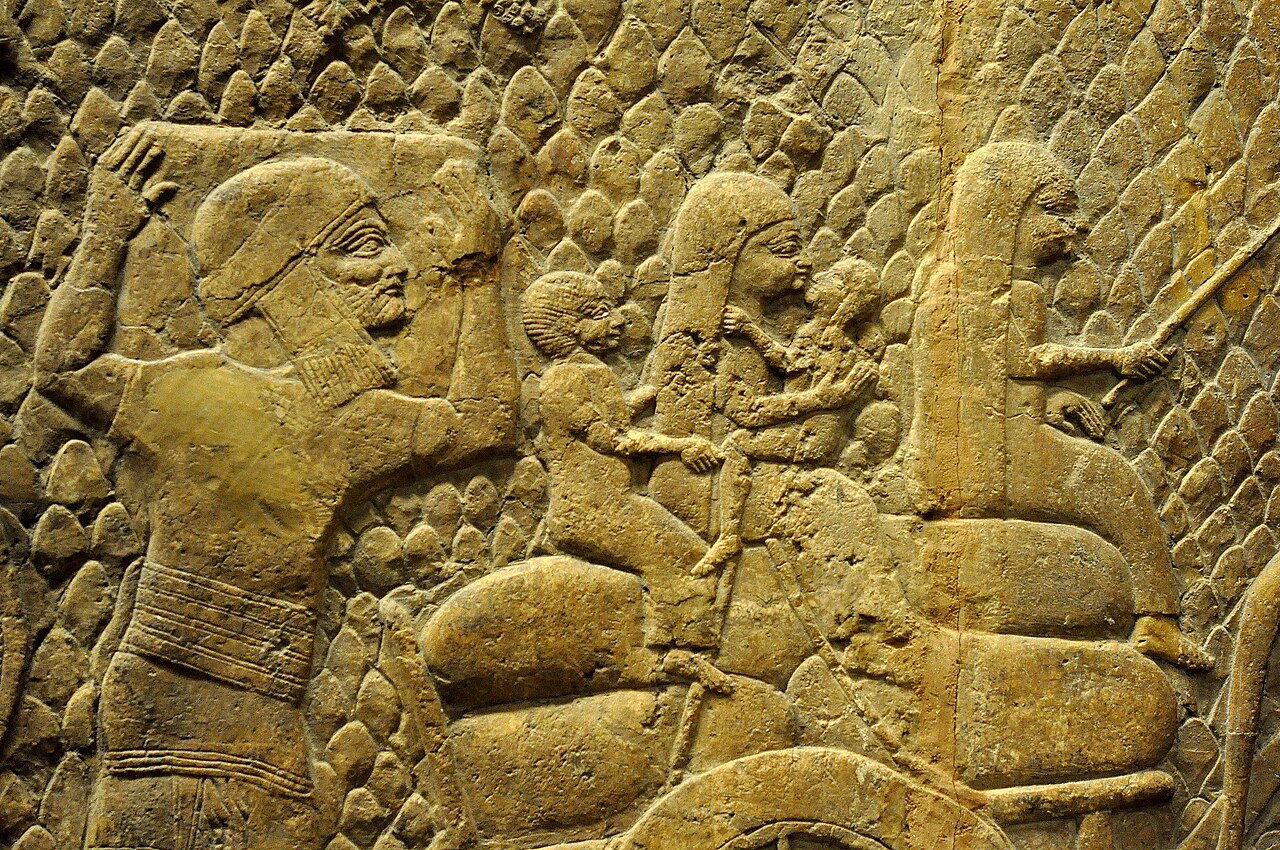
"Thou sellest thy people for nought" (v. 12) uses the language of slavery and war captives. Assyrian reliefs such as the siege of Lachish (pictured) show deportees led away; the psalm does not name which defeat it laments.
The heading and the date
"To the chief Musician for the sons of Korah, Maschil." The psalm names no battle. Proposals range from Hezekiah's time (701 BC) to the exile and to the Maccabean persecutions (2nd century BC). The protest that the people had kept the covenant fits some settings better than others, but no date is secure.
"Awake": temple and Talmud
The Mishnah (Ma'aser Sheni 5:15; Sotah 9:10) records that Levites called "awakeners" recited "Awake, why sleepest thou, O Lord?" daily in the temple, until the high priest John Hyrcanus (134–104 BC) abolished the practice; the Babylonian Talmud (Sotah 48a) explains that the words seemed to suggest God sleeps.
Romans 8:36
Paul quotes 44:22 in the Greek ("For thy sake we are killed all the day long; we are accounted as sheep for the slaughter") to describe Christian suffering that cannot separate believers from God's love. In the library the verse is Giguet's Greek 43:21 and the Vulgate's 43:22.
What the evidence shows
- The Mishnah records the daily temple recitation of 44:23 by "awakeners" until John Hyrcanus.
- Romans 8:36 quotes Psalm 44:22.
- Psalm 44 can be dated to a specific defeat.
Continue the journey
Connected elsewhere in ScriptureThe Covenant at Shechem and the BurialsJoshua 24:12: "Not with thy sword, nor with thy bow": the land as God's gift.More from this lesson
Why this matters to the rest of Scripture
- "Not with thy sword, nor with thy bow": the land as God's gift.
- "We are accounted as sheep for the slaughter."
- "Why hast thou cast us off for ever?"
- "Awake, awake, put on strength, O arm of the LORD."