Era 5 · The Promised LandJoshua
The Covenant at Shechem and the Burials
"As for me and my house, we will serve the LORD"
"Your fathers dwelt on the other side of the flood [the River] in old time, even Terah, the father of Abraham… and they served other gods." God took Abraham, gave Isaac, Jacob and Esau, sent Moses and Aaron, brought Israel out of Egypt and through the sea, gave them the Amorites' land, turned Balaam's curse into blessing, and gave them "a land for which ye did not labour, and cities which ye built not."
"Now therefore fear the LORD, and serve him in sincerity and in truth: and put away the gods which your fathers served on the other side of the flood, and in Egypt… choose you this day whom ye will serve… but as for me and my house, we will serve the LORD." The people answer: "God forbid that we should forsake the LORD." Joshua warns, "Ye cannot serve the LORD: for he is an holy God," but they insist, "Nay; but we will serve the LORD." "Ye are witnesses against yourselves."
"So Joshua made a covenant with the people that day, and set them a statute and an ordinance in Shechem. And Joshua wrote these words in the book of the law of God, and took a great stone, and set it up there under an oak, that was by the sanctuary of the LORD." "Behold, this stone shall be a witness unto us; for it hath heard all the words of the LORD."
Joshua dies at 110 and is buried at Timnath-serah. "And Israel served the LORD all the days of Joshua, and all the days of the elders that overlived Joshua." "And the bones of Joseph, which the children of Israel brought up out of Egypt, buried they in Shechem, in a parcel of ground which Jacob bought." Eleazar dies and is buried in the hill of his son Phinehas.
Shechem: the temple and the stone
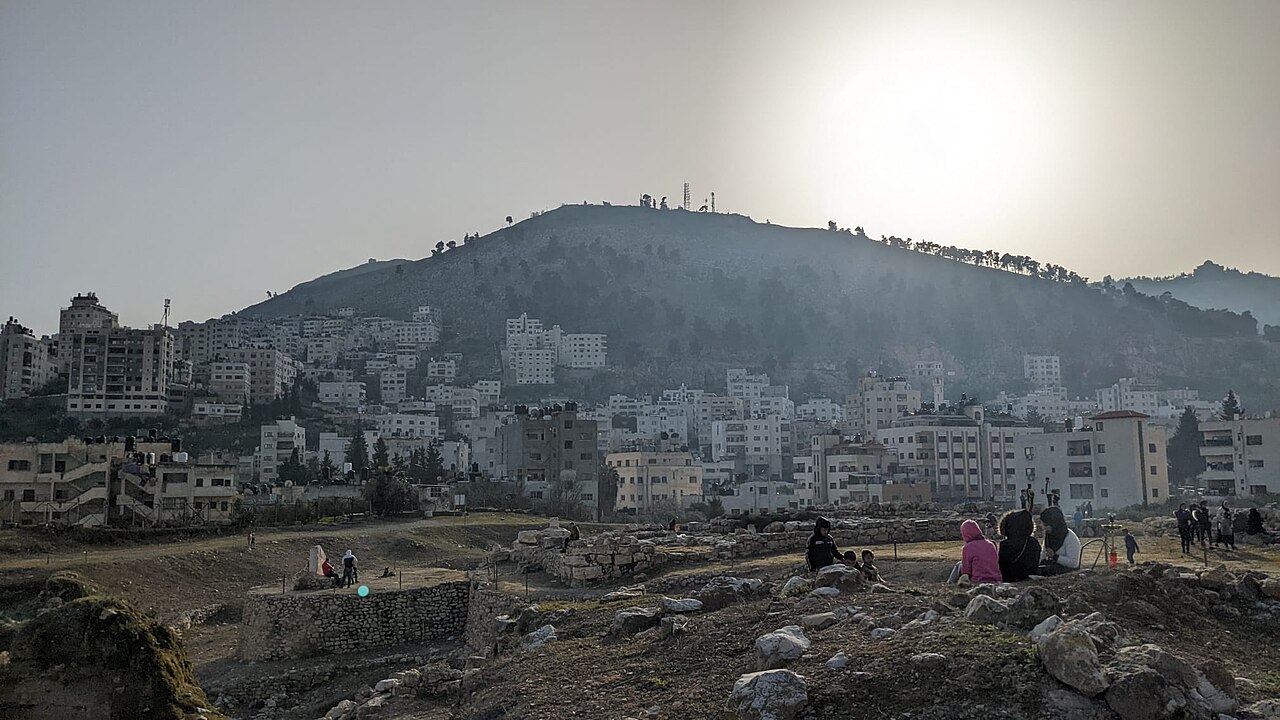
Shechem (Tell Balata, by Nablus) was a major Middle Bronze Age city with massive walls, a great gate and a fortress-temple (migdal). Ernst Sellin and later G. Ernest Wright's expedition (1956–73) found a large standing stone near the temple. Wright suggested a link with the stone of Joshua 24 or the temple of "El-berith" in Judges 9; that connection is not established. The finds show Shechem as a sacred center with standing stones, the kind of setting the chapter describes.
A covenant like a treaty
Joshua 24 follows the pattern of ancient treaties: the giver named, the history of his favors, the demand of exclusive loyalty, witnesses, a written document and a stone. George Mendenhall and Klaus Baltzer compared it with Hittite treaties of the 14th–13th centuries BC; others note similarities with later Assyrian forms. The comparison shows the form; it does not date the ceremony.
Bones and tombs
Joseph's request to be buried in the land (Genesis 50:25) is fulfilled at Shechem, on land Jacob bought (Genesis 33:19). A traditional Joseph's Tomb stands in Nablus; its structure is much later, and the identification is a tradition. The Greek Septuagint adds that the flint knives used at Gilgal were buried with Joshua, and after Eleazar's burial adds a note about the ark, Phinehas, and Israel's turn to Astarte and the Moabite king Eglon, leading into Judges.
The Case for the Biblical Account
Scripture's account
Covenant renewal at Shechem; the deaths and burials of Joshua, Joseph and Eleazar (Joshua 24).
What evidence would we expect?
Shechem as a sacred site with standing stones; covenant forms; traditions of the burials.
The discoveries
The fortress-temple and standing stone at Tell Balata; ancient treaty forms; the Septuagint's longer ending; traditional tombs of Joseph and Joshua.
Testing the discoveries
Shechem's sacred character is attested; the stone cannot be identified with Joshua's; the tombs are traditions.
The strongest reconstruction
Joshua 24 sets a covenant renewal at Israel's ancient sacred center, in the form of a treaty.
What remains possible
That Shechem's covenant tradition is very old; that it was shaped later as a summary of Israel's identity.
What the evidence shows
- Tell Balata had a Middle Bronze fortress-temple and a large standing stone.
- The excavated standing stone is Joshua's stone.
- The Septuagint adds the burial of the flint knives with Joshua and a longer ending. Checked in the library (Giguet), 24:31 and 24:33.
- Joshua 24 follows the form of ancient treaties.
- "As for me and my house, we will serve the LORD."
Continue the journey
Journey of a PassageJoshua 24:29–33: Flint knives in Joshua's tomb: the Greek endingThe Hebrew ends with three burials.More from this lesson
Echoes Across Civilizations
Optional: how other ancient peoples told similar stories. Open one to compare, then come back to the lesson.
Covenants shaped like treatiesHittite · Assyrian
Did ancient kings make treaties in the same shape as God's covenant at Sinai?
- Hittite: Hittite vassal treaties (e.g. Mursili II with Duppi-Teshub of Amurru; Suppiluliuma I with Shattiwaza) Possible historical contact
- Assyrian: The Succession Treaty of Esarhaddon (Vassal Treaties of Esarhaddon) Possible historical contact
Why this matters to the rest of Scripture
- Abram at Shechem.
- Genesis 33:18–20; 50:25Jacob's land; Joseph's bones.
- Moses takes Joseph's bones.
- Joshua's death retold.
- The patriarchs buried at Shechem.
- Joseph's bones.