Era 5 · The Promised LandJoshua
Hazor and the Northern Coalition
"Hazor beforetime was the head of all those kingdoms"
Jabin king of Hazor sends to the kings of the north, of the hills and the plains, "and they went out, they and all their hosts with them, much people, even as the sand that is upon the sea shore in multitude, with horses and chariots very many." They camp at the waters of Merom.
"Be not afraid because of them: for to morrow about this time will I deliver them up all slain before Israel: thou shalt hough their horses, and burn their chariots with fire." Israel falls on them suddenly and chases them to great Zidon and the valley of Mizpeh.
"And Joshua at that time turned back, and took Hazor, and smote the king thereof with the sword: for Hazor beforetime was the head of all those kingdoms… and he burnt Hazor with fire. But as for the cities that stood still in their strength, Israel burned none of them, save Hazor only." The chapter summarizes: "So Joshua took all that land… And the land rested from war." "There was not a city that made peace with… Israel, save the Hivites the inhabitants of Gibeon." Joshua cuts off the Anakim from the hills; only in Gaza, Gath and Ashdod do they remain.
Hazor in the ancient world
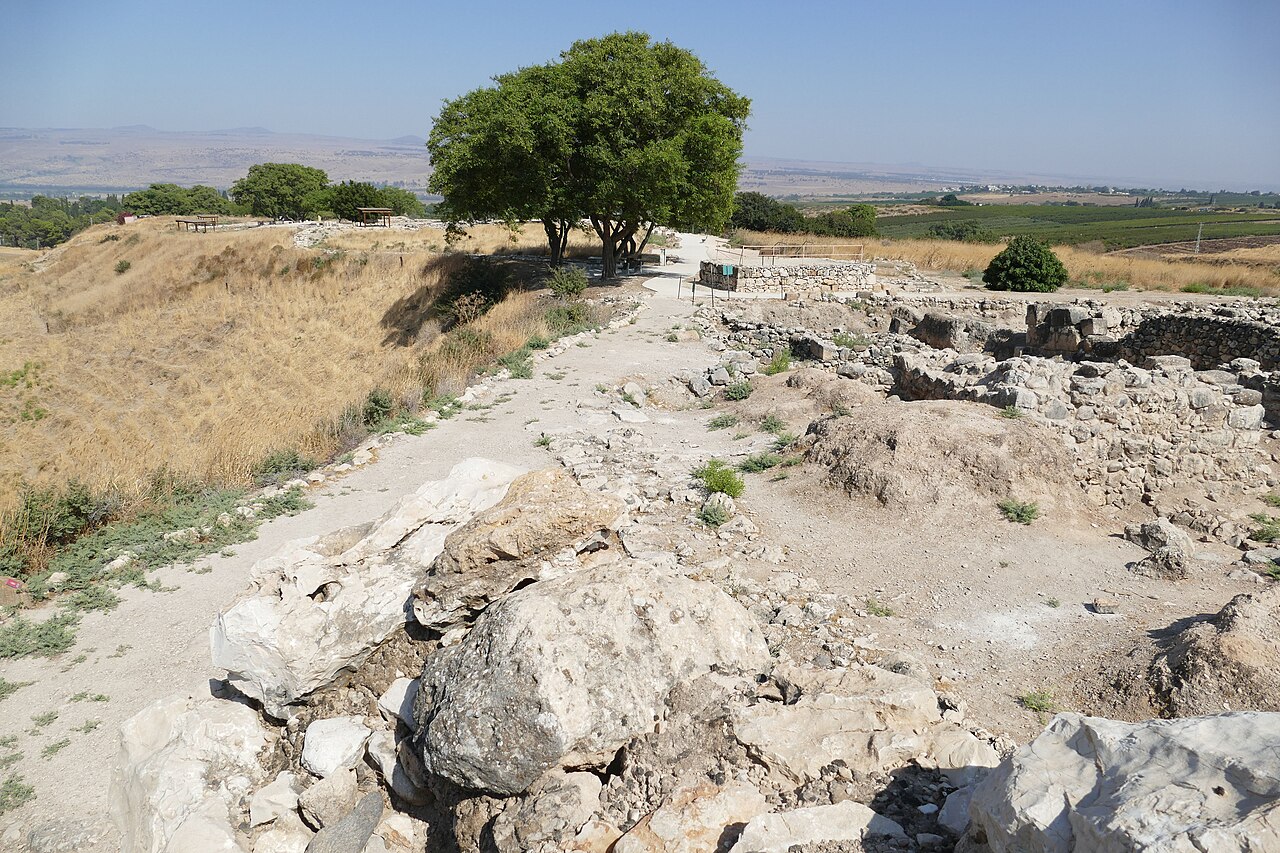
Tel Hazor in upper Galilee was the largest city in Canaan, about 80 hectares with its lower city. Mari letters of the 18th century BC mention its king, and in the 14th-century Amarna letters the king of Hazor is the only Canaanite ruler who calls himself "king." Joshua's "head of all those kingdoms" fits this.
The destruction
Yigael Yadin (1955–58, 1968) and Amnon Ben-Tor (from 1990) uncovered the Late Bronze city's final destruction in the 13th century BC: a fire so hot that mudbricks vitrified and basalt cracked, and statues of gods and kings deliberately decapitated and their hands cut off. Yadin and Ben-Tor attributed it to the Israelites. Others have suggested Egyptian or Sea Peoples' attacks, rival Canaanites, or an internal revolt (Sharon Zuckerman). A 2021 multi-proxy study (Bechar and colleagues) modeled the radiocarbon and stratigraphy and set out competing scenarios for the date and process.
Judges 4 later speaks of "Jabin king of Canaan, that reigned in Hazor" in the time of Deborah. Scholars debate whether Jabin was a dynastic name, whether the two accounts reflect one tradition told twice, or two different events.
Hamstrung horses
Chariots were the elite weapon of Late Bronze Age Canaanite kings, and Egyptian records list hundreds captured at Megiddo by Thutmose III. Israel's hill-country forces had none. Destroying them rather than using them fits both the military situation and Deuteronomy's warning against multiplying horses (17:16).
The Case for the Biblical Account
Scripture's account
The northern coalition is defeated and Hazor alone is burned (Joshua 11).
What evidence would we expect?
A major Canaanite Hazor destroyed by fire at the end of the Late Bronze Age; chariot warfare.
The discoveries
Hazor's 13th-century destruction with intense fire and mutilated statues; Mari and Amarna references to Hazor's kings; Egyptian chariot records.
Testing the discoveries
The destruction is one of the best fits between Joshua and archaeology. Its date (within the 13th century) and its attacker are disputed; the Israelite attribution is an interpretation.
The strongest reconstruction
A great Canaanite Hazor was violently destroyed in the 13th century BC, as Joshua describes; who destroyed it cannot be proven.
What remains possible
Israelite conquest; an internal uprising; another attacker; or memory attaching the fall to Joshua.
What the evidence shows
- Late Bronze Hazor was destroyed by an intense fire.Source: A. Ben-Tor, Hazor: Canaanite Metropolis, Israelite City (2016); S. Bechar et al., "The Destruction of Late Bronze Age Hazor" (multi-proxy study), Ägypten und Levante 31 (2021) ↗
- Statues at Hazor were deliberately mutilated in the destruction.Source: A. Ben-Tor, Hazor: Canaanite Metropolis, Israelite City (2016)
- Israelites destroyed Hazor.Source: S. Bechar et al., "The Destruction of Late Bronze Age Hazor" (multi-proxy study), Ägypten und Levante 31 (2021) ↗
- Hazor's king is called "king" in the Amarna letters.
Continue the journey
Ancient MysteriesHazor: Who Destroyed the City?Was Late Bronze Hazor burned by Joshua's Israelites?More from this lesson
Investigations
Optional deep dives: the ancient sources, the physical evidence, and every interpretation side by side, including unconventional ones, each labeled for what it is.
Hazor: Who Destroyed the City?Destruction: documented · Date: 13th century BC (range debated) · Attacker: disputed
Was Late Bronze Hazor burned by Joshua's Israelites?
Hazor, the largest city in Canaan, was destroyed in the 13th century BC in a fire hot enough to vitrify bricks, with statues of gods and kings deliberately mutilated. Its excavators attributed it to Israel; others suggest Egyptians, Sea Peoples, rival cities, or an uprising. A 2021 study modeled the evidence for its date and process.
Open the full investigation →Why this matters to the rest of Scripture
- Judges 4:2, 23–24Jabin king of Canaan in Hazor.
- Solomon rebuilds Hazor.
- "He shall not multiply horses."
- "Some trust in chariots, and some in horses."