Era 5 · The Promised LandJoshua
Shiloh and Benjamin
"How long are ye slack to go to possess the land?"
"And the whole congregation of the children of Israel assembled together at Shiloh, and set up the tabernacle of the congregation there. And the land was subdued before them." Seven tribes have not yet received their inheritance. "How long are ye slack to go to possess the land?"
"Give out from among you three men for each tribe… and they shall go through the land, and describe it according to the inheritance of them." "And the men went and passed through the land, and described it by cities into seven parts in a book, and came again to Joshua to the host at Shiloh. And Joshua cast lots for them in Shiloh before the LORD."
Benjamin's border runs from the Jordan past Bethel to Kirjath-jearim and back along Judah's border through the valley of Hinnom, "south side of the Jebusite." Its towns include Jericho, Bethel, Gibeon, Ramah, Mizpeh and Jebus, "which is Jerusalem."
Shiloh
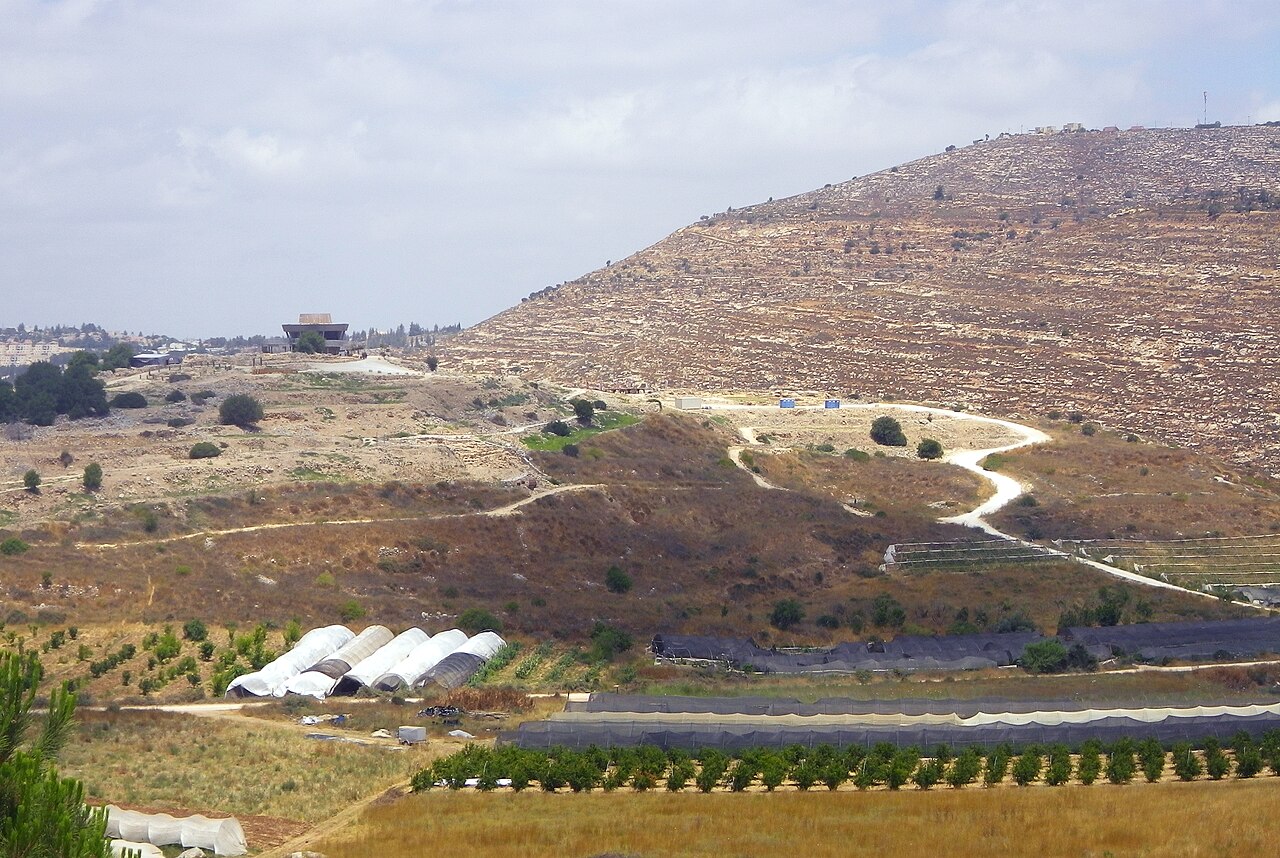
Shiloh (Khirbet Seilun) became Israel's central sanctuary until the days of Eli and Samuel (1 Samuel 1–4); Jeremiah later points to its ruin as a warning (Jeremiah 7:12). Danish excavations (1926–32), Israel Finkelstein (1981–84) and the Associates for Biblical Research (from 2017) found an Iron I settlement with storage buildings and large collared-rim jars, destroyed by fire in the 11th century BC, which many link with the Philistine victory of 1 Samuel 4. Proposals for the exact location of the tabernacle, including a leveled area north of the tell, are debated; no structure has been identified as the tabernacle itself.
A written survey
The surveyors "described" (katav, wrote) the land in a book. Ancient states surveyed land for taxes and allocation; Egyptian and Mesopotamian scribes kept field registers. The detail presents the allotment as a documented process.
Benjamin's place
Benjamin's narrow territory lies between Judah and Ephraim and includes Jerusalem, Gibeon, Bethel and Jericho, the setting of much of Joshua 2–10. Benjamin later produced Israel's first king, Saul of Gibeah.
The Case for the Biblical Account
Scripture's account
The tent at Shiloh; the survey and lot for seven tribes; Benjamin's land (Joshua 18).
What evidence would we expect?
An Iron I cultic center at Shiloh; identifiable towns of Benjamin.
The discoveries
Iron I Shiloh with public buildings and storage, destroyed in the 11th century BC; Benjaminite sites such as Gibeon, Bethel and Ramah.
Testing the discoveries
Shiloh's importance in Iron I is supported. The tabernacle's exact location and remains are not identified.
The strongest reconstruction
Shiloh was a central highland site in the period of the Judges, consistent with its role in Joshua and Samuel.
What remains possible
Whether proposed structures relate to the sanctuary.
What the evidence shows
- Shiloh was an important Iron I settlement destroyed by fire in the 11th century BC.
- The tabernacle's site at Shiloh has been identified.
- "Joshua cast lots for them in Shiloh before the LORD."
Continue the journey
Connected elsewhere in ScriptureHannah at Shiloh1 Samuel 1–4: Eli, Hannah and the ark at Shiloh.More from this lesson
Why this matters to the rest of Scripture
- Eli, Hannah and the ark at Shiloh.
- "Go ye now unto my place which was in Shiloh."
- "He forsook the tabernacle of Shiloh."
- "The lot is cast into the lap."