The kings of the land gather to fight Joshua. But the inhabitants of Gibeon "did work wilily": they come with "old sacks upon their asses, and wine bottles, old, and rent, and bound up; And old shoes and clouted upon their feet… and all the bread of their provision was dry and mouldy." "We be come from a far country: now therefore make ye a league with us."
"And the men took of their victuals, and asked not counsel at the mouth of the LORD. And Joshua made peace with them… and the princes of the congregation sware unto them." Three days later Israel learns they are neighbors: Gibeon, Chephirah, Beeroth and Kirjath-jearim. The people murmur, but the princes say: "We have sworn unto them by the LORD God of Israel: now therefore we may not touch them."
Joshua makes them "hewers of wood and drawers of water for the congregation, and for the altar of the LORD, even unto this day."
Gibeon found
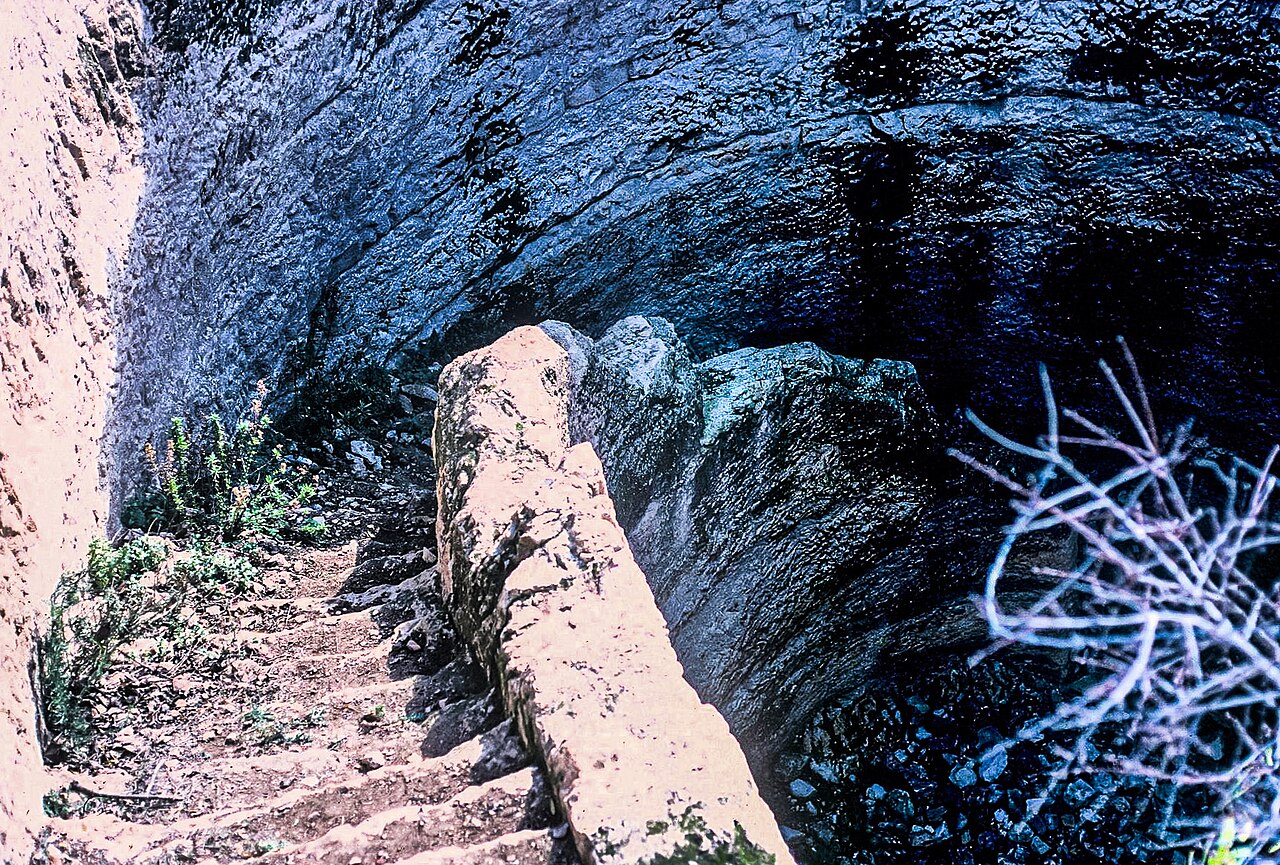
Gibeon is el-Jib, north of Jerusalem. James Pritchard's excavations (1956–1962) found jar handles inscribed gb'n, "Gibeon," securing the identification, along with a great rock-cut pool with a spiral staircase about 25 m deep (compare "the pool of Gibeon," 2 Samuel 2:13) and a winery with many cellars. Most of the finds are Iron Age; Late Bronze remains are sparse, mainly tombs. The site confirms the place, not the treaty.
Treaties and their oaths
Ancient treaties were sworn in the gods' names and breaking them invited the gods' curses. 2 Samuel 21 tells that Saul later killed Gibeonites, breaking the oath, and a famine followed until David made amends: the Bible treats the oath as binding for centuries. That later story is part of Israel's memory of the treaty.
Servants of the sanctuary
The Gibeonites' service has been compared with the later Nethinim, "given ones," temple servants in Ezra and Nehemiah, though the link is not stated. The story explains how a non-Israelite group lived within Israel and served at its sanctuary.
The Case for the Biblical Account
Scripture's account
The Gibeonites deceive Israel into a treaty and become temple servants (Joshua 9).
What evidence would we expect?
Gibeon as a real town; signs of a non-Israelite group among Israel.
The discoveries
El-Jib with inscribed handles naming Gibeon; the great pool; 2 Samuel 2 and 21; the four Hivite towns as identifiable sites.
Testing the discoveries
The identification is secure. Gibeon's Late Bronze occupation is thin, which affects how the episode is dated.
The strongest reconstruction
Joshua 9 explains Gibeon's status within Israel through a remembered treaty.
What remains possible
A historical treaty; an explanatory tradition about a group's service; or both.
What the evidence shows
- Gibeon is el-Jib, identified by inscribed jar handles.Source: J. B. Pritchard, Gibeon, Where the Sun Stood Still (1962)
- Gibeon had a substantial Late Bronze Age town. Remains are sparse.
- The treaty with the Gibeonites is historical.
Continue the journey
Connected elsewhere in ScriptureRizpah's Vigil and the Giants of Gath2 Samuel 21:1–14: Saul breaks the oath.More from this lesson
Why this matters to the rest of Scripture
- Saul breaks the oath.
- The pool of Gibeon.
- Solomon's dream at Gibeon.
- "The hewer of thy wood unto the drawer of thy water."
- On oaths.