Era 6 · The First Kings2 Samuel
Rizpah's Vigil and the Giants of Gath
"Rizpah… took sackcloth, and spread it for her upon the rock"
"There was a famine in the days of David three years." "It is for Saul, and for his bloody house, because he slew the Gibeonites." The Gibeonites, protected by Joshua's oath, ask for seven of Saul's sons "and we will hang them up unto the LORD in Gibeah of Saul." David spares Mephibosheth for Jonathan's sake and gives them Armoni and Mephibosheth, sons of Rizpah, and five sons of Merab (Hebrew: Michal; see below). They are put to death "in the days of harvest, in the first days, in the beginning of barley harvest."
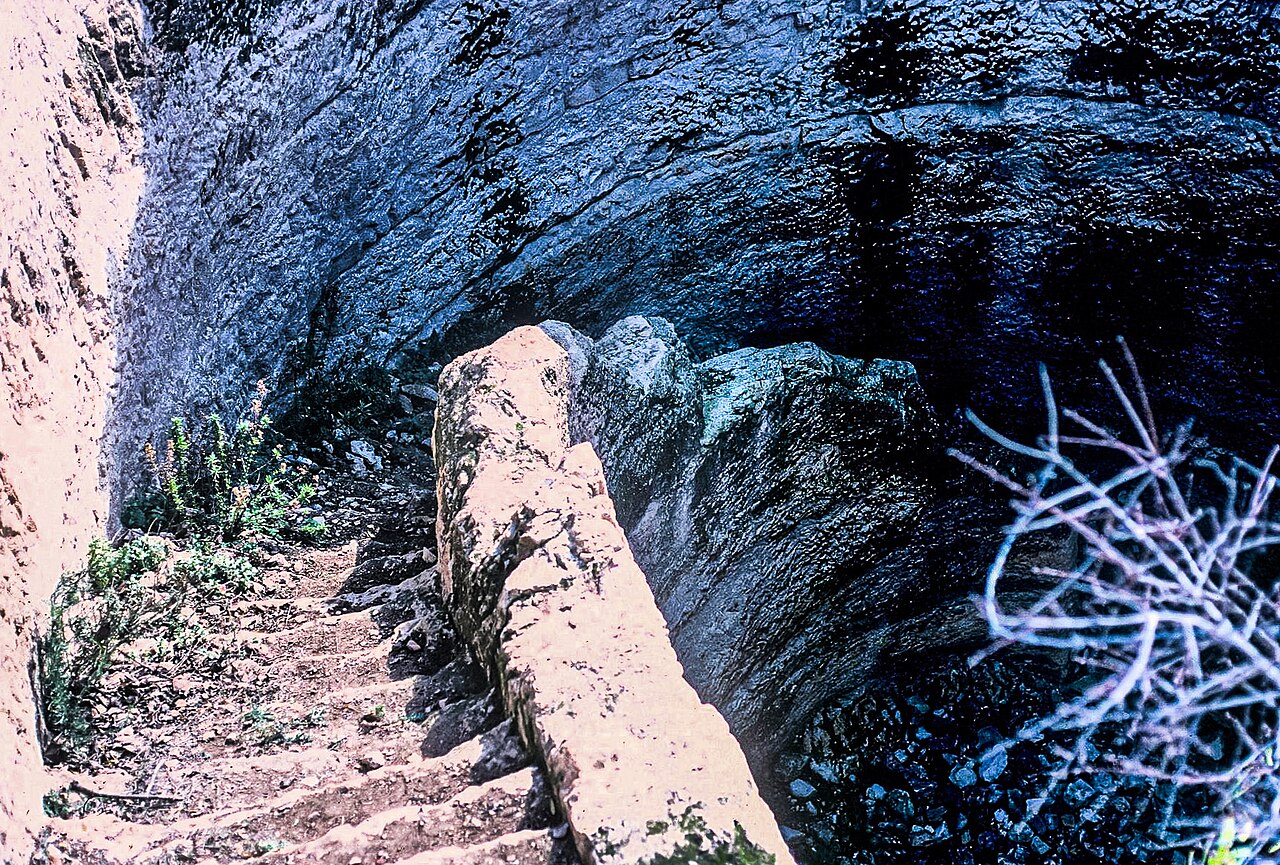
"And Rizpah the daughter of Aiah took sackcloth, and spread it for her upon the rock, from the beginning of harvest until water dropped upon them out of heaven, and suffered neither the birds of the air to rest on them by day, nor the beasts of the field by night."
David is told; he brings the bones of Saul and Jonathan from Jabesh-gilead and buries them, with the bones of the seven, in the tomb of Kish in Benjamin. "After that God was intreated for the land." Then the Philistine wars: Abishai saves David from Ishbi-benob, "of the sons of the giant [Rapha]"; Sibbecai kills Saph; "Elhanan the son of Jaare-oregim, a Bethlehemite, slew Goliath the Gittite, the staff of whose spear was like a weaver's beam"; Jonathan son of Shimeah kills a man with six fingers on each hand and six toes on each foot. "These four were born to the giant in Gath."
Rizpah
Rizpah was Saul's concubine, accused in 3:7. Here she acts alone: from barley harvest (April) to the rains (October), she protects her sons' bodies from scavengers, a terrible public act of mourning. In the ancient world exposure of the dead was the worst disgrace; her vigil moves David to give Saul's whole house an honorable burial.
Collective punishment
The execution of descendants for Saul's crime conflicts with Deuteronomy 24:16 ("every man shall be put to death for his own sin"). The text presents it as the Gibeonites' demand and links the famine to Saul's broken oath (Joshua 9). Readers have long found it troubling; some historians see it as a political removal of Saul's heirs. Both concerns are fair.
Michal or Merab? (21:8)
The Hebrew, the library's Greek and the Vulgate all say "the five sons of Michal… whom she bore to Adriel." But Merab was given to Adriel (1 Samuel 18:19), and Michal had no child (6:23). The KJV renders "brought up for Adriel"; two Hebrew manuscripts and some Greek witnesses read Merab, which most modern translations follow. See the passage page.
Elhanan and Goliath (21:19)
The Hebrew says Elhanan killed "Goliath the Gittite." The library's Greek and Vulgate agree (the Vulgate translates the names: "Adeodatus son of Saltus the weaver"). The KJV adds "the brother of" in italics, from 1 Chronicles 20:5, which says Elhanan killed "Lahmi the brother of Goliath." See the passage page.
The Rapha
"Born to the Rapha" may mean descendants of a man named Rapha, or members of a group of warriors linked with the Rephaim (Deuteronomy 2–3). The six-fingered man is an unusual physical detail; polydactyly is a known human condition. There is no authenticated evidence of a non-human "giant" population.
The Case for the Biblical Account
Scripture's account
The Gibeonites' revenge, Rizpah's vigil and the giants (2 Samuel 21).
What evidence would we expect?
Famines in the Levant; Gibeon as a town; Philistine warriors.
The discoveries
Gibeon at el-Jib; drought evidence in the region in Iron I–II; Gath at Tell es-Safi; polydactyly in ancient skeletal records.
Testing the discoveries
The setting is plausible; the events are known only from Samuel and Chronicles.
The strongest reconstruction
Thematic appendix material from different points in David's reign.
What remains possible
The original reading of 21:8 and 21:19.
What the evidence shows
- The Hebrew of 21:19 says Elhanan killed Goliath.Source: NET Bible, 2 Samuel 21:19 with notes (Bible Gateway) ↗
- The Hebrew, the library's Greek and the Vulgate read "Michal" in 21:8.
- The original of 21:8 read Merab.
- The Rapha were a non-human race.
Continue the journey
Journey of a Passage2 Samuel 21:19: Who killed Goliath?The Hebrew says Elhanan son of Jaare-oregim, a Bethlehemite, killed Goliath the Gittite.More from this lesson
Echoes Across Civilizations
Optional: how other ancient peoples told similar stories. Open one to compare, then come back to the lesson.
Giants, Watchers, and heavenly beingsJewish (Second Temple) · Mesopotamia · Greece
What did other cultures say about beings between heaven and earth?
- Jewish (Second Temple): 1 Enoch, the Book of the Watchers Shared literary world
- Mesopotamia: The Apkallu (the seven sages) Shared literary world
- Greece: Titans, Giants, and demigod heroes Resemblance only
Also covered: Ancient-astronaut interpretations, clearly labeled as a modern theory.
Compare side by side →Women who save and women who sufferJewish (Hellenistic) · Egyptian and Ugaritic · Greek
How do other ancient traditions portray women as deliverers and as victims of war?
- Jewish (Hellenistic): Judith Shared literary world
- Egyptian and Ugaritic: Warrior goddesses Anat and Astarte Resemblance only
- Greek: Trojan Women Similar human experience
Why this matters to the rest of Scripture
- The oath to the Gibeonites.
- Each for his own sin.
- The giants in Chronicles.
- David and Goliath.
- Og, last of the Rephaim.