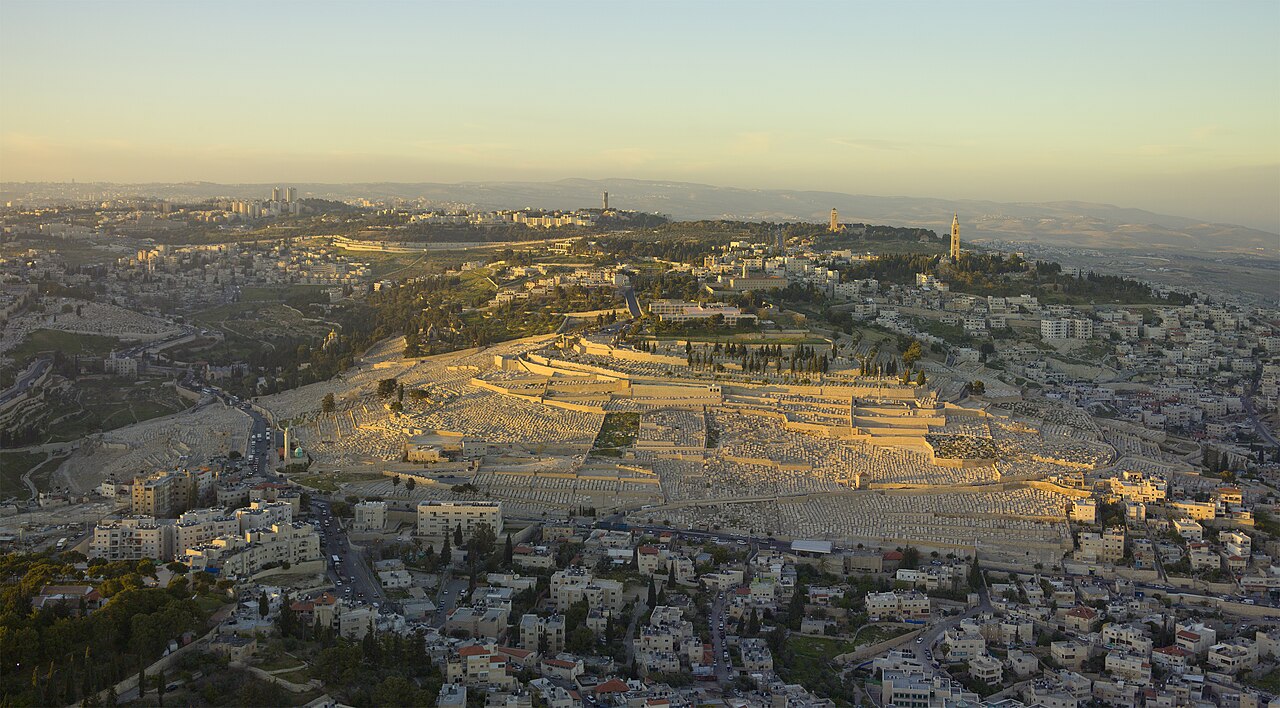
Absalom gets a chariot and fifty runners, and stands by the gate. "See, thy matters are good and right; but there is no man deputed of the king to hear thee… Oh that I were made judge in the land… So Absalom stole the hearts of the men of Israel."
"And it came to pass after forty years [some ancient texts: four years], that Absalom said unto the king, I pray thee, let me go and pay my vow… in Hebron." There his spies proclaim, "Absalom reigneth in Hebron." Ahithophel, David's counselor, joins him. David: "Arise, and let us flee." He leaves ten concubines to keep the house.
Ittai the Gittite, a foreigner who arrived only yesterday: "surely in what place my lord the king shall be, whether in death or life, even there also will thy servant be." David sends the ark back: "If I shall find favour in the eyes of the LORD, he will bring me again." He goes up the ascent of the Mount of Olives, "and wept as he went up, and had his head covered, and he went barefoot." "O LORD, I pray thee, turn the counsel of Ahithophel into foolishness." He sends Hushai back to Jerusalem as a spy.
Forty years or four? (15:7)
The Hebrew, the library's Greek ("he was over forty") and the Vulgate all read forty. The Lucianic (Antiochene) Greek, the Syriac and Josephus are reported to read four, which fits the story's timeline (Absalom's return, 14:28, plus a few years). Many modern translations read four. See the passage page.
The gate
Petitioners waited at the city gate for judgment (Deuteronomy 21:19; Ruth 4). Absalom positions himself where the king's justice was expected and promises better.
The route
David crosses the Kidron, climbs the Mount of Olives, passes Bahurim and heads for the Jordan. The general route is clear; the exact path is not.
Psalm 3
Psalm 3 is titled "when he fled from Absalom his son." The title is a canonical association.
The Case for the Biblical Account
Scripture's account
Absalom's rebellion and David's flight (2 Samuel 15).
What evidence would we expect?
Gate courts; mercenary guards; a route from Jerusalem to the Jordan.
The discoveries
Iron Age gate complexes with benches; the geography of the Kidron and Mount of Olives.
Testing the discoveries
The setting is real; the rebellion is known only from Samuel.
The strongest reconstruction
A memory of a succession revolt within David's house.
What remains possible
The original number in 15:7.
What the evidence shows
- The Hebrew, Giguet's Greek and the Vulgate read "forty" in 15:7.
- Lucianic Greek, Syriac and Josephus read "four." Reported; not in the library's texts.Source: NET Bible, note on 2 Samuel 15:7 (four or forty) ↗
- The original read four.
Continue the journey
Journey of a Passage2 Samuel 15:7: After forty years, or four?Absalom asks leave to go to Hebron "at the end of forty years." The Hebrew, the library's Greek and the Vulgate all say forty.More from this lesson
On the map
Location securely identified Probable identification Proposed or debated location Biblical route (roads schematic) Scholarly proposal
- David's flight from Absalom. Illustrative. Jerusalem → the Kidron and Mount of Olives → Bahurim (unlocated) → the Jordan fords near Jericho → Mahanaim (proposed). The forest of Ephraim is not located.
Why this matters to the rest of Scripture
- "LORD, how are they increased that trouble me!"
- Jesus goes to the Mount of Olives.
- Loyalty unto death.
- "I will raise up evil against thee out of thine own house."