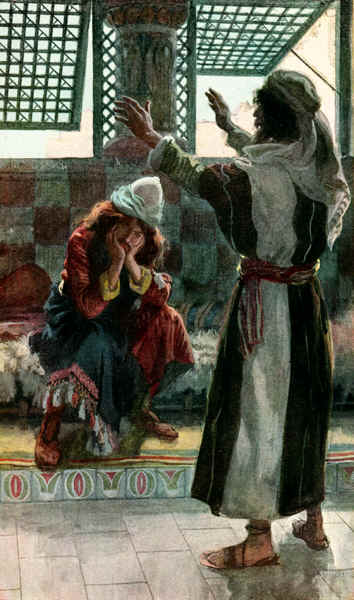
"There were two men in one city; the one rich, and the other poor. The rich man had exceeding many flocks and herds: But the poor man had nothing, save one little ewe lamb… it grew up together with him… and did eat of his own meat, and drank of his own cup, and lay in his bosom, and was unto him as a daughter." The rich man took it for his guest. "As the LORD liveth, the man that hath done this thing shall surely die."
"Thou art the man." "I anointed thee king over Israel… Wherefore hast thou despised the commandment of the LORD…? thou hast killed Uriah the Hittite with the sword, and hast taken his wife… Now therefore the sword shall never depart from thine house." "I have sinned against the LORD." "The LORD also hath put away thy sin; thou shalt not die. Howbeit… the child also that is born unto thee shall surely die."
David fasts and lies all night on the ground. On the seventh day the child dies. David rises, washes, worships and eats. "While the child was yet alive, I fasted and wept… But now he is dead… can I bring him back again? I shall go to him, but he shall not return to me." "And David comforted Bathsheba his wife… and she bare a son, and he called his name Solomon: and the LORD loved him," and Nathan names him Jedidiah, "beloved of the LORD." Joab takes the water city of Rabbah; David takes the crown of their king.
A prophet confronts a king
In much of the ancient world a king was above such rebuke. Nathan's parable uses David's own sense of justice. The ewe lamb "lay in his bosom… as a daughter" (bat, an echo of Bath-sheba).
The child's death
The death of the child for the father's sin is one of the hardest passages in Samuel. Traditional readings see God's judgment on David's house, the child taken into God's care ("I shall go to him"); modern readers object that the innocent suffer for the guilty, against Deuteronomy 24:16. The text records both David's grief and the judgment without resolving the tension.
Bathsheba
Bathsheba loses a husband and a child. The text says David "comforted" her; it is the first time she is called "his wife." She will reappear as a decisive voice in Solomon's succession (1 Kings 1–2).
Saws and brickkilns (12:31)
The Hebrew says David "put" the Ammonites "to" (or "under") saws, iron picks and axes, and made them pass through the brick-mold. Many modern translations read it as forced labor; older translations and the library's Greek ("exterminated… under saws") read it as torture and killing. The Hebrew allows both; see the passage page.
Psalm 51
Psalm 51 is titled "when Nathan the prophet came unto him, after he had gone in to Bathsheba." Psalm titles are ancient but later than the psalms; the link is a canonical association, not an independent record.
The Case for the Biblical Account
Scripture's account
Nathan's rebuke and its consequences (2 Samuel 12).
What evidence would we expect?
Court prophets; siege of Rabbah; crowns of Ammonite kings.
The discoveries
Court prophets at Mari and in Assyria; Ammonite royal statues and crowns of the 9th–8th centuries BC from Amman.
Testing the discoveries
The institutions are documented; the event is known only from Samuel.
The strongest reconstruction
A prophetic narrative judging the king by the law of God.
What remains possible
How the account was preserved.
What the evidence shows
- Court prophets confronted kings elsewhere in the ancient Near East. Mari letters include prophetic rebukes to the king.
- 12:31 describes forced labor rather than torture.
- "The LORD also hath put away thy sin."
Continue the journey
Journey of a Passage2 Samuel 12:31: Saws and brick-molds: labor or torture?After Rabbah falls, David "put" its people "to" or "under" saws, iron picks and iron axes, and made them pass "through the brick-mold." Older translations read torture and killing; many modern ones read forced labor.More from this lesson
Why this matters to the rest of Scripture
- "Have mercy upon me, O God."
- Children shall not be put to death for their fathers.
- Elijah confronts Ahab.
- Solomon's mother.