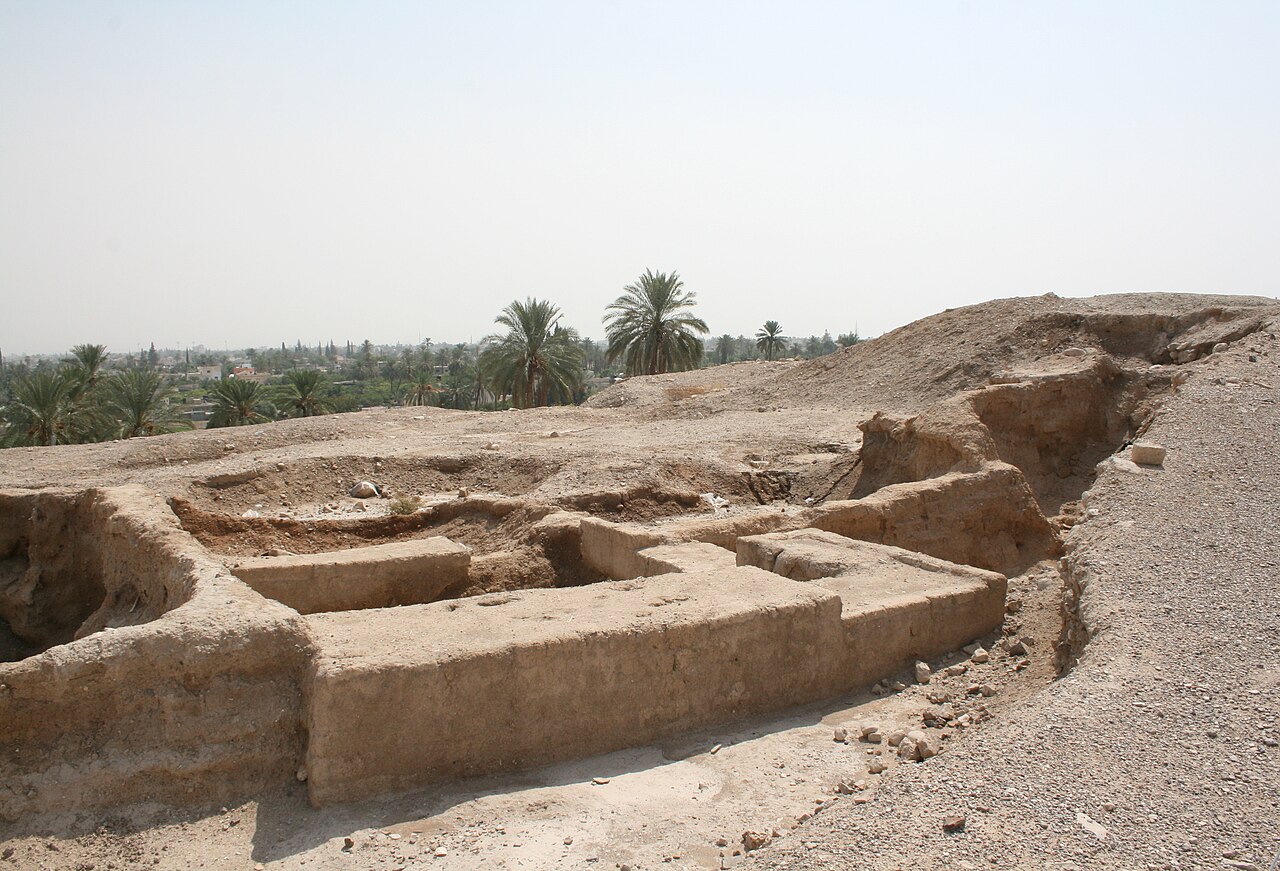
"Now Jericho was straitly shut up because of the children of Israel: none went out, and none came in." "Ye shall compass the city, all ye men of war, and go round about the city once. Thus shalt thou do six days. And seven priests shall bear before the ark seven trumpets of rams' horns: and the seventh day ye shall compass the city seven times."
"So the people shouted when the priests blew with the trumpets… and the wall fell down flat, so that the people went up into the city, every man straight before him, and they took the city. And they utterly destroyed all that was in the city, both man and woman, young and old, and ox, and sheep, and ass, with the edge of the sword."
The two spies bring out Rahab and all her family. The city is burned; silver, gold, bronze and iron go into the treasury of the LORD. "And she dwelleth in Israel even unto this day." Joshua swears: "Cursed be the man before the LORD, that riseth up and buildeth this city Jericho: he shall lay the foundation thereof in his firstborn, and in his youngest son shall he set up the gates of it."
Rams' horns
The "trumpets" are shofarot, rams' horns, not the silver trumpets of Numbers 10. The shofar is still blown at the Jewish New Year.
Excavating Jericho
| Excavator | Years | Conclusion |
|---|---|---|
| John Garstang | 1930–1936 | A collapsed double wall and burned city ("City IV") destroyed about 1400 BC; he linked it to Joshua |
| Kathleen Kenyon | 1952–1958 | Garstang's double wall was Early Bronze Age; City IV was destroyed about 1550 BC, and Jericho was nearly empty in the 13th century BC |
| Bryant Wood | 1990 (reanalysis) | Pottery and a scarab sequence point to about 1400 BC, supporting an early Exodus date |
| Bruins and van der Plicht | 1995 | Radiocarbon dating of short-lived grain from the destruction gives the 16th century BC |
| Italian-Palestinian expedition (Nigro) | 1997– | Confirms a Middle Bronze Age destruction; finds only limited Late Bronze occupation |
| Titus Kennedy | 2023 | Argues again for a destruction around 1400 BC |
Everyone agrees on the evidence of a violent end: collapsed mudbrick from the walls at the foot of the revetment, a burned layer about a meter thick, and storage jars still full of grain, suggesting a short siege after harvest and a city not looted for food. The disagreement is about the date. The majority, supported by radiocarbon, places it in the 16th century BC, too early for either common Exodus date; a minority argues for about 1400 BC, matching the early date. No massive walled city destroyed in the 13th century BC has been found.
The curse fulfilled
1 Kings 16:34 reports that in Ahab's reign (9th century BC) Hiel of Bethel rebuilt Jericho "with Abiram his firstborn, and set up the gates thereof in his youngest son Segub, according to the word of the LORD." Iron Age remains at Jericho are modest.
The Case for the Biblical Account
Scripture's account
Jericho's walls fall, the city is destroyed and burned, Rahab is spared (Joshua 6).
What evidence would we expect?
A walled city destroyed by fire; collapsed walls; a date matching the conquest.
The discoveries
A burned Middle Bronze Age city with collapsed walls and full grain jars; radiocarbon dates in the 16th century BC; little Late Bronze occupation.
Testing the discoveries
The physical destruction is certain. Its date is disputed: most date it about 1550 BC; some argue for about 1400 BC. Earthquakes are common in the Jordan rift and have been proposed as a mechanism; a destruction layer cannot itself show who or what caused it.
The strongest reconstruction
Jericho was a real fortified city that was violently destroyed, but on the majority dating, before the period usually assigned to Joshua.
What remains possible
An early (c. 1400 BC) conquest matching a revised destruction date; a later conquest whose remains eroded away; or a story built around the ruins of an older city.
Then and Later
Jericho, then and later
- c. 9000 BCOne of the oldest towns. Neolithic Jericho builds a stone tower and wall.
- 16th c. BC (majority) or c. 1400 BC (minority)City IV destroyed. Collapsed walls, a burned city, jars full of grain.
- 9th c. BCHiel rebuilds. "According to the word of the LORD."
- 1st c. BC – 1st c. ADHerod's palaces. New Testament Jericho lies nearby; Jesus heals Bartimaeus and meets Zacchaeus there.
- 2023UNESCO. Ancient Jericho/Tell es-Sultan is inscribed as a World Heritage site, for its archaeology, not as a verdict on Joshua 6.
What the evidence shows
- Jericho is Tell es-Sultan.
- City IV was destroyed by fire with its walls collapsed.Source: K. M. Kenyon, Digging Up Jericho (1957); Excavations at Jericho III (1981); L. Nigro, Italian-Palestinian Expedition to Tell es-Sultan (1997–), excavation reports
- The destruction dates to the 16th century BC.Source: H. J. Bruins and J. van der Plicht, "Tell es-Sultan (Jericho): Radiocarbon Results of Short-Lived Cereal and Multiyear Charcoal Samples from the End of the Middle Bronze Age," Radiocarbon 37 (1995) ↗; K. M. Kenyon, Digging Up Jericho (1957); Excavations at Jericho III (1981)
- The destruction dates to about 1400 BC.Source: B. G. Wood, "Did the Israelites Conquer Jericho? A New Look at the Archaeological Evidence," BAR 16:2 (1990); T. Kennedy, "The Bronze Age Destruction of Jericho, Archaeology, and the Book of Joshua," Religions 14 (2023) (early-date interpretation) ↗
- A large walled Jericho was destroyed in the 13th century BC. Not found.
- The walls fell at the people's shout by God's power.
Continue the journey
Ancient MysteriesJericho: Did the Walls Fall?Does the destroyed city at Tell es-Sultan match Joshua 6?More from this lesson
Investigations
Optional deep dives: the ancient sources, the physical evidence, and every interpretation side by side, including unconventional ones, each labeled for what it is.
Jericho: Did the Walls Fall?Site: secure · Destruction: real · Date: disputed (majority 16th century BC) · Link to Joshua: disputed
Does the destroyed city at Tell es-Sultan match Joshua 6?
Tell es-Sultan, ancient Jericho, has the remains of a fortified city destroyed by fire, with collapsed walls and storage jars still full of grain. Excavators agree on the destruction. They disagree on its date: most place it in the 16th century BC; a minority argue for about 1400 BC, matching an early Exodus. No large walled city of the 13th century BC has been found.
Open the full investigation →Why this matters to the rest of Scripture
- "By faith the walls of Jericho fell down."
- Hiel rebuilds Jericho.
- The law of herem.
- The silver trumpets (different instruments).
- Zacchaeus at Jericho.