Era 5 · The Promised LandJoshua
Ai and the Covenant Altar
"Then Joshua built an altar unto the LORD God of Israel in mount Ebal"
God says: "Fear not… lay thee an ambush for the city behind it." Thirty thousand men hide west of Ai between Bethel and Ai. Joshua's main force draws the king of Ai out, feigning flight; the city is left open. "Stretch out the spear that is in thy hand toward Ai." The ambush rises, takes the city and sets it on fire; Ai's men are caught between the two forces. Twelve thousand die. Joshua "burnt Ai, and made it an heap for ever," and hangs its king on a tree until evening.
"Then Joshua built an altar unto the LORD God of Israel in mount Ebal… an altar of whole stones, over which no man hath lift up any iron." "And he wrote there upon the stones a copy of the law of Moses." All Israel, "as well the stranger, as he that was born among them," stands half facing Gerizim and half facing Ebal. "There was not a word of all that Moses commanded, which Joshua read not before all the congregation of Israel, with the women, and the little ones, and the strangers that were conversant among them."
Where was Ai?
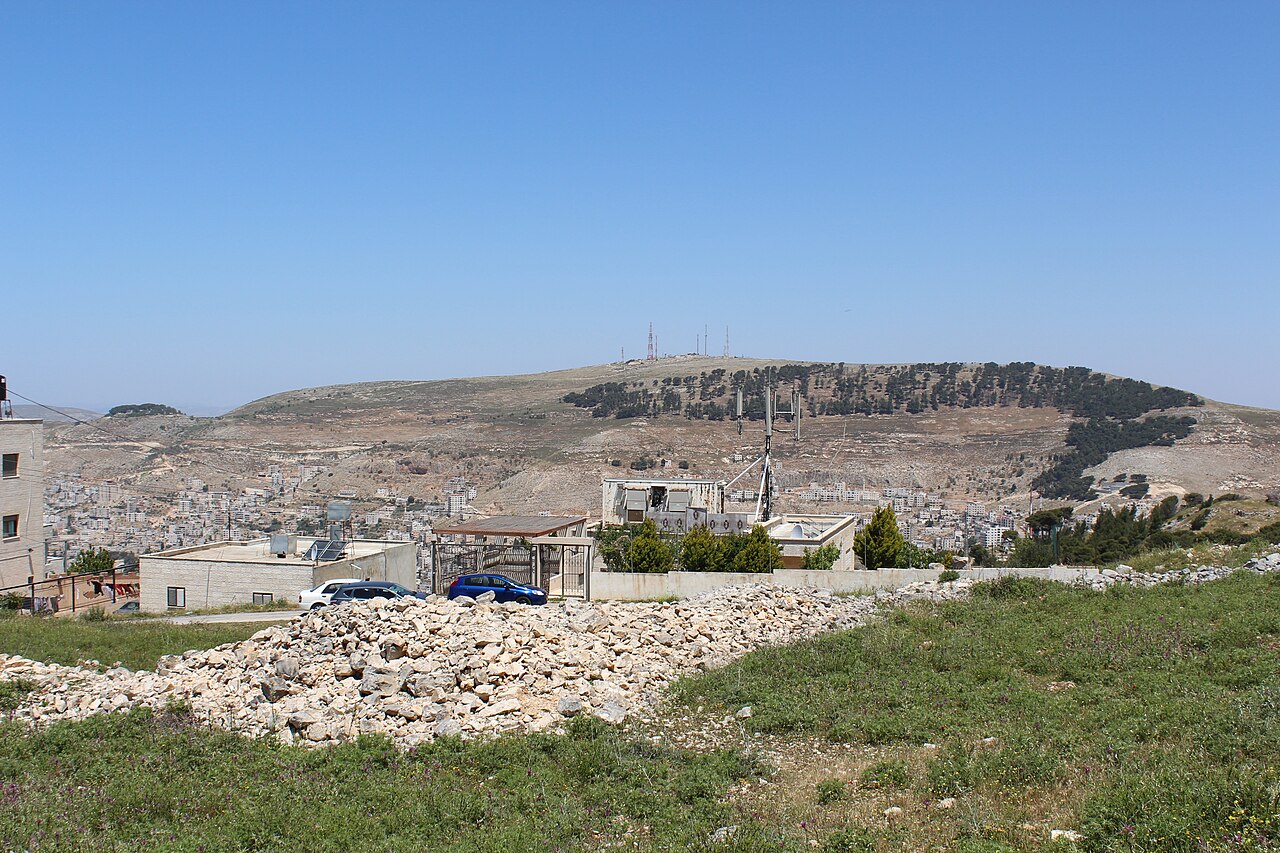
"Ai" means "the ruin." Most scholars identify it with et-Tell, east of Bethel. Excavations there (Judith Marquet-Krause 1933–35; Joseph Callaway 1964–72) found a large Early Bronze Age city destroyed about 2400 BC, then nothing until a small unwalled Iron Age I village. That fits neither common date for Joshua, and many scholars read the story as an explanation of the great ruin. The Associates for Biblical Research excavated Khirbet el-Maqatir, about 1 km west, and argue it was a small Late Bronze I fortress fitting a 15th-century conquest; this is an advocacy position, not the field consensus. The identification of Bethel (Beitin or el-Bira) affects the argument.
Where does the altar ceremony belong?
| Witness | Placement of the altar and reading | Status |
|---|---|---|
| Masoretic Text | 8:30–35, after the capture of Ai | Extant; checked in the library |
| Septuagint | After 9:2, just before the Gibeonites | Checked in the library's Greek (Giguet): the passage appears at 9:2–4 |
| 4QJosh-a (4Q47) | Apparently before 5:2, right after the crossing of the Jordan | Fragmentary; the order is partly reconstructed by the editor (Ulrich). Not all letters are extant |
| Josephus (Antiquities 5) | Retells the ceremony later, after the conquest | A retelling, not a manuscript |
Deuteronomy 27:2–4 says the stones are to be set up "on the day when ye shall pass over Jordan." Some scholars think the Qumran order, right after the crossing, is the oldest, and that the passage moved later in other traditions, especially if the altar was on Gerizim, as the Samaritan text of Deuteronomy 27:4 says. Others argue the Masoretic position is original. Studies of 2024 (JBL) and 2025 (Segal, Vetus Testamentum) disagree. The passage page lays out the witnesses.
The Case for the Biblical Account
Scripture's account
Ai is taken by ambush; the altar is built on Ebal and the law read (Joshua 8).
What evidence would we expect?
A destroyed town at Ai in the conquest period; an altar on Ebal; consistent placement of the ceremony.
The discoveries
Et-Tell: Early Bronze ruins and an Iron I village; Khirbet el-Maqatir: claimed Late Bronze I fortress; Zertal's disputed Iron I structure on Ebal; three different placements of the ceremony in ancient witnesses.
Testing the discoveries
At et-Tell the archaeology does not match; Maqatir's identification and dating are contested. The textual placements show the passage moved in transmission.
The strongest reconstruction
Ai's story is anchored to an impressive ruin whose identification and date are unresolved; the altar episode circulated in more than one position.
What remains possible
That Ai is et-Tell and the story explains its ruins; that Ai is Maqatir; that the ceremony was originally placed at the crossing.
What the evidence shows
- Et-Tell's major city was destroyed about 2400 BC.Source: J. A. Callaway, excavations at et-Tell (Ai), 1964–1972
- Khirbet el-Maqatir is Joshua's Ai.Source: Associates for Biblical Research, "The Search for Joshua's Ai" (advocacy of Khirbet el-Maqatir) ↗
- The Septuagint places the altar ceremony after 9:2. Checked in the library (Giguet).
- 4QJosh-a places the ceremony before 5:2. Based on a partly reconstructed fragment.Source: E. Ulrich, "4QJosh-a," DJD XIV (1995); The Biblical Qumran Scrolls (2010)
- The Qumran order is original.Source: M. Segal, "From the Jordan to Mt. Ebal and Back," Vetus Testamentum 75 (2025) ↗; "Conquests Need Monuments and Monuments Need Inscriptions: The Textual Location of the Mount Ebal Altar Episode in Joshua," JBL 143 (2024) ↗
Continue the journey
Journey of a PassageJoshua 8:30–35: Where does the altar ceremony belong?The altar on Mount Ebal and the reading of the law stand after the fall of Ai in the Hebrew, after 9:2 in the Greek, and apparently right after the crossing of the Jordan in a Dead Sea Scroll.More from this lesson
Investigations
Optional deep dives: the ancient sources, the physical evidence, and every interpretation side by side, including unconventional ones, each labeled for what it is.
Ai: et-Tell or Khirbet el-Maqatir?Identification: disputed · et-Tell: does not fit · Maqatir: advocacy proposal
Has Joshua's Ai been found?
Ai, "the ruin," is usually identified with et-Tell near Bethel, a great Early Bronze Age city destroyed about 2400 BC, followed by a small Iron Age village: no city in either proposed period of Joshua. Advocates of an early conquest argue that Ai is Khirbet el-Maqatir, a small site nearby with a claimed Late Bronze I fortress.
Open the full investigation →Why this matters to the rest of Scripture
- The command for stones and an altar.
- Blessing on Gerizim, curse on Ebal.
- Abram's altar between Bethel and Ai.
- The law read to men, women and all who could understand.