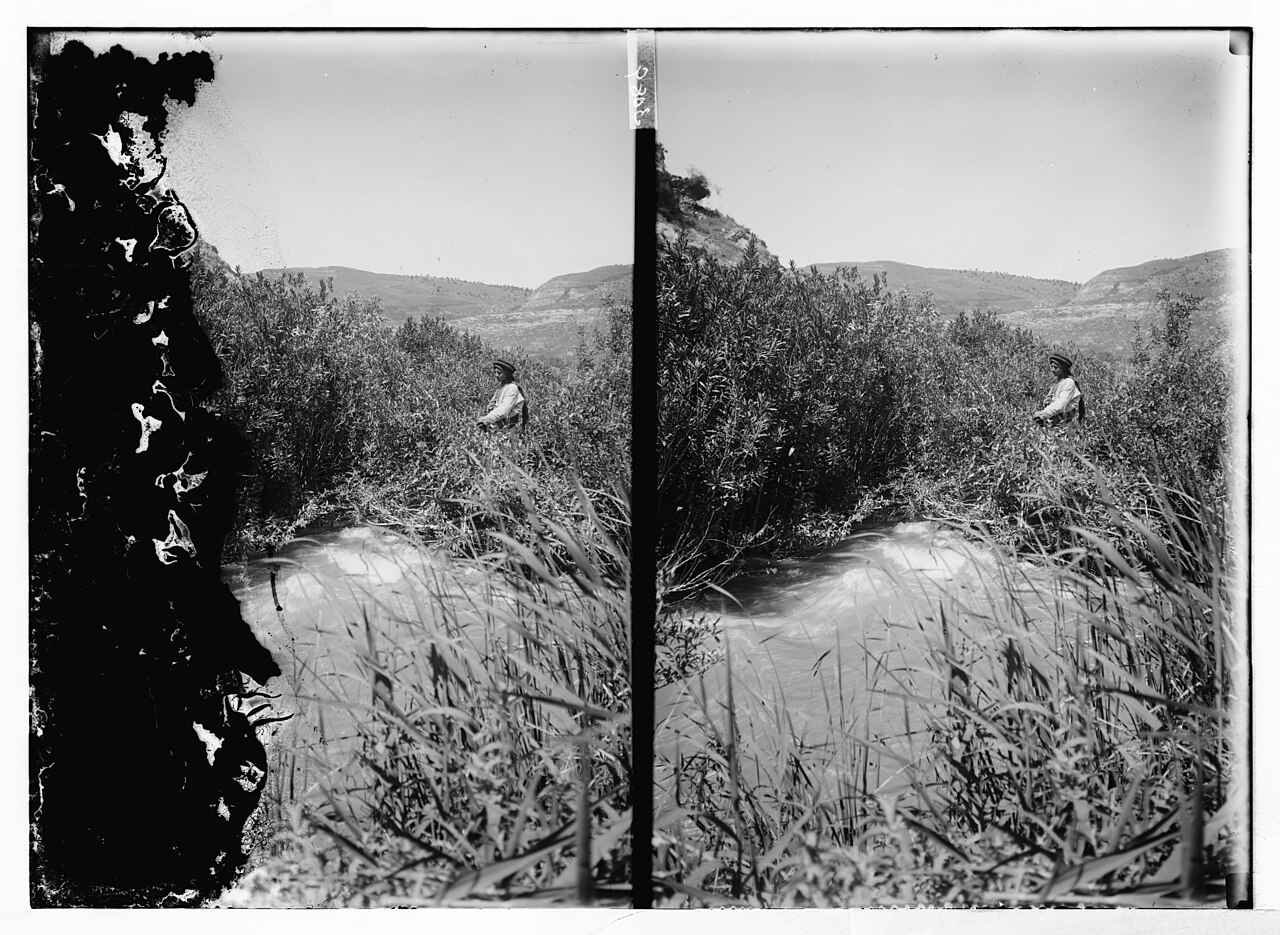
"Now after the death of Moses the servant of the LORD it came to pass, that the LORD spake unto Joshua the son of Nun, Moses' minister, saying, Moses my servant is dead; now therefore arise, go over this Jordan, thou, and all this people, unto the land which I do give to them."
"Every place that the sole of your foot shall tread upon, that have I given unto you… From the wilderness and this Lebanon even unto the great river, the river Euphrates, all the land of the Hittites, and unto the great sea toward the going down of the sun." "As I was with Moses, so I will be with thee: I will not fail thee, nor forsake thee. Be strong and of a good courage."
"This book of the law shall not depart out of thy mouth; but thou shalt meditate therein day and night… for then thou shalt make thy way prosperous, and then thou shalt have good success. Have not I commanded thee? Be strong and of a good courage; be not afraid, neither be thou dismayed."
Joshua tells the officers to prepare food: "within three days ye shall pass over this Jordan." He reminds Reuben, Gad and half of Manasseh of their promise to Moses. They answer: "All that thou commandest us we will do… only be strong and of a good courage."
From the Torah to the Prophets
Joshua is the first book after the Torah. In the Jewish Bible it opens the Former Prophets (Joshua, Judges, Samuel, Kings); in Christian Bibles it begins the historical books. Its first chapter deliberately echoes Deuteronomy 31: the same charge, "be strong and of a good courage," and the same promise, "I will not fail thee, nor forsake thee." The book of the law that Moses wrote now guides his successor.
An ideal map
The borders in 1:4, from the southern wilderness to Lebanon and the Euphrates, describe a promise, not a territory Israel ever ruled in Joshua's time. Even under David and Solomon, Israel's control over Syria was indirect. The site's atlas marks these borders as a textual ideal, not a surveyed boundary.
"Meditate day and night"
The verb hagah means to murmur or recite in a low voice: reading aloud, not silent thought. Psalm 1:2 uses the same words for the righteous: "in his law doth he meditate day and night."
The Case for the Biblical Account
Scripture's account
God commissions Joshua; the eastern tribes pledge support (Joshua 1).
What evidence would we expect?
Continuity with Deuteronomy; ancient installation and loyalty language.
The discoveries
Joshua 1 reuses Deuteronomy's language closely; ancient Near Eastern royal installations and loyalty oaths use encouragement and obedience formulas.
Testing the discoveries
The literary link to Deuteronomy is clear and is a key argument for the "Deuteronomistic History" theory. No external record mentions Joshua.
The strongest reconstruction
Joshua 1 is written as the continuation of Deuteronomy, presenting the book as the fulfillment of Moses' word.
What remains possible
That the charge preserves an old installation tradition; that its present wording is Deuteronomic.
What the evidence shows
- Joshua 1 closely repeats the language of Deuteronomy 31.
- Israel controlled territory to the Euphrates in Joshua's time. The borders are an ideal; Joshua 13 says much land remained.
- "As I was with Moses, so I will be with thee."
Continue the journey
Connected elsewhere in ScriptureJoshua and the Written LawDeuteronomy 31:6–8, 23: Moses charges Joshua.More from this lesson
Why this matters to the rest of Scripture
- Moses charges Joshua.
- Joshua commissioned.
- The eastern tribes' promise.
- "In his law doth he meditate day and night."
- "I will never leave thee, nor forsake thee."