Era 5 · The Promised LandJoshua
The Jordan Opens
"The waters which came down from above stood and rose up upon an heap"
Israel camps at the Jordan three days. The officers command: "When ye see the ark of the covenant of the LORD your God, and the priests the Levites bearing it, then ye shall remove from your place, and go after it. Yet there shall be a space between you and it, about two thousand cubits." "Sanctify yourselves: for to morrow the LORD will do wonders among you."
"Hereby ye shall know that the living God is among you." "And as they that bare the ark were come unto Jordan, and the feet of the priests… were dipped in the brim of the water, (for Jordan overfloweth all his banks all the time of harvest,) That the waters which came down from above stood and rose up upon an heap very far from the city Adam, that is beside Zaretan… and the people passed over right against Jericho."
"And the priests that bare the ark… stood firm on dry ground in the midst of Jordan, and all the Israelites passed over on dry ground, until all the people were passed clean over Jordan."
The river in flood
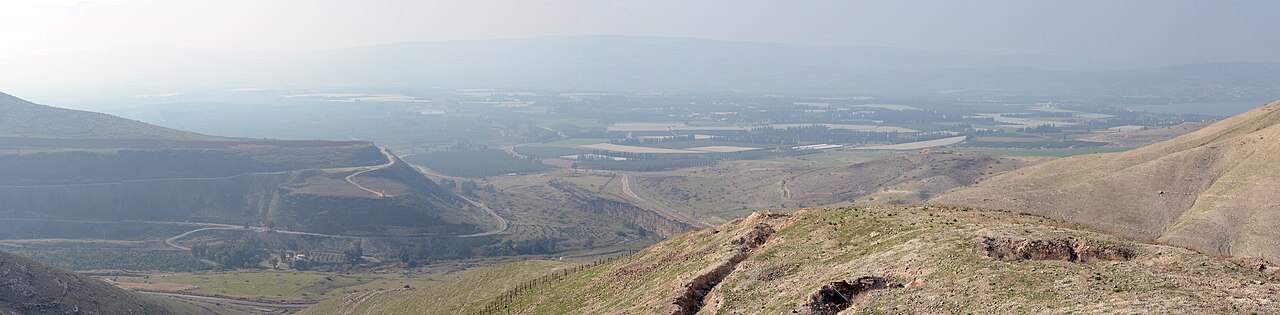
The narrative sets the crossing in the first month, at the barley harvest (4:19; 5:10–11), when snowmelt from Mount Hermon raised the Jordan. Before modern dams and water diversion, the lower Jordan could swell well beyond its channel in spring.
Landslides at Adam
Adam is usually identified with Tell ed-Damiyeh, about 30 km upstream of Jericho, where the river runs between high, soft marl banks. Two blockages are recorded there. The Arab historian al-Nuwayri describes the river stopping for hours in AD 1267 (dated 1266/67) when a bank collapsed. During the earthquake of July 11, 1927, landslides near Damiya blocked the flow, by reports for about 21 hours. These show a natural way the Jordan can stop near Adam. They cannot show that this is what happened in Joshua 3, and the narrative presents the timing at the priests' feet as God's act.
Sea and river
| Exodus 14 | Joshua 3 | |
|---|---|---|
| Leader | Moses' staff | The ark carried by priests |
| Water | "A wall unto them" | "Rose up upon an heap" |
| Ground | "Dry ground" | "Dry ground" |
| Purpose | "The Egyptians shall know that I am the LORD" | "That all the people of the earth might know the hand of the LORD" (4:24) |
The Case for the Biblical Account
Scripture's account
The Jordan stops near Adam as the priests carry the ark into it (Joshua 3).
What evidence would we expect?
A plausible place and mechanism for the water to stop; a crossing point near Jericho.
The discoveries
Tell ed-Damiyeh as Adam; recorded landslide blockages at Damiya in AD 1267 and 1927.
Testing the discoveries
The blockages are historically reported. They show a physical possibility, not a demonstration of the biblical event.
The strongest reconstruction
The account describes a real river and a place where the Jordan is known to stop; the event itself is known only from Scripture.
What remains possible
A providential natural blockage; a miracle beyond natural mechanism; or a liturgical retelling modeled on the Exodus.
What the evidence shows
- Landslides blocked the Jordan near Damiya in 1927.
- Al-Nuwayri reports a similar blockage in 1267. Medieval report; archival details to be checked.
- Adam is Tell ed-Damiyeh.
- A landslide explains Joshua 3.
- "Hereby ye shall know that the living God is among you."
Continue the journey
Connected elsewhere in ScripturePharaoh's PursuitExodus 14:21–22: The sea divided.More from this lesson
Why this matters to the rest of Scripture
- The sea divided.
- "Jordan was driven back."
- Elijah and Elisha part the Jordan.
- Jesus baptized in the Jordan.