"Take you hence out of the midst of Jordan, out of the place where the priests' feet stood firm, twelve stones, and ye shall carry them over with you, and leave them in the lodging place." "That this may be a sign among you, that when your children ask their fathers in time to come, saying, What mean ye by these stones? Then ye shall answer them, That the waters of Jordan were cut off before the ark of the covenant of the LORD."
"And Joshua set up twelve stones in the midst of Jordan, in the place where the feet of the priests… stood: and they are there unto this day." When the priests come up out of the river, "the waters of Jordan returned unto their place, and flowed over all his banks, as they did before."
"And the people came up out of Jordan on the tenth day of the first month, and encamped in Gilgal, in the east border of Jericho. And those twelve stones… did Joshua pitch in Gilgal." About forty thousand armed men of the eastern tribes cross before Israel. "On that day the LORD magnified Joshua in the sight of all Israel."
Two sets of stones?
Joshua 4:9 says Joshua set up twelve stones "in the midst of Jordan"; 4:20 says he set up at Gilgal the twelve taken out of the river. Readers have explained this as two monuments, one in the river and one at the camp; as two traditions joined; or (some ancient versions and modern translators) as one set of stones "from the midst of Jordan." The text is presented as it stands.
Where was Gilgal?
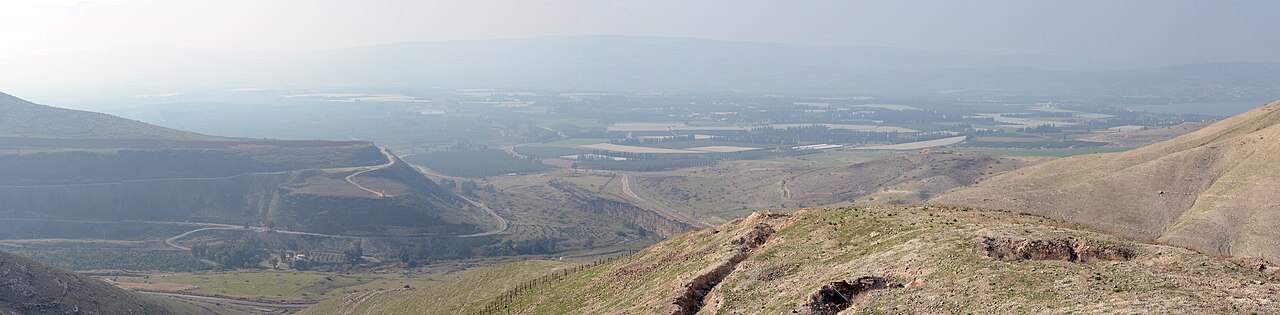
Gilgal ("circle" of stones, or "rolling") was Israel's first camp, east of Jericho. Its location has not been securely identified; candidates near Jericho include Khirbet el-Mafjar and Khirbet en-Nitla. Adam Zertal identified large stone enclosures in the Jordan valley shaped like a foot or sandal as early Israelite gathering places he called "gilgals"; this is a minority proposal. No excavated monument has been identified as Joshua's stones. Other places called Gilgal appear in the Bible (near Shechem, and Elijah's Gilgal), and should not be confused.
Children's questions
The question "What mean ye…?" appears at Passover (Exodus 12:26), at the redemption of the firstborn (Exodus 13:14), about the law (Deuteronomy 6:20), and here. The Passover seder's "four questions" continue this tradition.
The Case for the Biblical Account
Scripture's account
Twelve stones commemorate the crossing at Gilgal (Joshua 4).
What evidence would we expect?
A stone monument near Jericho; an identified Gilgal.
The discoveries
No identified Gilgal; Zertal's foot-shaped enclosures in the Jordan valley; standing-stone sites elsewhere in Canaan (Gezer's row of stones, Arad's shrine).
Testing the discoveries
Standing stones were a common memorial and cult form. Zertal's interpretation is debated.
The strongest reconstruction
A memorial at Gilgal anchored Israel's memory of the crossing; its remains are unknown.
What remains possible
That the stones lay at a site not yet identified or destroyed.
What the evidence shows
- Joshua 4 mentions stones in the Jordan (4:9) and at Gilgal (4:20).
- Gilgal's location is known.
- Zertal's foot-shaped enclosures are Israelite gilgals.Source: A. Zertal, "Has Joshua's Altar Been Found on Mt. Ebal?" BAR 11:1 (1985); on the Jordan valley "foot" enclosures (gilgal), A. Zertal (2002–2016)
Continue the journey
Connected elsewhere in ScriptureWhen Did the Exodus Happen?Exodus 12:26–27: "What mean ye by this service?"More from this lesson
Why this matters to the rest of Scripture
- "What mean ye by this service?"
- "When thy son asketh thee."
- Jacob's stone at Bethel.
- Ebenezer, "hitherto hath the LORD helped us."