Era 5 · The Promised LandJoshua
The Land Still Unconquered
"There remaineth yet very much land to be possessed"
"Now Joshua was old and stricken in years; and the LORD said unto him, Thou art old and stricken in years, and there remaineth yet very much land to be possessed." The land still to be taken includes "all the borders of the Philistines," the five lords of Gaza, Ashdod, Ashkelon, Gath and Ekron, the land of the Canaanites to Sidon, and Lebanon to the entrance of Hamath. "Them will I drive out… only divide thou it by lot unto the Israelites."
East of the Jordan, Moses had given land to two and a half tribes: Reuben from the Arnon, including Medeba, Heshbon, Dibon, Bamoth-baal and Beth-baal-meon; Gad, Jazer and Gilead to the Jabbok; half of Manasseh in Bashan. "Balaam also the son of Beor, the soothsayer, did the children of Israel slay with the sword." The Geshurites and Maachathites were not driven out "but… dwell among the Israelites until this day." "But unto the tribe of Levi Moses gave not any inheritance: the LORD God of Israel was their inheritance."
Philistines in the text
The Philistines settled the southern coast in the 12th century BC, after the Sea Peoples' movements; their distinctive pottery and pig consumption appear then. Their five cities are named here as already existing. If the conquest is placed before 1200 BC, the reference reflects the narrator's later geography. Calling a region by its later name is common in the Bible and does not by itself date every part of the book.
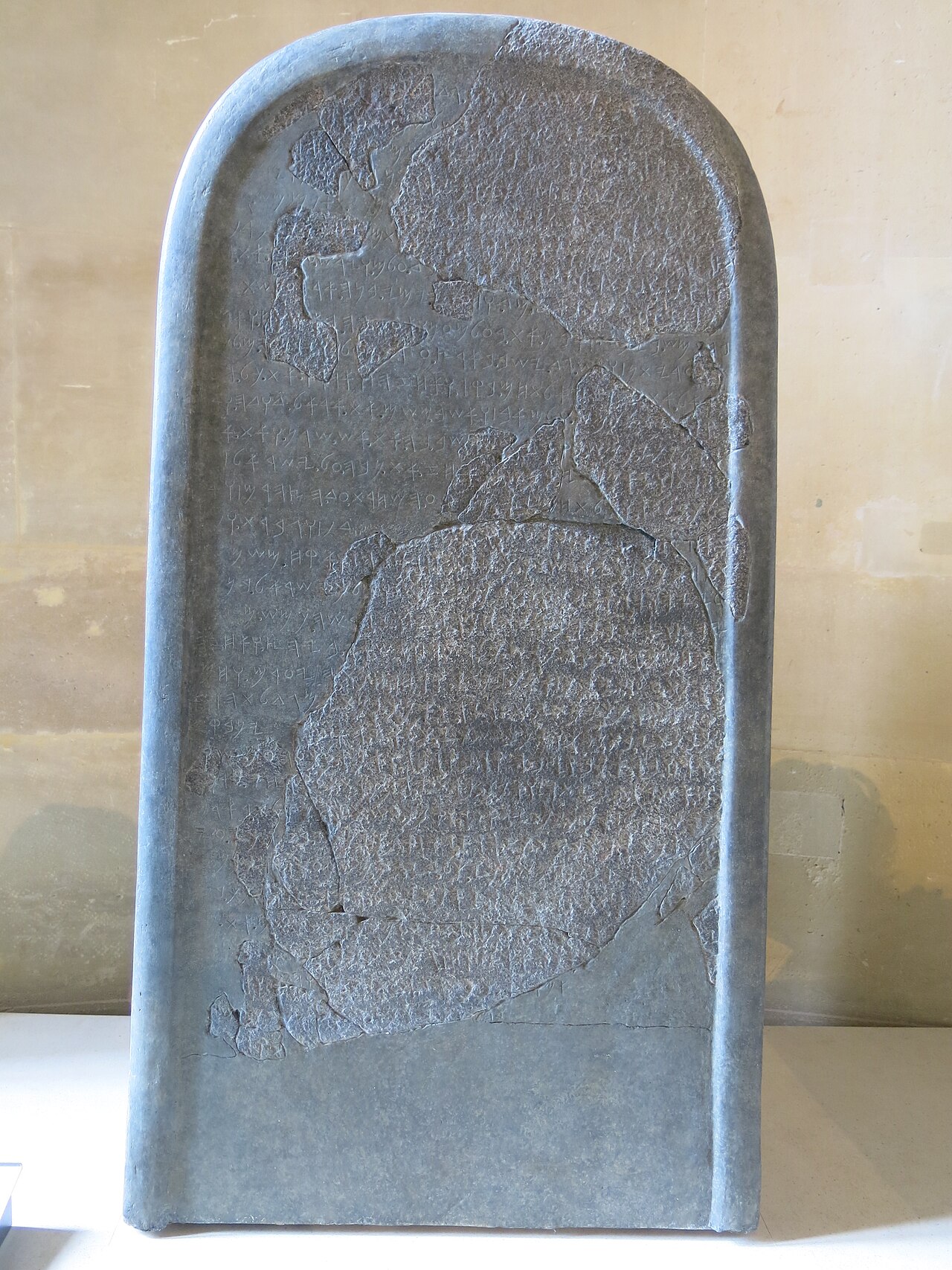
Moabite names on a Moabite stone
Several towns given to Reuben in Joshua 13 (Medeba, Dibon, Baal-meon, Ataroth, Nebo) appear in the 9th-century BC Mesha Stele as cities Moab recovered from Israel. The stone shows later Israel–Moab contest over the same towns.
Land and its limits
| Passage | Statement |
|---|---|
| 1:4 | From the wilderness to the Euphrates |
| 11:23; 21:43 | "So Joshua took the whole land… And the land rested from war" |
| 13:1 | "There remaineth yet very much land to be possessed" |
| 15:63 | Judah could not drive out the Jebusites of Jerusalem |
| 16:10 | The Canaanites of Gezer remained |
| 17:12–13 | Manasseh could not drive out the Canaanites |
The Case for the Biblical Account
Scripture's account
Much land remains; the eastern tribes' territories are described (Joshua 13).
What evidence would we expect?
Philistine and Phoenician cities; Transjordanian towns.
The discoveries
Philistine material culture from the 12th century BC; Phoenician coastal cities; the Mesha Stele's towns; Geshur in the Golan (Bethsaida, et-Tell).
Testing the discoveries
The Philistine presence is later than an early conquest date; the place names are real.
The strongest reconstruction
Joshua 13 preserves real geography and openly admits incomplete conquest.
What remains possible
That the Philistine references reflect later updating.
What the evidence shows
- Philistine material culture appears on the southern coast in the 12th century BC.
- Joshua 13:1 says much land remained unconquered.
- The Mesha Stele names towns of Reuben's allotment.Source: Mesha Stele, Louvre AO 5066 ↗
Continue the journey
Connected elsewhere in ScriptureReuben, Gad, and the Lands East of the JordanNumbers 32: The eastern tribes.More from this lesson
Why this matters to the rest of Scripture
- The eastern tribes.
- Balaam killed.
- Nations left to test Israel.
- David's wife Maacah, daughter of the king of Geshur.