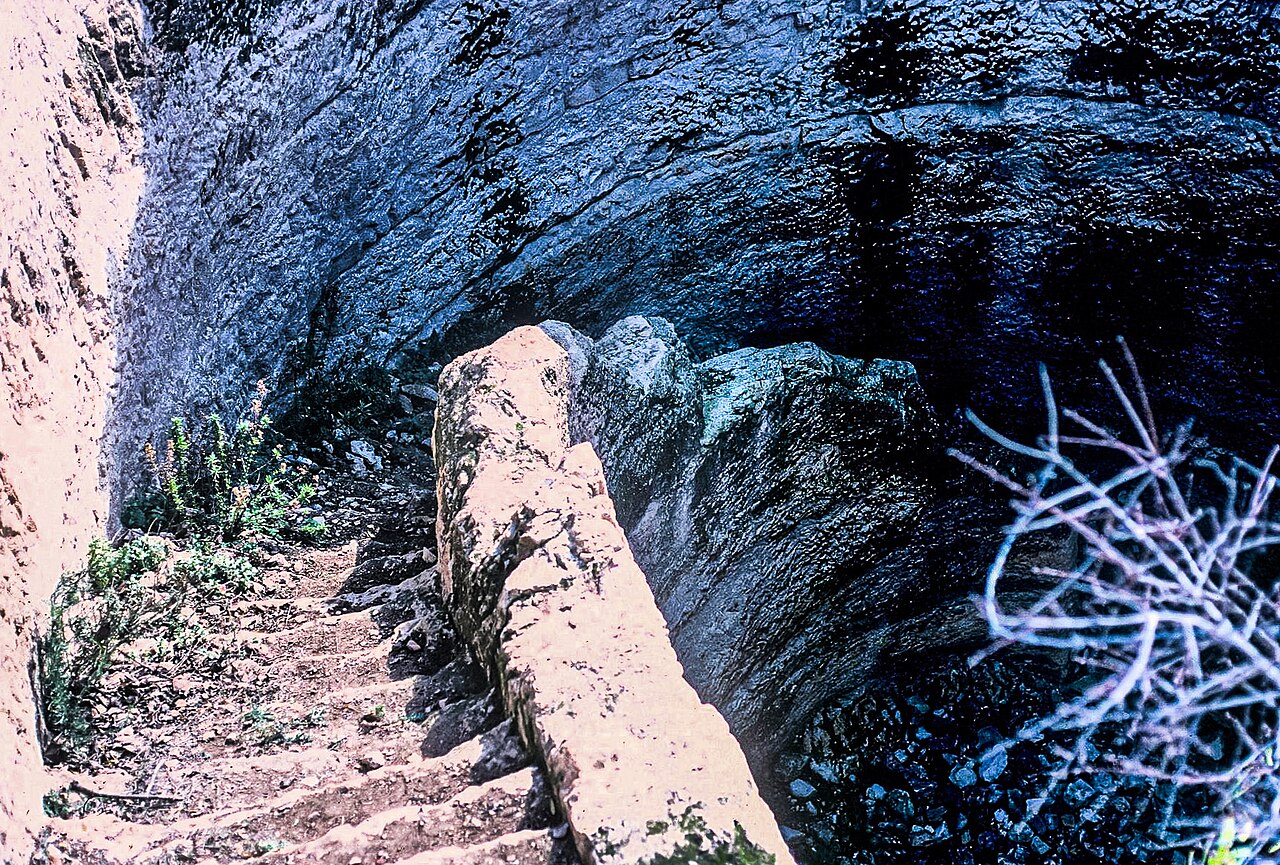
Adoni-zedek king of Jerusalem and the kings of Hebron, Jarmuth, Lachish and Eglon attack Gibeon for making peace with Israel. Gibeon sends to Joshua: "Slack not thy hand from thy servants." Joshua marches all night from Gilgal and falls on them suddenly. They flee by the ascent of Beth-horon, "and the LORD cast down great stones from heaven upon them… they were more which died with hailstones than they whom the children of Israel slew with the sword."
The five kings hide in a cave at Makkedah. Joshua has them brought out; his captains put their feet on the kings' necks, and Joshua kills them and hangs them on trees until evening. Then Makkedah, Libnah, Lachish, Eglon, Hebron and Debir are taken: "he left none remaining, but utterly destroyed all that breathed, as the LORD God of Israel commanded."
The lost Book of Jashar
"The book of Jasher" (Sefer ha-Yashar, "the book of the upright") is cited here and for David's lament over Saul and Jonathan (2 Samuel 1:18). It was evidently a collection of old poetry. It is lost. Later works with the same title, a Hebrew retelling printed in Venice in 1625 and an English forgery published in 1751, are not that book. The Greek Septuagint here lacks the question "Is not this written in the book of Jasher?" (checked in the library's Greek).
What did the sun do?
- A miracle: the day was literally lengthened; the traditional reading.
- Poetry: an old victory song in the style of Judges 5:20 ("the stars in their courses fought against Sisera"), read literally by the prose that follows.
- Darkness, not light: the verb dom can mean "be silent" or "be still"; some read a prayer for the sun to stop shining, for clouds and hail or a cooler day.
- An eclipse: Colin Humphreys and Graeme Waddington (2017) proposed an annular solar eclipse visible in Canaan on 30 October 1207 BC; Vainstub, Yizhaq and Avner (2020) also read the passage as an eclipse. These are calculations of what could have been seen; they do not show that Joshua saw one, and the dates do not fit every chronology.
- Omens: Mesopotamian astrologers recorded the sun and moon "standing" in relation to each other as omens; some scholars read the verse against that background.
No physical record shows the Earth's rotation stopping. Claims that NASA found a "missing day" are a modern urban legend with no source.
Beth-horon and Lachish
The ascent of Beth-horon is a real pass from the hill country to the coastal plain, the site of later battles, including the Maccabees' victory (1 Maccabees 3:13–24) and a Roman defeat in AD 66. Lachish (Tel Lachish) was destroyed in the Late Bronze Age, but its final Canaanite city (Level VI) fell around 1150–1130 BC, later than Hazor and later than either common date for Joshua. Debir is identified with Tell Beit Mirsim or Khirbet Rabud.
The Case for the Biblical Account
Scripture's account
The southern coalition is defeated; the sun stands still; southern cities are taken (Joshua 10).
What evidence would we expect?
Destruction layers at the named cities in the same period; a record of an unusual sky event.
The discoveries
Lachish destroyed c. 1150–1130 BC; varied histories at Hebron, Debir and Eglon; Amarna letters showing Jerusalem, Lachish and Gezer as rival Canaanite city-states in the 14th century BC; eclipse calculations for 1207 BC.
Testing the discoveries
The destructions do not form one campaign horizon. The eclipse is a possible interpretation, not evidence of the event.
The strongest reconstruction
Joshua 10 preserves real places and an old poem, framed as one sweeping campaign.
What remains possible
A historical battle at Gibeon remembered in poetry; a literal miracle; a later idealized summary of many conflicts.
What the evidence shows
- The Book of Jashar is cited in Joshua 10:13 and 2 Samuel 1:18 and is lost.
- The Septuagint lacks the reference to Jashar in 10:13. Checked in the library (Giguet).
- An annular eclipse was visible from Canaan on 30 October 1207 BC.Source: C. Humphreys and G. Waddington, "Solar eclipse of 1207 BC helps to date pharaohs," Astronomy & Geophysics 58 (2017) ↗
- Joshua 10 describes that eclipse.Source: C. Humphreys and G. Waddington, "Solar eclipse of 1207 BC helps to date pharaohs," Astronomy & Geophysics 58 (2017) ↗; D. Vainstub, H. Yizhaq and U. Avner, on Joshua 10:12–13 as an eclipse, Vetus Testamentum (2020) ↗
- NASA found a "missing day." An urban legend with no source.
- Lachish's last Canaanite city fell c. 1150–1130 BC.
- The LORD hearkened unto the voice of a man.
Continue the journey
Journey of a PassageJoshua 10:12–13: "Sun, stand still" and the Book of JasharThe Hebrew quotes a poem and cites "the book of Jasher" as its source.More from this lesson
Investigations
Optional deep dives: the ancient sources, the physical evidence, and every interpretation side by side, including unconventional ones, each labeled for what it is.
The Lost Book of Jashar and the Day the Sun Stood StillBook: lost · Later "Jasher" books: not the original · Eclipse: a proposal
What was the Book of Jashar, and what happened at Gibeon?
Joshua and 2 Samuel quote a "book of Jasher," an ancient collection of poems now lost. Books published since 1625 under the same name are different works. The sun-and-moon poem it supplied has been read as a miracle, as poetry, as a prayer for darkness, and as an eclipse.
Open the full investigation →Why this matters to the rest of Scripture
- The lament in the Book of Jasher.
- "The sun and moon stood still in their habitation."
- "The stars in their courses fought."
- "As in the valley of Gibeon."
- Jerusalem, Hebron and Debir in Judges.