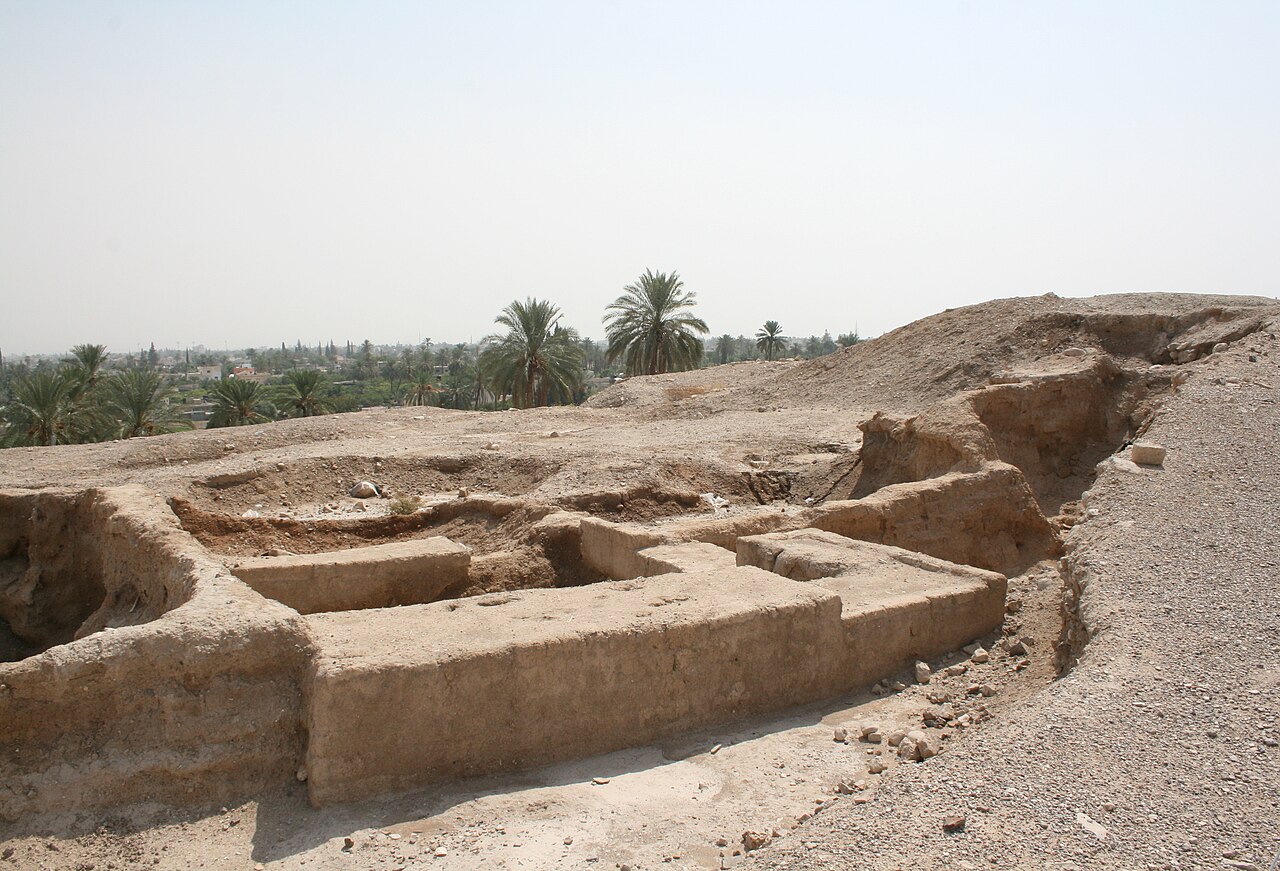
Tell es-Sultan, ancient Jericho, has the remains of a fortified city destroyed by fire, with collapsed walls and storage jars still full of grain. Excavators agree on the destruction. They disagree on its date: most place it in the 16th century BC; a minority argue for about 1400 BC, matching an early Exodus. No large walled city of the 13th century BC has been found.
Site: secure · Destruction: real · Date: disputed (majority 16th century BC) · Link to Joshua: disputed
Site or place photographTell es-Sultan, the mound of ancient Jericho.Image credit
1 What Scripture says
"So the people shouted when the priests blew with the trumpets… and the wall fell down flat… And they burnt the city with fire" (Joshua 6:20, 24).
2 What evidence we might expect
A walled city in the period of the conquest.
Evidence of collapse and burning.
Little looting of food, if the city was devoted to destruction.
3 What discoveries exist
Researcher
Years
Conclusion
John Garstang
1930–36
City IV destroyed c. 1400 BC; walls fallen
Kathleen Kenyon
1952–58
City IV destroyed c. 1550 BC; Garstang's walls Early Bronze; little 13th-century occupation
Bryant Wood
1990
Pottery and scarabs support c. 1400 BC
H. J. Bruins and J. van der Plicht
1995
Radiocarbon on short-lived grain: 16th century BC
Italian-Palestinian Expedition (L. Nigro)
1997–
Middle Bronze destruction; modest Late Bronze remains
Titus Kennedy
2023
Re-argues c. 1400 BC
Site or place photographTell es-Sultan, the mound of ancient Jericho.Image credit
The physical evidence: a stone revetment wall with a mudbrick wall on top; collapsed bricks piled at the base of the revetment in places; a burn layer about a meter thick; dozens of storage jars full of charred grain. Jericho lies on the Jordan rift, an active earthquake zone, and an earthquake has been proposed as a cause of the collapse; that is a physical possibility, not an established cause.
4 How interpretations compare
Traditional reading
Early conquest (c. 1400 BC)
The destruction of City IV was Joshua's conquest; the radiocarbon dates and Kenyon's pottery arguments are disputed.
Assessment: A minority position among archaeologists.
City IV fell around 1550 BC, perhaps in Egyptian campaigns after the expulsion of the Hyksos; there was no major city for Joshua to conquer in the 13th century.
Late Bronze remains existed but eroded away, leaving the story's setting invisible.
Assessment: Possible but untestable; Kenyon found some Late Bronze tombs and a building.
Scholarly reconstruction
Etiology
The story was told to explain the impressive ruins of an older city.
5 The strongest supported reconstruction
Jericho was a real walled city destroyed violently. The majority of the evidence dates that destruction to the 16th century BC, earlier than the usual dates for Joshua; a minority argues for about 1400 BC. The archaeology cannot show who or what destroyed the city.
6 What remains possible or unknown
The exact date of City IV's destruction.
The extent of Late Bronze occupation.
The cause of the wall collapse.
What the evidence shows
Independently documentedCity IV was burned and its walls collapsed.
Source: K. M. Kenyon, Digging Up Jericho (1957); Excavations at Jericho III (1981)
Strongly supportedRadiocarbon dates the destruction to the 16th century BC.