Psalm 110: Sit at My Right Hand
A priest for ever after the order of Melchizedek
"The LORD said unto my Lord, Sit thou at my right hand, until I make thine enemies thy footstool. The LORD shall send the rod of thy strength out of Zion: rule thou in the midst of thine enemies. Thy people shall be willing in the day of thy power, in the beauties of holiness from the womb of the morning: thou hast the dew of thy youth."
"The LORD hath sworn, and will not repent, Thou art a priest for ever after the order of Melchizedek. The Lord at thy right hand shall strike through kings in the day of his wrath. He shall judge among the heathen, he shall fill the places with the dead bodies; he shall wound the heads over many countries. He shall drink of the brook in the way: therefore shall he lift up the head."
"The LORD said unto my Lord"
Ne'um YHWH la'doni: "An oracle of YHWH to my lord." Adoni, "my lord," is the ordinary title for a king or master (1 Samuel 22:12). In the setting of a royal psalm, a prophet or court poet announces God's word to the king. The KJV distinguishes "LORD" (YHWH) and "Lord" (adoni).
Melchizedek
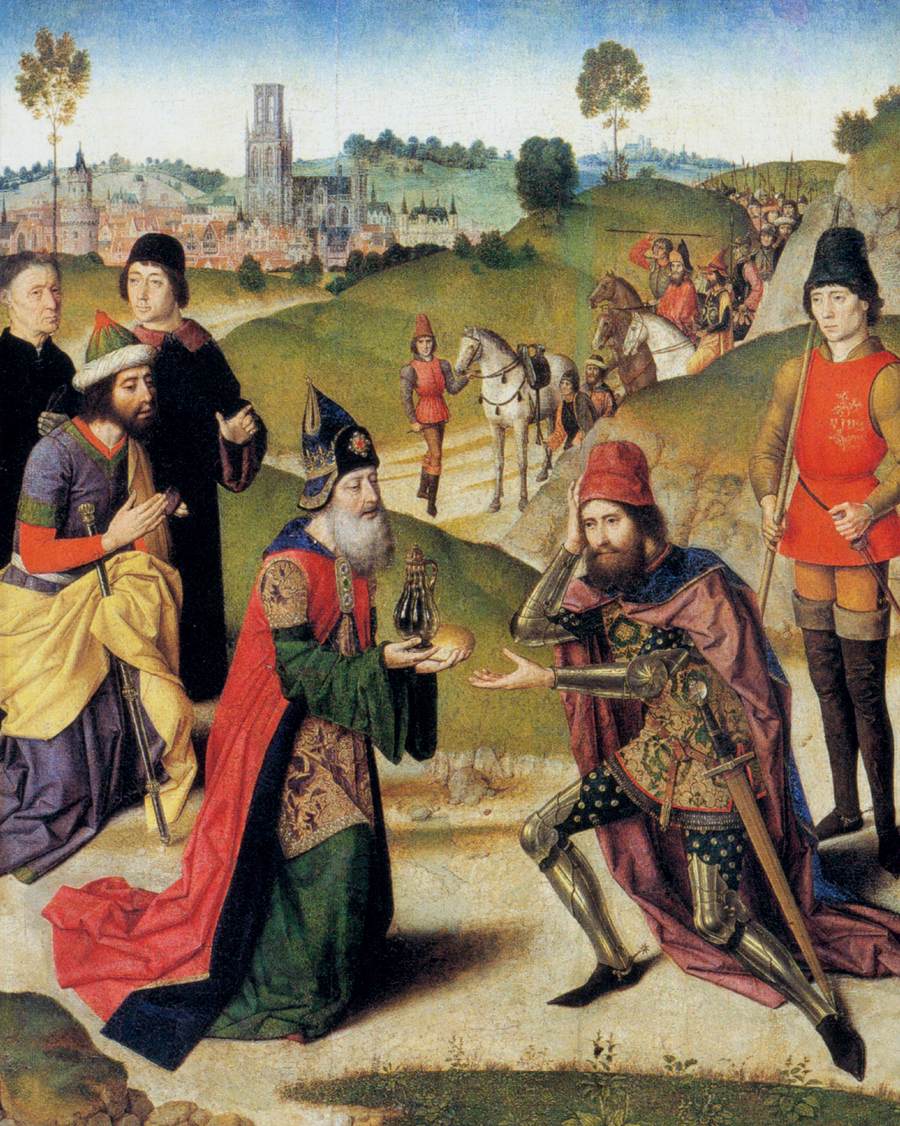
Melchizedek was the priest-king of Salem who blessed Abraham (Genesis 14:18–20). A king of Jerusalem in David's line, "a priest for ever after the order of Melchizedek," claimed the city's ancient priest-king tradition, apart from the Levitical priesthood. The phrase "order" ('al-divrati) may also mean "for the sake of" or "according to the manner of."
In the New Testament
Jesus asks how the Messiah can be David's son if David calls him "Lord" (Mark 12:35–37; Matthew 22:41–45; Luke 20:41–44), an argument that assumes Davidic authorship. Peter cites 110:1 of the resurrection and ascension (Acts 2:34–35); it is behind "sitting at the right hand" in many texts (Romans 8:34; Ephesians 1:20; Hebrews 1:3, 13; 1 Peter 3:22). Hebrews 5–7 builds its argument for Christ's priesthood on 110:4. In its original setting most scholars read it as a royal psalm for a king of Judah; Jewish interpreters applied it to Abraham, David or the Messiah.
110:3, the hardest verse
The Hebrew of v. 3 is obscure: "Your people are freewill offerings in the day of your power, in holy splendour; from the womb of the dawn, yours is the dew of your youth." With different vowels, the last line reads "I have begotten you" (yelidtikha) instead of "your youth" (yaldutekha). The Greek reads "From the womb, before the morning star, I begot you" (Giguet "Je t'ai engendré de mes entrailles, avant l'étoile du matin"; Vulgate "ex utero ante luciferum genui te"), compare Psalm 2:7. The Greek reading shaped early Christian teaching on the eternal generation of the Son. See the passage page.
What the evidence shows
- Psalm 110:1 is the Old Testament verse most often quoted or alluded to in the New Testament.
- The Greek of 110:3 reads "I begot you before the morning star."Source: The site's library: Westminster Leningrad Codex, KJV, Clementine Vulgate (Gallican Psalter), Giguet's French of the Greek, Douay-Rheims
- Psalm 110 was originally a royal psalm for a king of Judah.
Continue the journey
Journey of a PassagePsalm 110:3: "The dew of thy youth" or "I have begotten thee"One of the hardest verses in the Psalter.More from this lesson
Why this matters to the rest of Scripture
- Melchizedek king of Salem.
- "David himself calleth him Lord."
- "A priest for ever after the order of Melchisedec."