Investigation: Singing in the First and Second Temple
Guilds, trumpets, lyres and processions: what texts say and what objects show
Psalm 150 names the orchestra: shofar, nevel (a large lyre or harp), kinnor (lyre), tof (hand drum) with dancing, strings, pipe, and two kinds of cymbals. Psalm 81 calls for the shofar "in the new moon, in the time appointed, on our solemn feast day." Psalm 68 describes a procession: "the singers went before, the players on instruments followed after; among them were the damsels playing with timbrels."
Chronicles (written perhaps in the 4th century BC) gives the Levite singers a history: David appointed Asaph, Heman and Jeduthun with cymbals, harps and lyres (1 Chronicles 15:16–22; 16:4–7); there were 288 trained singers in 24 courses (25:7). At the dedication of Solomon's temple, 120 priests sounded trumpets and the singers sang "For he is good; for his mercy endureth for ever" (2 Chronicles 5:12–13). After the exile, at the founding of the second temple, priests with trumpets and "the sons of Asaph with cymbals" sang the same refrain (Ezra 3:10–11).
These texts tell us how Second Temple writers understood their own musicians' origins. Some details may be older memory, some may project the Chronicler's own temple back onto David. Historians weigh them carefully; the instruments themselves can be checked against archaeology.
| Hebrew word | Usual translation | What the evidence shows |
|---|---|---|
| kinnor | harp (KJV); lyre | A hand-held lyre. Lyres appear on Near Eastern seals, ivories and reliefs from the 3rd millennium BC on, including a lyre-player on an ivory from Megiddo (c. 12th century BC) and lyre-players led away by Assyrian soldiers on Sennacherib's reliefs (c. 700 BC, reported). Bar Kokhba coins (AD 132–135) show lyres. |
| nevel | psaltery; harp | Probably a larger lyre or harp; exact form debated. |
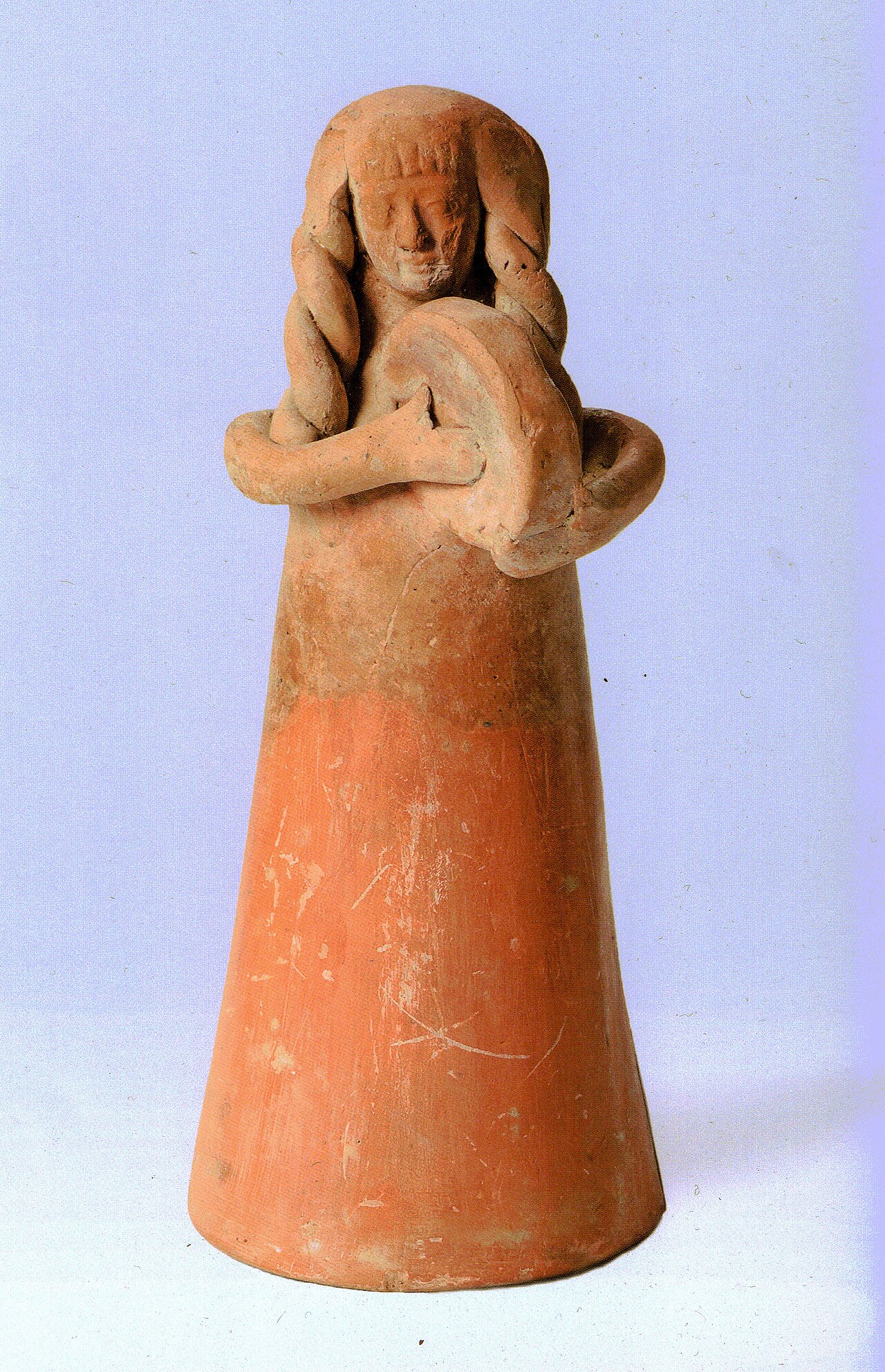
| tof | timbrel | A frame drum, often played by women; Iron Age clay figurines of women holding frame drums are common in Israel and its neighbours. |
| shofar | trumpet; cornet | A ram's horn, used for signals and festivals; still blown today. |
| chatsotsrah | trumpet | A straight metal trumpet blown by priests (Numbers 10:1–10). Two silver trumpets are carved on the Arch of Titus among the Temple spoils; Egyptian metal trumpets survive from Tutankhamun's tomb. |
| metsiltayim / tseltselim | cymbals | Bronze cymbals are known from many Levantine sites. |
| chalil, ugav | pipe, organ | Reed pipes and a wind instrument; details uncertain. |
The words in the headings
Lamnatseach ("to the chief Musician," 55 times) probably means "for the leader." Selah (71 times in Psalms, 3 in Habakkuk) is unexplained; the Greek translated it diapsalma, perhaps "interlude." Headings name tunes or instruments: "upon Shoshannim" (lilies), "Aijeleth Shahar" (the hind of the dawn), "Alamoth" (maidens? high voices?), "Sheminith" (the eighth: an octave? an eight-string instrument?), "Gittith," "Neginoth" (stringed instruments), "Nehiloth" (flutes?). Each psalm lesson explains its own heading and marks what is unknown.
The Levites' song of the day
The Mishnah (Tamid 7:4) lists the psalm the Levites sang at the daily offering in the Second Temple: Sunday 24, Monday 48, Tuesday 82, Wednesday 94, Thursday 81, Friday 93, and on the Sabbath 92 ("A Psalm or Song for the sabbath day"). The Greek Psalter's headings agree for several of these (Greek 23, 47, 93, 92 name the day). Jewish morning prayer still includes the psalm of the day. See the Book IV investigation.
The fifteen steps
The Mishnah (Middot 2:5; Sukkah 5:4) describes fifteen steps between the Court of the Women and the Court of Israel, on which the Levites stood to sing, "corresponding to the fifteen Songs of Ascents in Psalms." That is a later description of Herod's temple, one explanation among several for the title "Songs of Ascents." See the pilgrimage investigation.
Can we hear what they sang?
No. The oldest substantial written music from the Near East is a Hurrian hymn on a tablet from Ugarit (c. 1400 BC), whose notation is read in several incompatible ways. The Masoretic accents (te'amim), added to the Hebrew text in the early Middle Ages, guide chanting in the synagogue and mark the syntax of each verse; they are not Temple melodies. Attempts to decode the accents as ancient music (for example Suzanne Haïk-Vantoura's) are not accepted by most specialists. Gregorian psalm tones and Jewish cantillation traditions are ancient and beautiful, but no surviving tradition can be shown to preserve a melody from the Temple.
What material evidence attests
Instruments of the types named in the Psalms existed in the region; musicians, including women with frame drums, appear in figurines and pictures; Assyrian reliefs show lyre-players among deportees (identification as Judeans reported, C check); the Arch of Titus shows Temple trumpets as Roman booty. No inscription names a Temple singer from the Psalms (Asaph, Heman, Jeduthun, Korah's descendants). The guild system described in Chronicles is attested only in biblical and later Jewish texts.
Images
The page uses the site's self-hosted image of a frame-drum figurine. Image slots are open for a lyre (kinnor) depiction and the Arch of Titus trumpets panel, pending licence checks; no stock reconstruction is shown as an ancient object.
What the evidence shows
- Chronicles describes Levitical singing guilds under Asaph, Heman and Jeduthun.
- The guild organization described in Chronicles goes back to David. The Chronicler's account; no independent evidence.
- Mishnah Tamid 7:4 lists the Levites' psalm for each day.
- Lyres, frame drums, horns, trumpets and cymbals are attested archaeologically in the region.
- Any surviving melody goes back to the Temple. No evidence connects any tune to Temple singing.
- The meaning of Selah is known.
Continue the journey
Journey of a PassagePsalm 24:7: "Lift up your heads, O ye gates"The Hebrew commands the gates: "Lift up, O gates, your heads." The Greek reads "Lift up your gates, O princes" (Giguet "Princes, levez vos portes"; Vulgate "Attollite portas, principes, vestras").More from this lesson
Why this matters to the rest of Scripture
- The 288 singers.
- Trumpets and singers at the temple's dedication.
- "For he is good."
- The silver trumpets.