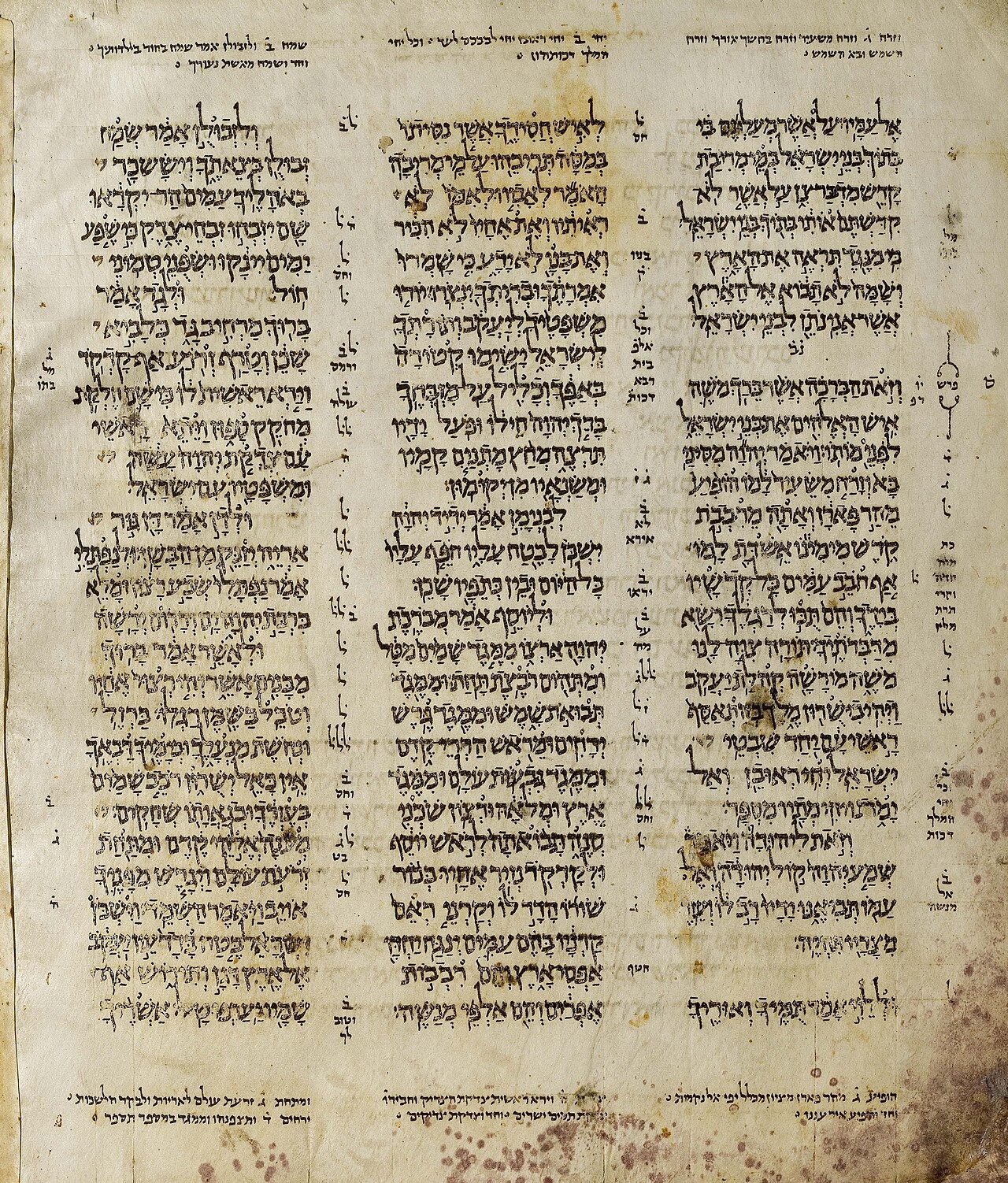
"Praise ye the LORD. I will praise the LORD with my whole heart, in the assembly of the upright, and in the congregation. The works of the LORD are great, sought out of all them that have pleasure therein. His work is honourable and glorious: and his righteousness endureth for ever. He hath made his wonderful works to be remembered: the LORD is gracious and full of compassion."
"He hath given meat unto them that fear him: he will ever be mindful of his covenant… The works of his hands are verity and judgment; all his commandments are sure… He sent redemption unto his people: he hath commanded his covenant for ever: holy and reverend is his name. The fear of the LORD is the beginning of wisdom: a good understanding have all they that do his commandments: his praise endureth for ever."
A half-line alphabet
After "Hallelujah," each half-line begins with the next letter of the Hebrew alphabet: 22 half-lines, arranged as two per verse and three in the last two verses. In the library's Hebrew the verses begin with alef, gimel, he, zayin, tet, kaf, mem, samekh, pe and resh, as the pattern requires. Psalm 112 has exactly the same form.
Psalms 111 and 112 as a pair
Psalm 111 praises God's works; Psalm 112 describes the person who fears God. Phrases are shared: God's "righteousness endureth for ever" (111:3) and the righteous person's "righteousness endureth for ever" (112:3, 9); God is "gracious and full of compassion" (111:4), the righteous man "is gracious, and full of compassion" (112:4). The God who is praised is mirrored in the person who fears him.
Wisdom
"The fear of the LORD is the beginning of wisdom" (111:10) repeats Proverbs 9:10 (compare 1:7; Job 28:28). The psalm has no heading other than Hallelujah; Greek and Latin number it 110.
Setting and reception
The setting is public worship: "in the assembly of the upright, and in the congregation." In Christian Vespers of the Latin rite, Psalms 110, 111, 112 and 113 (Vulgate "Dixit Dominus," "Confitebor," "Beatus vir," "Laudate pueri") are sung in sequence; Mozart's Vesperae solennes de confessore sets them.
What the evidence shows
- Psalm 111 is a half-line acrostic.Source: The site's library: Westminster Leningrad Codex, KJV, Clementine Vulgate (Gallican Psalter), Giguet's French of the Greek, Douay-Rheims; Tyndale House, "The ABCs of Hebrew Acrostic Poems" (2023) ↗
- Psalms 111 and 112 share phrases deliberately.
Continue the journey
Connected elsewhere in ScriptureProverbs 9: Two Houses, Two InvitationsProverbs 9:10: "The fear of the LORD is the beginning of wisdom."More from this lesson
Why this matters to the rest of Scripture
- "The fear of the LORD is the beginning of wisdom."
- The companion acrostic.