"Praise ye the LORD. Sing unto the LORD a new song, and his praise in the congregation of saints. Let Israel rejoice in him that made him: let the children of Zion be joyful in their King. Let them praise his name in the dance: let them sing praises unto him with the timbrel and harp. For the LORD taketh pleasure in his people: he will beautify the meek with salvation."
"Let the saints be joyful in glory: let them sing aloud upon their beds. Let the high praises of God be in their mouth, and a twoedged sword in their hand; to execute vengeance upon the heathen, and punishments upon the people; to bind their kings with chains, and their nobles with fetters of iron; to execute upon them the judgment written: this honour have all his saints. Praise ye the LORD."
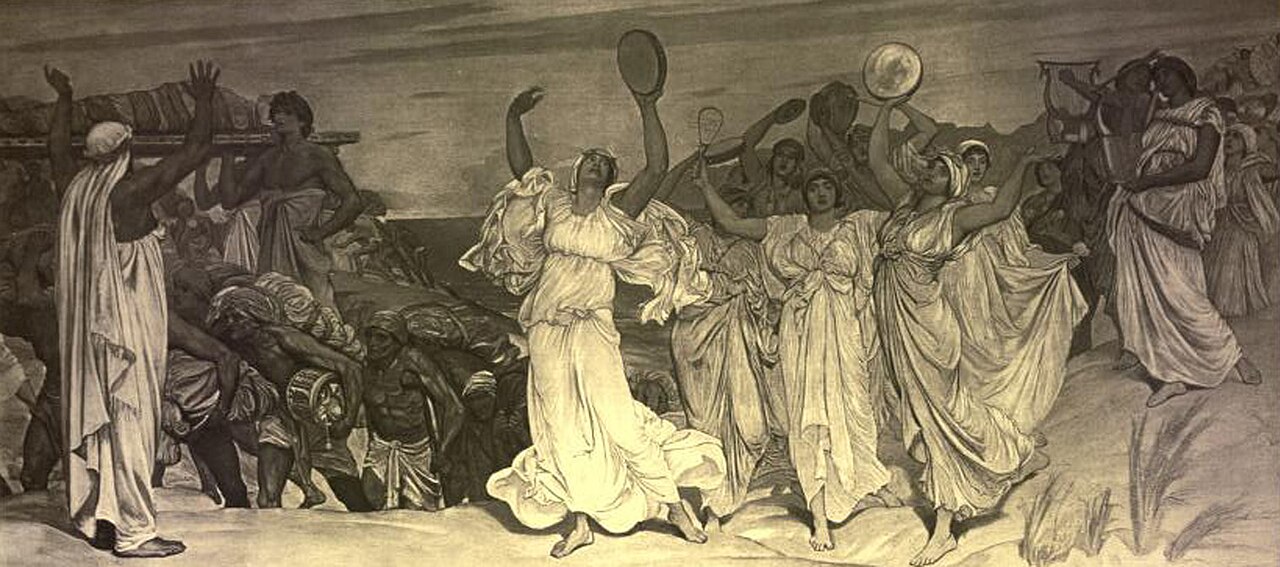
Dance and timbrel
Dancing with timbrels (frame drums) celebrated victory, led by women like Miriam (Exodus 15:20; pictured) and Jephthah's daughter (Judges 11:34). The psalm's first half is a festival of joy.
The sword in the hand
The second half joins praise with a sword to bind kings and "execute the judgment written," the language of holy war against the nations. The psalm belongs to a world of imperial conquest and the hope that God would reverse it. In later history the verse was invoked to justify religious violence, for example in the wars of the Reformation period; Jewish and Christian interpreters have also read the "sword" as the word of God (Hebrews 4:12; Ephesians 6:17). It is ancient war rhetoric and is not a command for violence today. Psalms 146–150 have no heading other than "Praise ye the LORD" (hallelu-yah), with which each begins and ends; the Greek and Latin put "Alleluia" at their head. They are the closing doxology of the whole Psalter and are recited every morning in Jewish worship (Pesukei de-Zimra).
What the evidence shows
- Psalm 149 joins praise with the language of holy war.
- Psalm 149 commands religious violence today. The site rejects this reading as a misuse of ancient war rhetoric.
Continue the journey
Connected elsewhere in ScriptureThe Song of the SeaExodus 15:20–21: Miriam's timbrel.More from this lesson
Why this matters to the rest of Scripture
- Miriam's timbrel.
- "Sharper than any twoedged sword."
- A sharp sword from his mouth.