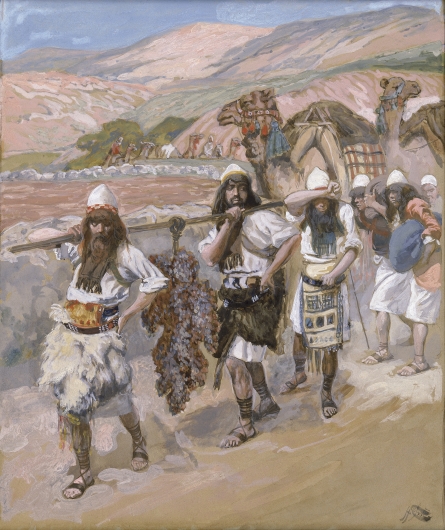
"Give ear, O Shepherd of Israel, thou that leadest Joseph like a flock; thou that dwellest between the cherubims, shine forth. Before Ephraim and Benjamin and Manasseh stir up thy strength, and come and save us. Turn us again, O God, and cause thy face to shine; and we shall be saved."
"O LORD God of hosts, how long wilt thou be angry against the prayer of thy people? Thou feedest them with the bread of tears… Turn us again, O God of hosts, and cause thy face to shine; and we shall be saved."
"Thou hast brought a vine out of Egypt: thou hast cast out the heathen, and planted it… It sent out her boughs unto the sea, and her branches unto the river. Why hast thou then broken down her hedges, so that all they which pass by the way do pluck her? The boar out of the wood doth waste it, and the wild beast of the field doth devour it."
"Return, we beseech thee, O God of hosts… and visit this vine… Let thy hand be upon the man of thy right hand, upon the son of man whom thou madest strong for thyself. So will not we go back from thee… Turn us again, O LORD God of hosts, cause thy face to shine; and we shall be saved."
A refrain that grows
The refrain returns three times, and the divine name grows each time: "O God" (v. 3), "O God of hosts" (v. 7), "O LORD God of hosts" (v. 19). "Cause thy face to shine" echoes the priestly blessing (Numbers 6:25). The swelling address mirrors the growing urgency.
Northern tribes
Joseph, Ephraim, Manasseh and Benjamin are northern and central tribes, those of Rachel's line. The psalm may come from the northern kingdom's crisis under Assyria (before 722 BC), or from a Judean prayer for the lost north; the Greek heading adds "concerning the Assyrian." The vine image appears also in Isaiah 5 and Jeremiah 2:21, and in John 15.
"The man of thy right hand"
80:17 "the man of thy right hand… the son of man (ben adam) whom thou madest strong for thyself." In context it is probably the king, or Israel as God's "son" (compare v. 15, "the branch that thou madest strong"). "Man of thy right hand" may play on Benjamin, whose name means "son of the right hand." The Targum reads the line of the king Messiah; Christian readers connected it with the Son of Man.
The middle letter of the Psalms
In 80:13 (Hebrew 80:14) the word mi-ya'ar, "from the forest," is written with a raised (suspended) ayin in the Masoretic tradition. The Babylonian Talmud (Kiddushin 30a) says this ayin is the middle letter of the Psalms. The library's digital Hebrew does not show the raised letter as a separate mark; the scribal feature is documented in printed editions and manuscripts.
The heading and the boar
"To the chief Musician upon Shoshannim-Eduth, A Psalm of Asaph." The library's Vulgate renders the "wild beast of the field" as "singularis ferus," "the solitary wild one," an expression from which the French word sanglier (boar) derives.
What the evidence shows
- The refrain's divine title grows across vv. 3, 7, 19.Source: The site's library: Westminster Leningrad Codex, KJV, Clementine Vulgate (Gallican Psalter), Giguet's French of the Greek, Douay-Rheims
- The Talmud names the ayin of 80:13 as the middle letter of the Psalms.
- "Man of thy right hand" plays on Benjamin.
Continue the journey
Connected elsewhere in ScriptureIsaiah 5: The Song of the VineyardIsaiah 5:1–7: The song of the vineyard.More from this lesson
Why this matters to the rest of Scripture
- The song of the vineyard.
- "I am the true vine."
- "The LORD make his face shine upon thee."