After the Fall of the King: Book IV and "The LORD Reigneth"
Book III ends with Psalm 89 asking where God's promises to David have gone. Book IV (Psalms 90–106) begins with the only psalm headed "of Moses," proclaims again and again that "the LORD reigneth" (93, 96, 97, 99), recalls Moses and the wilderness (90, 95, 99, 103, 105, 106), and ends with a prayer to be gathered from among the nations. Many scholars, following Gerald Wilson, read this as a deliberate editorial answer to the exile: the Davidic king has fallen, but the LORD is still King, as he was in Moses' time before there were kings. The individual psalms are older and varied; the argument concerns their arrangement.
The pattern: documented · Deliberate editorial design: supported but debated
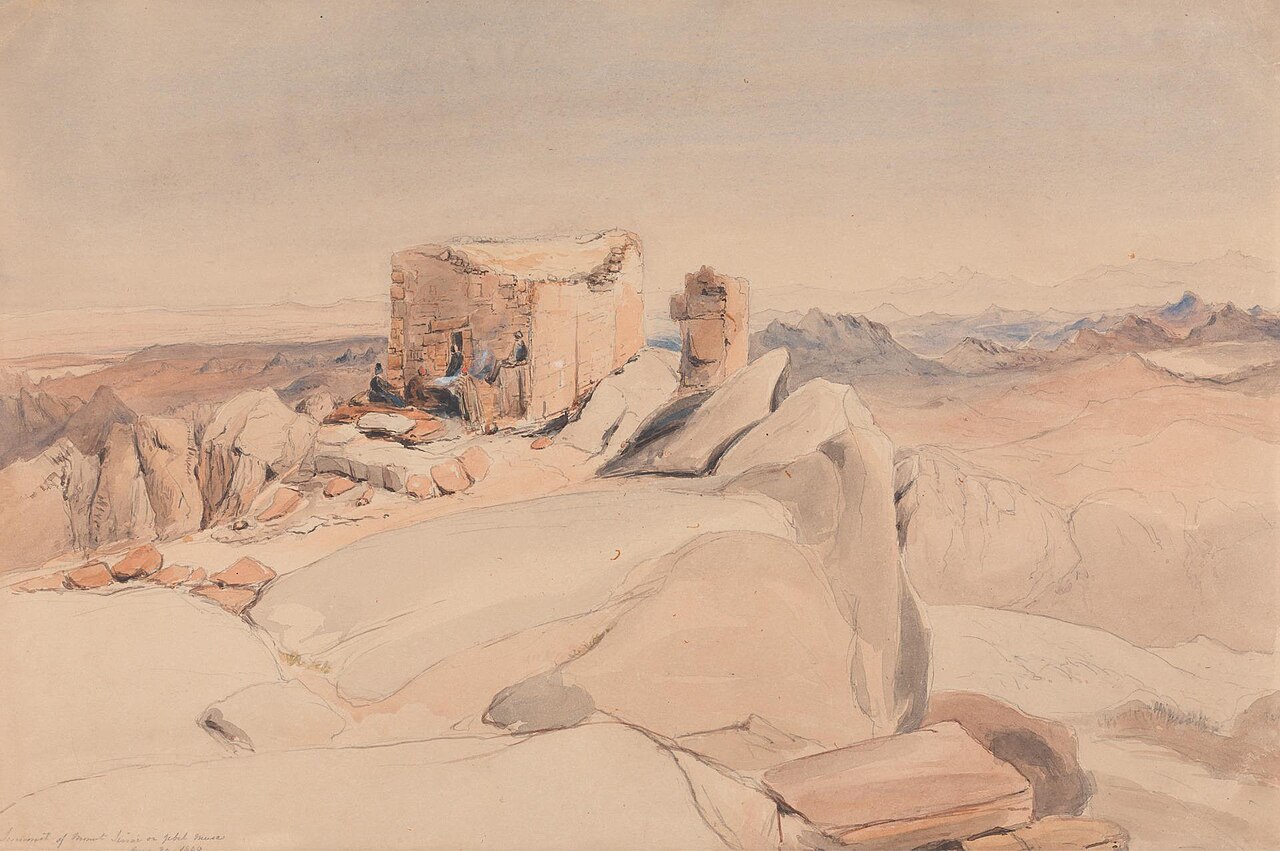
Later artwork, not historical evidenceEdward Thomas Daniell, Summit of Mount Sinai (Jebel Musa), 19th century.Image credit
1 What Scripture says
Psalms 93; 95–99
"Lord, where are thy former lovingkindnesses, which thou swarest unto David?" (89:49). "Lord, thou hast been our dwelling place in all generations" (90:1). "The LORD reigneth" (93:1).
2 What evidence we might expect
If the arrangement is deliberate, Book IV should answer the specific crisis of Psalm 89 and stress themes from before the monarchy.
3 What ancient sources survive
Psalms 89–106 (Masoretic order)
Language
Hebrew
Composed
Individual psalms of various dates; book arrangement probably after the exile
Oldest surviving copy
Qumran Psalms scrolls show variation in the order of Books IV–V (e.g. 11QPs-a), while Books I–III are more stable (reported, C check)
Status
Scripture
Moses is named seven times in Book IV (90:1; 99:6; 103:7; 105:26; 106:16, 23, 32) and only once elsewhere in the Psalter (77:20), counted in the library's KJV.
4 What discoveries exist
The Dead Sea Psalms scrolls suggested that the order of the later books of the Psalter was still fluid in the 1st century BC, while the first three books were more settled. That evidence underlies many theories about when and why Books IV–V took their present shape.
5 How interpretations compare
Scholarly reconstruction
An editorial answer to the exile
The editors placed Psalm 89's crisis at the end of Book III and answered it with Moses, the wilderness and God's kingship in Book IV.
Evidence offered: Moses named seven times in Book IV; the "LORD reigneth" psalms; the plea for gathering in 106:47.
Assessment: Influential since Wilson (1985); widely accepted in outline.
Source: G. H. Wilson, The Editing of the Hebrew Psalter (SBLDS 76, 1985)
Scholarly reconstruction
Liturgical or thematic grouping
Psalms were grouped by use and theme (kingship psalms, Sabbath and festival psalms) without a single argument across the books.
Assessment: Compatible with many observations; the two views can be combined.
6 The strongest supported reconstruction
Whatever the dates of individual psalms, Book IV as arranged speaks to a people without a reigning Davidic king, pointing them to Moses' God who was their dwelling place before kings and who still reigns.
7 What remains possible or unknown
Who arranged Book IV and when.
Whether the arrangement was planned as one argument.
What the evidence shows
Independently documentedMoses is named seven times in Book IV and once elsewhere in the Psalter.
Source: The site's library: Westminster Leningrad Codex, KJV, Clementine Vulgate (Gallican Psalter), Giguet's French of the Greek, Douay-Rheims
Strongly supportedBook IV was arranged as an answer to the crisis of Psalm 89.
Source: G. H. Wilson, The Editing of the Hebrew Psalter (SBLDS 76, 1985)