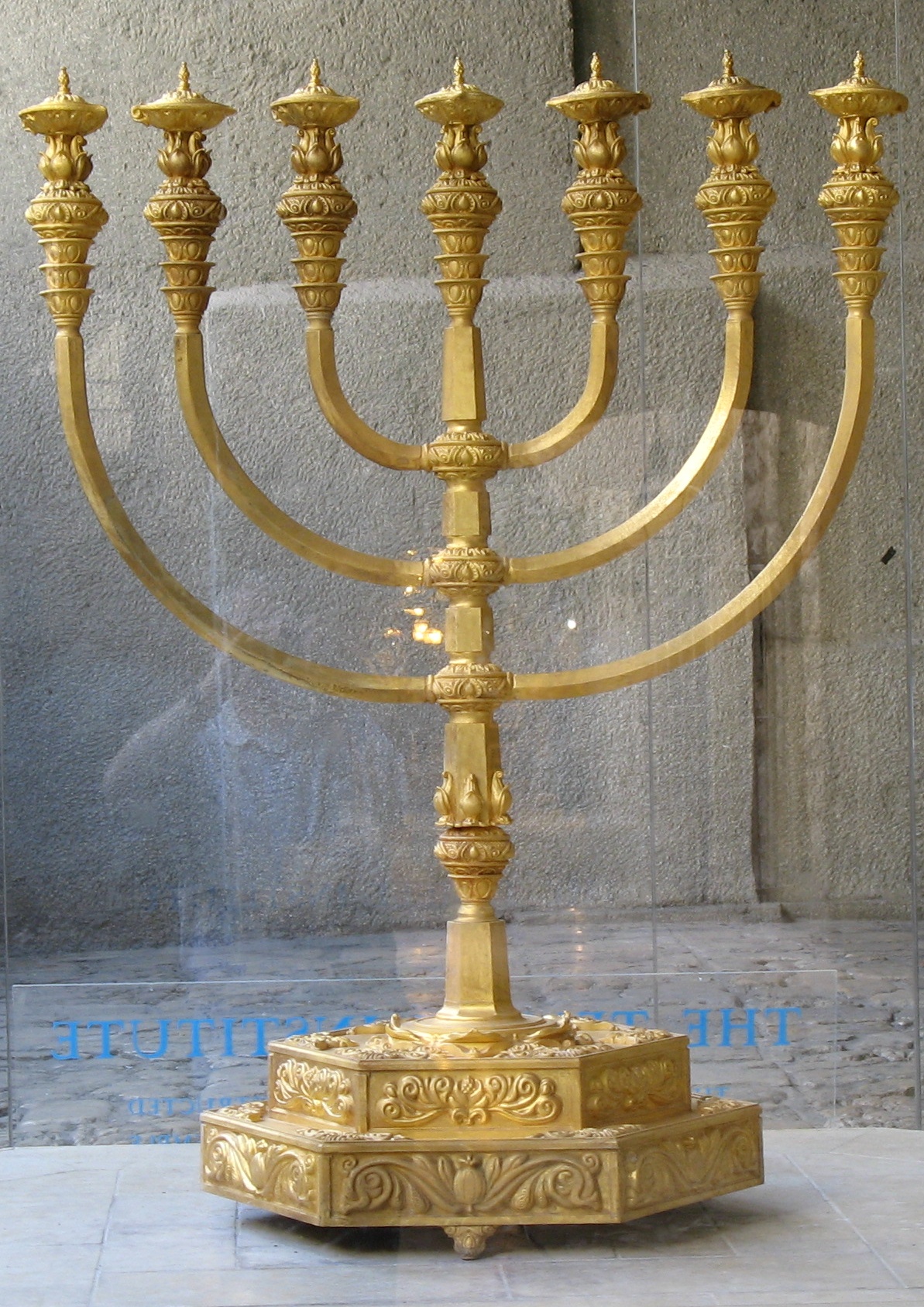
"Then came David to Nob to Ahimelech the priest: and Ahimelech was afraid… Why art thou alone?" "The king hath commanded me a business." He asks for bread. "There is no common bread under mine hand, but there is hallowed bread; if the young men have kept themselves at least from women." The priest gives him the showbread, "that was taken from before the LORD, to put hot bread in the day when it was taken away."
"Now a certain man of the servants of Saul was there that day… Doeg, an Edomite, the chiefest of the herdmen that belonged to Saul." David asks for a weapon. "The sword of Goliath the Philistine… is here wrapped in a cloth behind the ephod." "There is none like that; give it me."
David flees to Achish king of Gath. The servants say: "Is not this David the king of the land? did they not sing one to another of him in dances?" David "was sore afraid," "changed his behaviour before them, and feigned himself mad… and scrabbled on the doors of the gate, and let his spittle fall down upon his beard." "Have I need of mad men?"
The bread of the Presence
Twelve loaves were set before the LORD each Sabbath and eaten by priests (Leviticus 24:5–9). Ahimelech gives them to David's men if they are ritually pure. Jesus cites this episode when his disciples pick grain on the Sabbath.
Ahimelech or Abiathar? (Mark 2:26)
In Mark 2:26 Jesus says David entered the house of God "in the days of Abiathar the high priest." In 1 Samuel the priest is Ahimelech, Abiathar's father. Explanations: "in the days of Abiathar" means "in the passage about Abiathar" (as Mark 12:26 says "at the bush"); Abiathar was present and later more famous; or an error in transmission. Matthew 12:4 and Luke 6:4 omit the name; some manuscripts of Mark do too. This is a comparison between books, not an ancient variant in 1 Samuel. See the passage page.
Nob and numbering
Nob, "the city of the priests" (22:19), was near Jerusalem (Isaiah 10:32); proposals include Mount Scopus and el-Isawiya. In Hebrew Bibles this chapter begins one verse later (English 20:42b is Hebrew 21:1), so verse numbers differ by one.
The Case for the Biblical Account
Scripture's account
David at Nob and Gath (1 Samuel 21).
What evidence would we expect?
A priestly town near Jerusalem; Philistine Gath with a king.
The discoveries
Gath (Tell es-Safi) as a major 10th–9th century BC city; Achish as a Philistine royal name (an Achish rules Ekron in the 7th-century inscription).
Testing the discoveries
Gath fits; Nob is unlocated; Achish of Gath is not independently attested.
The strongest reconstruction
Traditions of David's flight through priestly and Philistine territory.
What remains possible
The location of Nob.
What the evidence shows
- Achish is a Philistine royal name. Ekron inscription, 7th century BC.
- Achish of Gath is attested outside the Bible.
- Mark 2:26's "Abiathar" is a scribal error.
Continue the journey
Journey of a Passage1 Samuel 21:1–6; Mark 2:25–26: Ahimelech or Abiathar?1 Samuel names the priest at Nob as Ahimelech.More from this lesson
On the map
Location securely identified Probable identification Proposed or debated location Biblical route (roads schematic) Scholarly proposal
- David's years as a fugitive. Gibeah → Ramah → Nob → Gath → Adullam → Keilah → the wildernesses of Ziph and Maon → En-gedi → Carmel → Gath → Ziklag. Several sites are proposals (Ramah, Nob, Ziklag); order and lines are schematic.
Why this matters to the rest of Scripture
- The bread of the Presence.
- "In the days of Abiathar."
- "Have ye not read what David did?"
- Titled "when he changed his behaviour before Abimelech."