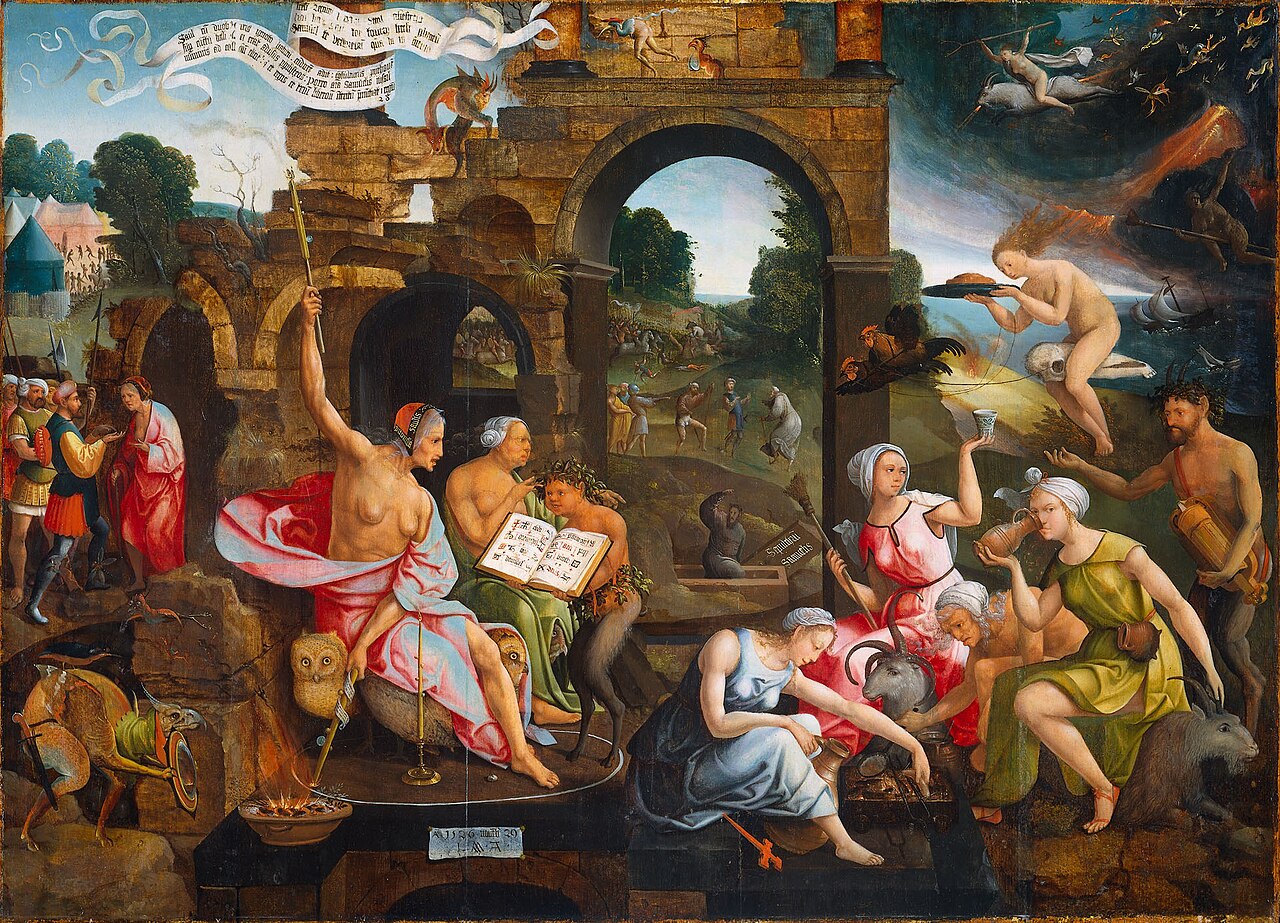
"Now Samuel was dead… And Saul had put away those that had familiar spirits, and the wizards, out of the land." The Philistines gather at Shunem; Saul at Gilboa. "And when Saul enquired of the LORD, the LORD answered him not, neither by dreams, nor by Urim, nor by prophets." "Seek me a woman that hath a familiar spirit [ba'alat 'ov]." "There is a woman that hath a familiar spirit at Endor."
Saul disguises himself and comes by night. "Bring me him up, whom I shall name unto thee." "Bring me up Samuel." "When the woman saw Samuel, she cried with a loud voice… Why hast thou deceived me? for thou art Saul." "What sawest thou?" "I saw gods [elohim] ascending out of the earth." "What form is he of?" "An old man cometh up; and he is covered with a mantle."
"Why hast thou disquieted me, to bring me up?" "God is departed from me, and answereth me no more." "The LORD hath rent the kingdom out of thine hand, and given it to thy neighbour, even to David: because thou obeyedst not the voice of the LORD… to morrow shalt thou and thy sons be with me." Saul falls full length on the ground. The woman kills a fatted calf and bakes bread: "let me set a morsel of bread before thee… that thou mayest have strength, when thou goest on thy way." They eat, and go out into the night.
Not a "witch"
The Hebrew calls her "a woman, mistress of an 'ov." An 'ov was a spirit of the dead or a ritual pit or object used to call one up; the term is also used in Deuteronomy 18:11, Leviticus 19:31 and Isaiah 8:19. English "witch of Endor" is a later label. Necromancy was practiced throughout the ancient world: Mesopotamian texts describe rituals to raise a ghost (eṭemmu), the Epic of Gilgamesh has Enkidu's ghost rise from the underworld, and in Homer's Odyssey (book 11) Odysseus digs a pit and calls up the dead.
What came up?
The text calls him Samuel and his words come true; Sirach 46:20 says Samuel "prophesied after his death." God permitted it as judgment; the woman's shock suggests something beyond her usual practice.
Some early Christian writers held that a demon impersonated Samuel, since God forbids necromancy.
Some readers think only the woman saw and spoke, and Saul heard what she reported. Modern scholarship studies the scene as a window on Israelite beliefs about the dead and as a polemic against necromancy.
Readings of the apparition as a technological projection or alien contact have no ancient or archaeological support.
"Gods" ascending
The woman says she saw elohim, normally "God" or "gods," with a plural verb. Here it seems to mean a spirit-being or divine being. The Greek and Latin also say "gods." This is a translation question, not a variant.
En-dor
En-dor lay north of the hill of Moreh, behind the Philistine camp at Shunem; the village of Indur and nearby Khirbet Safsafa are proposed. To reach it Saul had to pass near the enemy lines.
The Case for the Biblical Account
Scripture's account
Saul consults the dead at En-dor (1 Samuel 28).
What evidence would we expect?
Necromancy practices in the region; laws forbidding them.
The discoveries
Mesopotamian ghost-raising rituals; Gilgamesh tablet XII; Odyssey 11; Torah prohibitions; recent studies of the ritual background.
Testing the discoveries
The practice is well attested; the encounter is a matter of the text and faith.
The strongest reconstruction
A prophetic narrative of Saul's final rejection, set in real ritual practice.
What remains possible
What the woman saw.
What the evidence shows
- Necromancy rituals are attested in Mesopotamia and Greece.Source: On ancient necromancy and the ritual setting of 1 Samuel 28, JSOT (2024) ↗; Comparative study of necromancy and 1 Samuel 28, Religions 17 (2026) ↗
- The Torah forbids consulting the dead.
- Samuel himself appeared.
- The apparition was a technological phenomenon. Speculation only.
Continue the journey
Journey of a Passage1 Samuel 28:13: "I saw gods ascending"The medium says she sees elohim, with a plural verb, "rising from the earth." The Greek, Latin and KJV all say "gods." The question is what the word means here: a divine being, a spirit, or Samuel himself.More from this lesson
On the map
Location securely identified Probable identification Proposed or debated location Biblical route (roads schematic) Scholarly proposal
- Saul's last battle. Illustrative. Philistines muster at Aphek and camp at Shunem; Saul goes by night to En-dor; the battle on Gilboa; bodies hung at Beth-shean; the men of Jabesh-gilead retrieve them. En-dor and Jabesh-gilead are proposed sites.
Investigations
Optional deep dives: the ancient sources, the physical evidence, and every interpretation side by side, including unconventional ones, each labeled for what it is.
The Medium at En-dorNecromancy in antiquity: documented · What appeared: disputed · Technological readings: speculative
Who was the woman of En-dor, what was an 'ov, and who appeared to Saul?
Saul consults "a woman, mistress of an 'ov," to bring up the dead Samuel. Necromancy is well attested across the ancient world and forbidden in the Torah. Interpreters have long debated whether Samuel truly appeared, whether a spirit impersonated him, or whether the woman staged it. The text calls what rose "elohim" and "Samuel."
Open the full investigation →Echoes Across Civilizations
Optional: how other ancient peoples told similar stories. Open one to compare, then come back to the lesson.
Calling up the deadMesopotamian · Greek · Israelite
Did other ancient peoples try to consult the dead, and how?
- Mesopotamian: Ghost-raising rituals and Gilgamesh XII Shared literary world
- Greek: The Odyssey, book 11 (the Nekyia) Resemblance only
- Israelite: Isaiah against necromancers Possible historical contact
Also covered: A hologram at En-dor?, clearly labeled as a modern theory.
Compare side by side →Why this matters to the rest of Scripture
- No one who consults the dead.
- "Should not a people seek unto their God? for the living to the dead?"
- Saul died for asking counsel of a medium.
- The rich man asks for a messenger from the dead.